Wednesday, December 8, 2010

Auf wiederschauen Österreich!, part 10 of 10

An entire shop dedicated to Mozartkügeln (Mozart balls).
Friday:
Me: Es regnet.  (It’s raining.)

Today we have two goals: to visit Mozart’s birthplace, and to see the historical musical instrument museum, both near each other in the old part of Salzburg.  Although the one is fairly expensive, the other is cheap and comes with entrance to the historical toy museum, too.  The Geburtshaus Mozart museum is actually located in the very rooms Mozart’s parents occupied for 26 years, in a building on the Getreidegasse, now famous as a shopping district.  DH is disappointed that the apartment was filled with display cases; not even the bedroom is furnished as it might have looked then.  (In fact, the bedroom/birthroom was staged as an odd sort of shrine, with some of Mozart’s personal effects in black column cases in the darkened chamber.)  We compare the various portraits of the composer, read excerpts from his letters, and ooh at the collection of set and costume designs for his operas.  Okay, I am the one doing the ooh-ing, as I’m particularly taken with Karl Friedrich Schinkel’s designs for Die Zauberflöte.  If you’ve seen Amadeus, you may  remember the star-strewn sky in front of which the Queen of the Night sings her famous aria.  That detail in the movie is historical but a-chronological, as Schinkel’s production was staged in 1815, but the movie obviously takes place before Mozart’s death in 1791.  (Rather a lot of that movie is true-but-not-true; DH is planning to write a blog post about it.)


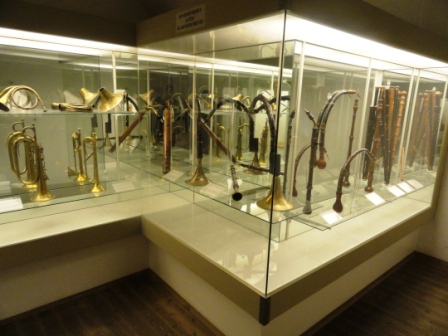
The historical instrumental museum has all manner of old keyboard, wind, and brass instruments.  Many were quite strange, like the combo violin-hunting horn (below); the bassoon with the sea dragon head (below); and the ocarinas that look like porcelain ray-guns (really--you'll have to take my word on this, as I don't seem to have a picture of them).  We eat lunch while listening to musical examples and descriptions (in English!) of many of the instruments.  Then it’s upstairs to the toy museum, with a train collection, play rooms for children, and a special exhibit about circus toys.  In the film room we watch (a dubbed) Danny Kaye escape from a circus lion cage, a fairly malevolent Mickey Mouse/Donald Duck short, and the Poochini cartoon I’m sure I saw on tv as a kid—the one about a dog magician who conducts a snobby tenor in Figaro’s famous aria while plaguing him with questionable ethnic and regional stereotypes, including a brief blackface episode.  Thoroughly out-museumed by now, we purchase an Advent calendar designed like the manuscript for “Stille Nacht” and head out into the rain, looking for a Konditerei.  Down one of the numerous alleys we find a quaint little place where we enjoy hot chocolate and a generous and truly delicious slice of plum tart.  (I have discovered that I love plum tart.)  Although it was good to sit in the warm and dry, we have to get back to the hotel, pick up our bags, and travel 5 hours up to Frankfurt, where we have a hotel room waiting for us a few minutes from the train station.


Saturday:
Him: See you on Skype!

DH gets up at the first alarm, grabs his bags, and walks to the Hauptbahnhof (main train station), where he catches the Strassenbahn to the Flughof (airport).  By the time I am finishing breakfast and similarly heading to the Hauptbahnhof, his flight to Heathrow is taking off.  I take the train to Fulda and change to Dresden.  By the time I am back in my apartment 6 hours later, he is somewhere over the Atlantic, on a 10-hour flight from Heathrow to DFW, where some of my relatives come to visit with him and see our pictures during his 4-hour layover there, before finally flying home again.

Although we walked a lot and had a fairly ambitious itinerary of sights, I think it was an enjoyable vacation.  DH would have preferred to “do Austria” without jet-lag, but he was happy to travel together.  It was certainly a mental break for me.  For just one week I stopped thinking about my dissertation all the time, and I will be sorry to get back to the grind.  Probably the catch-up reading I’ll do this weekend will light my fire again, and then there will be the sprint to Christmas/New Year’s.

The poster outside our Pension room is the closest we get to The Sound of Music.

Auf wiederschauen!


Tuesday, December 7, 2010

This isn't Mozart's Salzburg anymore, part 9 of 10

Thursday:
Mozart hated Salzburg; he found it provincial.  Although today it is a Mozart- and Sound-of-Music mecca, in his time this settlement nestled along the Salzach River was a salt-mining town and garrison.  The picture at left was taken from the fortress that overlooks the Altstadt.  I can’t get over the fact that the Festung Hohensalzburg was a fortress built by and for the various princely (arch)bishops who ruled here.  I am familiar with the Church’s secular and political Macht (power) up into the early-modern period, but the obvious militariness of it all is even more disturbing than the fact that they’ve set up a jail cell as a torture chamber, even though no prisoners were actually subjected to enhanced interrogation techniques here (the German audio guide makes this point twice).  Most of the rooms are pretty much empty, although there is a smallish museum of period material culture (furniture, tableware, jewelry, instruments).  In the gift shop I notice a sign the says the speedy Bergbahn up and down the plateau will be out of service beginning in January, in order to make improvements and decrease the ride time!  I guess it's a bottleneck during the tourist season.

There is also an unrelated Marionette Museum tucked in one corner.  Because the marionette theater is not playing anything the nights we’re in Salzburg, I make it point to stop in here.  I associate stringed puppets with Central Europe, not because of the Sound of Music, but because on my first trip there (to Prague in 1994), my brother and I were quite taken with the marionettes a street performer used.  In a box somewhere are the puppets on which we spent our precious souvenir money, a witch and a wizard.  And anyway, Richard Rogers got the idea for the "Lonely Goatherd" scene from the puppet theater that was founded here in 1913 already.  (The one at Schloβ Schönbrunn in Vienna may be older.)  Unsurprisingly, Mozart operas are a staple of marionette theater in Austria; you can see as at right as Papagano and Papagena from Die Zauberflöte.

We are traveling after the usual tourist season (which ends with October) and before the holiday season, so we thankfully miss most of the crowds.  Normally both DH and I bemoan the bleeding of Advent into the fall (the Christmas chocolates appeared in the grocery stores in Dresden two weeks before Halloween!).  However, we are grateful this one time that merchants are catering to tourists and have started the holidays early, because it means we get to “do” Christmas together this year after all.  And in fact, the Christkindlmarkt opens on the squares around St. Peter’s Cathedral and the Residenzschloss today.  We ogle the rows upon rows of straw, glass, and painted-wood decorations which would be adorable if it weren’t so obvious they were mass-produced.  We try a Schneeball (left) and a Winter Zauber (an alcoholic hot chocolate too strong for our tastes).


Then it’s back to the hotel to warm up and nap before going out for dinner.  We first try the traditional Austrian Stuberl next door, but it turns out that it is most authentic in its smokiness, something I have quickly come to associate with Salzburg, because it seems like someone near us is constantly smoking.  Austria is governed by the European Union’s smoking regulations, which require that restaurants have smoking and non-smoking sections (the “club” next door is apparently exempt).  However, of all the restaurants we visit with separate sections, not one ever actually closed the doors between the two sections, so it seems Europe is where much of the United States was ten years ago.  We are happy to live in a state that has gone smoke-free, because we are both fairly sensitive to smoke.  So we quit the Stuberl for the restaurant on the corner that is smoke-free, almost empty, and serves Austrian, Italian, and Indian cuisine.  We consume a yummy candle-lit meal of tortellini and schnitzel.


Monday, December 6, 2010

The treasures of Attnang-Puchheim, part 8 of 10

Wednesday:
On account of our over-stimulation on Monday, and also a pot of Goulasch made just for us, we decide to postpone our trip to Salzburg and spend another half-day here in Oberösterreich.  We enjoy a relaxed early morning and a traditional “sweet” Austrian breakfast of breads, meats, cheeses, and jams that suspiciously resembles the “savory” dinner we had last night of breads, meats, cheeses, and pickles.  Then the three of us (distant cousin, DH, and I) set off across some fields and woods to a nearby castle (Schloss Puchheim) and basilica (Wallfahrtsbasilika Maria Puchheim, below).


The "castle" is really just two long buildings around a central courtyard; one is an arts academy and the other was owned by some descendant of a noble family who recently passed away; it is in disrepair and the town is trying to acquire it for renovation.  The church is a certified pilgrimage site dedicated in 1891 to die Mutter von der immerwärenden Hilfe (“the mother of perpetual help”).  The central icon is a portrait of Mary and the Christ child, the Gnadesbild (mercy image), which is not only a replica of a painting in Rome but has also been touched to the original, which is credited with several healings.  The history of the icon is illustrated in paintings around the edges of the nave, and the basilica’s copy hangs in the chancel over the crucifix.  There is also a copy under a little pitched wooden roof on the path in the wood; such mini-shrines still dot the landscape in Catholic parts of Germany and Austria, although presumably they used to be more common.  What is more, thankful pilgrims will donate an image to the basilica in thanks for answered prayers.  There is an entire hallway of such pictures, going all the way back to the 1890s.  You can see the Gnadesbild in some of the frames on the wall.


The last, and really cool, detail about this church is the Krippe.  It dates from the 18th century and is what appears to us a “typical” Austrian nativity, in that it is stuffed with figures, most of whom are not mentioned in the Gospel accounts (townspeople, mountain men, musicians; heck, the stall can be debated, but we won’t go there right now).  The creche is protected from the light by a red velvet curtain, and here you can see some snapshots.  To read DH's blog post about nativity scenes, click here.


After a delicious lunch of Goulasch, Spätzle, and cucumber/vinegar salad, we hop on a train for the quick ride to nearby Salzburg.  Being none too ambitious, we wander through the Mirabelle gardens down to the old town, where we visit a woodworking shop, and end the day with Indian food.


Sunday, December 5, 2010

Second Sunday in Advent--Strieselmarkt on the Altmarkt

The Friday afternoon Thanksgiving, instead of going to the archive, I went to the foreign office to hand in the rest of my paperwork for my temporary residency permit. Because it was also the Friday before the first Sunday in Advent, the biggest and oldest of Dresden's Christmas markets had opened, so I wandered around, ogling the merchandise, enjoying the piped music festival atmosphere, and taking photographs. This is the 576th Striezelmarkt, stretching back continuously to 1434 (claims their website) In my opinion, the Christkindlmarkt in Salzburg was pretty, with its identical green wooden sheds and Christmas lights. But the Dresden market wins hands down, for its decorated stalls (my photos on Flickr).

In the rest of Germany, Striezel (or Hefestriezel) is a braided sweet bread godparents give children on All Saints‘ Day. In Dresden a local variation is called Stollen and is eaten during Advent. A German recently told me you have to start baking Stollen in August or September—the latest in October—so it can age well. When I told him I was planning to bake a loaf for my church group in a few weeks, and without the rum, he was aghast. ; Without the rum, it wouldn’t taste like anything, he warned me, because actually Stollen isn’t very good! But I guess they bake and eat it anyway, because it’s traditional. Sounds like the German version of fruitcake!

Another big draw of the  Strieszelmarkt is Erzgebirgische wooden handicrafts. The Erzgebirge is a mountainous region of Saxony on the border with the Czech Republic known for mining and woodworking. At the entrance to the market is an enormous Weihnachtsbogen (or Schwibbogen), a common window decoration in Germany which looks sort of like a menorah. The basic idea is an arch (Bogen) with candles on top and figures or cut-out scenes underneath. One of my photos on Flickr shows a detail of this Bogen: three singers in old-fashioned black robes; they are usually accompanied by a fourth carrying a star lantern on a pole. These are Kurrende, Ergebirgische Christmas carolers, as one of the vendors explained to me. At 13.5 m/44.28 ft wide, this Weihnachtsbogen is in the Guiness Book of World Records (since 2009) and serves as an observation platform to look out over the whole market.

There is also the world's largest wooden Weihnachtspyramide (a Christmas pyramid 14 m/46 ft tall), another common German decoration that has a particular Erzgebirgische form: the Flügelräder (fan wheel). The traditional pyramid has several horizontal platforms with figures and candles, whose warm air wafts upward to turn the helicopter blades at the top. (Sadly, Weihnachtspyramide are like penguins: flightless.) We always had a bigger or smaller metal version as the centerpiece for Christmas dinner, one with clappers dangling from the fan wheel to hit little bells; during the meal we invariably ended up rotating the blades with our fingers because the longer the candles burned, the shorter they got, thereby depriving the contraption of its energy source. Serious design flaw there, unless one cannot stand the constant "ping, ping" of the bells!

Supposedly there is also the world's biggest Nussknacker (nutcracker) at the Striezelmarkt, but somehow I missed it.  In addition to the wooden handicrafts, one can buy Christmas ornaments and other decorations, socks, wooden toys and games, glass artwork, candy, hot beverages and snacks, felt hats, candles, and paper or plastic stars that light up.  I am writing a separate post about Christmas market food and drinks, so the last thing I'll tell you about in this post is the Moravian stars that are so popular here.

Lots of homes and businesses have 26-point star-shaped lanterns hanging from their doors and balconies that remind me of one of my favorite Christmas tree decorations, my mother's white paper Moravian stars.   Since I am so curious about local culture and traditions, when I ran across a booth at the Striezelmarkt with a sign saying "Leipziger Sterne," I ventured to ask the proprietress if the star lanterns I had seen came from Leipzig. No, she said, all the lanterns I'd seen were the original design, sold by their competition, Herrnhuter! But weren't hers also nice?   In the early 18th century, Old Moravian church members founded the town of Hernnhut in Oberlausitz, Saxony.  In the mid-19th century, a mathematics teacher at one of their boarding schools came up with a paper folding/pasting craft as a lesson plan for students missing Christmas with their families that quickly became a first Sunday in Advent tradition for Germans wherever Moravian missionaries went.  In addition to the original paper lanterns, which come in various sizes, there are also plastic ones that can be hung outside.  Wikipedia tells me these 26-point stars are properly called great stellated rhombicuboctahedrons, and that my mother's Moravian stars should be called Froebel stars, after a different German who invented them!

This one is for Grandma G.--part 7 of 10


Tuesday:

Today is the long-awaited day: DH’s return, and my first visit, to Zell am Pettenfirst, the tiny village in Oberösterreich (Upper Austria) where DH’s grandmother, great-grandmother, aunt, and father spent the 10 years after World War II.  His Oma just died in August, so it is a bittersweet pilgrimage.  From her eulogy I learned that they had been living in what was once Yugoslavia; she spoke German, Croatian, Hungarian, and—after immigrating in the 1950s—English.  When ethnic Germans were no longer welcome after the war, they traveled by foot north to this little farming community.  My father-in-law was only 2 years old.  There, Oma helped rebuilt the fire house, destroyed by Allied bombing intended for the nearby railroad station; and everyday she hiked over the Pettenfirst to work the fields.  We take pictures of the fire house (seen at left from the bus stop), church, the old school building, and the place where their house used to stand.  (By the time the family visited 17 years ago, it had already been torn down.)   And of course, we have to hike up the Pettenfirst.  At the beginning of this post you can see the town from the hill at the foot of the trail; it takes half an hour to reach the summit.  Someone has created a Wald der Kinder (Children’s Wood), with interactive stations all the way up to the top, so on our way down we indulge our inner kids and goof off a little.


We eat dinner that evening with some of DH’s remaining relatives in the Old Country: Oma’s cousin and her husband, and two of their daughters.  It is my job to tell them about Oma’s death, which puts a damper on what was otherwise a happy meeting sharing news and photographs of our families. We spend the night at the house of one of the daughters.


Thursday, December 2, 2010

A typical tourist itinerary, part 6 of 10

Monday:
            On this, our last day in the capital, we do too much, although not by design.  After finding out about this and that to do or see, our itinerary gets rather crowded.

What I had planned:
What we actually do:
·   “A Klimt Walk Through Vienna”
·   visit the Josephinum history of medicine museum
·   eat lunch
·   visit the Hundertwasserhaus and museum (Kunst Haus Wien)
·   eat dinner
·  take a photo of Succession Haus (closed on Mondays)
·  take photo of DH in front of the Mozart Haus
·  tour the catacombs at St. Stephan’s
·  see the exhibits (especially the wax anatomical models) at the Josephinum
·  eat lunch at Café Berg
·  buy a postcard for my Doktorvater at the Sigmund Freud Haus und Museum down the street
·  go across town to the Friedensreich Hundertwasser apartment building and visited his nearby museum (Kunst Haus Wien)
·  hoof it to the Belvedere in the hopes of getting our picture taken kissing in front of The Kiss (no luck, as the museum was open but the grounds were closed, so we couldn’t get in)
·  walk back to the hotel
·  (almost) fail at buying grapes at the Billa
·  eat cold leftovers for dinner in our room

This is the closest we come to Klimt and the Succession art movement while in Vienna.  The writing across the front of this Art Nouveau temple to the arts says "Der Zeit ihre Kunst der Kunst ihre Freiheit," which means, "Each age[has] its art, and art [should have] its freedom."  My photographs for this day all come out rather dark, as it is cloudy.

Meanwhile, back at the cathedral, the catacombs are pretty cool, especially the ossuaries.  To make more room in the graves, prisoners were sent down to collect the long bones (and sometimes the skulls), which were then stacked like firewood in separate chambers.  We see a mass plague burial pit and learn that Mozart’s “pauper’s burial” was not his adopted city devaluing his genius on account of his debts (cf. Amadeus) but rather part of the enlightened despot Joseph II’s (1741-1790) rational reforms: in addition to setting up a medico-surgical school at the eponymous Josephinum, he also prohibited burials within the city limits, on sanitary grounds.  Oh, but those clever wealthy townspeople: some wanted to be buried near the relics in the cathedral anyway, and if they couldn’t do it on St. Stephan’s Platz, they would do it under the Platz.  Hence, (more) catacombs.  Problem was, 400 rotting bodies per room x 30 rooms, proved too...odiferous (even walled up in their coffins), and after 40 years the stench was so bad that they couldn’t hold church services in the Dom anymore!  So the larger/newer portion of the catacombs under the Platz was abandoned, and only church officials are buried in the older but frequently renovated part under the church proper.
            2/3 of the Josephinum’s history of medicine exhibits is dedicated to old dead white guys and their books and instruments.  Even for me the appeal largely lies in recognizing this or that one.  The best part is, hands down, the wax anatomical models from the 1780s.  These consist of both body parts in various recognizable stages of dissection, and of entire bodies sculpted either laying down or standing up.  The laying-down ones include a so-called Medici Venus from Florence: a naked woman lies on a pillow in a glass coffin—er, case—her long hair flowing over her shoulders, a double strand of pearls around her neck, and her thorax and abdomen open to the searching (male?) gaze of the beholder.  I delight in pointing out various anatomical structures to DH.  [Ed.'s note: photography was not allowed, but you can see two images on the English version of the models' webpage.]

The afternoon we spend absorbing the art and architecture of Friedensreich Regentag Dunkelbunt Hundertwasser (1928-2000), the famous Austrian designer and environmentalist whose adopted name translates as “Peaceful-Realm Rainy-Day Darkly-Colorful Hundred-Waters”.  He has to be famous: who else can design, construct, and dedicate an entire art museum to themselves, 15 years before they die?  Hundertwasser thought modern architecture with its straight lines was too constraining on humanity’s innate creativity, and that the spiral was the ultimate symbol of life and death.  He wanted to unite technology and nature—hence the “tree tenants” growing out of the windows of his apartment buildings.  To prevent one’s surroundings from fading into blah-ness, he used crooked lines, bright colors, and often made the floors uneven (they would not be ADA-compliant!).  He was also a pioneer of green-roof technology.  Hundertwasser's 3D work is a feast for the senses—perhaps too rich for some tastes.  His 2D work is not for everyone.  At his best, Hundertwasser entertains me.  Other times, it just looks like he’s tripping on something.  Maybe an uneven floorboard?


Wednesday, December 1, 2010

From the pew to the podium, part 5 of 10

Sunday:
Me: Sitting down: now there’s a concept.
DH: Yes, apparently human beings fold in the middle, so they can be stored in various positions, including sitting and lying down. They are not always found upright and in motion.


This exchange gives you a little taste of what our Sunday is like—and yet, it does not feel like we are trying to do too much. After getting up and showering, we wash some laundry in the bathroom sink. DH hasn’t managed to bring quite enough clothes to get through the whole two weeks, plus I need clean pajamas for when we visit his extended family later in the week. The hotel’s Continental breakfast is delightful, and then, somewhat behind schedule, we set off for mass in the St. Stephan’s Cathedral, very fast, and in the wrong direction. This becomes apparent after we walk for longer than necessary past unfamiliar shops. Finally we find a transit stop and manage to get to the Dom 15 minutes late, right in the middle of the singing of the Gospel lesson from the book of John. That is our favorite part of the service, not least because we know what is going on (geekily, we had been discussing John [and Isaiah] during lunch at the palace the day before). Unfortunately, the rest of the mass is mostly incomprehensible Catholic rites and a mumbled homily on St. Elizabeth and charity, so there is time to absorb the heavily decorated interior, with its statues of saints and bishops, its altars and paintings, and the candles and chandeliers. This church is important in Viennese history, and I suppose it is beautiful by old church standards, but it is a bit much for me.

The locals call this figure "Christ with a toothache"
(Zahnweh-Herrgottbecause of his pained expression.

View from the Südturm

For lunch we meet a UofI Fulbright scholar and his girlfriend for Goulasch (goulash) and Zitrone (hot lemonade) at Café Alt Wien until the catacombs open. Back at the cathedral, while walking around the outside of the building, looking for the entrance to the underground tombs, we come across some documentation of the cleaning and restoration work, as well as some fabulous—and fabulously old—religious artwork around the outside of the church. When we
We climbed this high!
finally find the catacomb entrance (inside), we are turned away, because the sanctuary is being closed in preparation for a special mass that afternoon. Instead, we climb the 343 steps up to the lookout in the south tower. We get down in time to  witness the looong procession of the Austrian Catholic men’s association into the Dom; although that is kind of cool, it also means that we can’t see the catacombs that day after all. Schade.

The other stop on our agenda for Sunday is the Haus der Musik, a hands-on multimedia music history museum and sound-exploration center. We hear how the Vienna Philharmonic has a unique sound among orchestras; play with vowel sounds; mix a track of classical music/ street noise/ music of the spheres; take turns conducting a video-recording of the Vienna Philharmonic in Brahm’s “Hungarian Dance”; and enjoy exhibits on Vienna’s most well-known composers (Haydn, Mozart, Beethoven [right], Schubert, Strauss, and Mahler).* Dinner is at the restaurant at the top of the museum. On the way home from the Haus der Musik we stumble upon a very large monument dedicated to all the Soviet soldiers who died while liberating Austria from fascist Germany in April 1945. What is perhaps more surprising than finding an enormous marble and bronze monument to dead Soviet soldiers in the middle of Vienna is the fact that it was dedicated in August 1945 already.

*--There is also a very small room with Schopenhauer and two other members of the Second Viennese School (of 12-tone composition)—DH notices they didn’t play any of their music on loudspeakers. For more on 12-tone music, look under "serialism" here.