Sunday, April 24, 2022

Taking the waters in Saratoga Springs, NY

For my first in-person conference since the pandemic began, I was thrilled to attend the 95th annual meeting of the American Association of the History of Medicine in Saratoga Springs, New York, known for its spas and horseracing. I traveled a day early by car, rail shuttle, plane, rail shuttle, train, train, and van in order to take part in a walking tour Thursday morning and tune in for the Sigerist Circle presentations in the afternoon.


The town was incorporated around 1820, but most of the picturesque buildings along Broadway date from the late nineteenth century. There is one corner that has had the same four tenants since 1916: the town hall (above left), bank (above right), post office (not pictured), and a pharmacy (below).


We learned a lot about architectural styles: symmetric Federal buildings with shutters gave way to early Victorian buildings with asymmetrical entrances and decoration near the roofline. In the 1870s, when Paris officials tried to tax property owners for every floor except the "attic," architects dropped the roofline to create the "mansard" roof, as on this beautiful brick inn.


There were a number of hotels, both small and large, as the population swelled in the warmer months. Below are two such hotels with porticos. The photo at the top of the post shows a "high Victorian" edifice with turret and frilly decorations. The only thing missing from a Queen Anne mansion is the wrap-around veranda.


Our tour guide clearly knew a LOT about the history of Saratoga Springs, but I wish she had edited herself more. For instance, I appreciated the scandalous patricide story behind the gas station, but I didn't really need to know about the bank vault that wouldn't fit in the new building. 


The main attraction was, of course, the spring waters, which are 55 degrees year-round. (Because they are not hotter, they cannot properly be called geysers, even though some of them do spurt.)


Our first stop was Hawthorn spring. It was a harshly carbonated and vaguely orange water that was tough to choke down. Reportedly good for digestive ailments (causing or curing them?). Cheers!


Then it was across the rainbow-colored crosswalk to Congress Park; carousel visible in the middle ground.


I did not have time to visit the museum in the old casino, but I did try two other springs, which were more palatable. This is Congress Spring, discovered in 1792.


Some springs were "discovered" by entrepreneurs who tunneled down to the water table and bottled what they were able to pump up, but this depleted the water level for all the springs, so eventually the state government stepped in and socialized the springs. They keep up these and the ones in the state park so that the minerals don't clog the pipes, and they ensure that access is free. (You do have to pay for the bottled and branded Saratoga Springs water you saw above; that one was MUCH easier to drink.)


Then it was time for the conference, which was held masked and vaccinated (or tested). There was pretty good turn out. Here you can see me horsing around in the convention hall; these fiberglass statues were painted and displayed around the city to promote the racetrack, which opened in 1863.


I brought an old swag bag from the 2012 meeting in Baltimore and wore my plague doctor socks.


Saturday I displayed a poster about sneaking history of medicine into the nutrition course I piloted for medical students in January. It was very popular, so now I definitely have to keep my promise to publish about it this summer. The poster below had an interactive component, inviting viewers to write a note on a sticky and attach it to the poster.


While listening to papers, I made excellent progress on my next anatomical cross stitch project, a very tricky uterus. Below is where I started on Friday, by adding the orange Fallopian tube on the left. I am re-purposing an old piece of linen that I think used to belong to the grandmother who lived next door when I was growing up. She made the flowers and butterfly at the bottom.


And here is what I had done by midday Sunday. Alas, I discovered that I had counted my stitches wrong in a couple of places, most notably for the Fallopian tube on the right, so I added a subserosal fibroid. I am particularly proud of the bi-color flowers in the upper right.


I typed this while sitting the Albany airport waiting on my way home via van, plane, plane, and car.

Monday, March 14, 2022

Seen at the Heard Museum

While visiting the Southwest, I wanted to make sure we learned about the local/relocated Native American people. So after the archeological site of Pueblo Grande, we spent a good four hours in the award-winning Heard Museum. It is named for Dwight and Maie [sic] Bartlett Heard, who donated their collection of artifacts in 1929. The campus has grown since then to a cluster of Spanish colonial-style buildings around several courtyards and clustered with statuary. Dear Husband and I just missed their annual arts and crafts festival by a few days.

We started with Away from Home: American Indian Boarding School Stories and then ate lunch while digesting our sorrow. You have probably heard Richard Pratt's 1892 pronouncement, "Kill the Indian in him, and save the man." While that sounds more liberal than General Philip Sheridan's (re-written) 1869 comment, "The only good Indian is a dead Indian," it represents a nasty kind of progressivism that allowed that Native Americans could be educated; however, this was cultural and actual genocide by a different name, as Pratt acknowledged that it was cheaper to educate Native children than to kill them in military actions; plus, because the schools were located off the reservations, that money was injected into the local White economy.

On the left, an old-fashioned barber chair surrounded by long black braids; the sound of scissors played on a speaker. On the right, medical equipment for treating the tuberculosis that often ran rampant through the schools (you can see gravestones reflected in the glass of the display case).


This is a contemporary art piece, a basket woven from strips of paper with the (extremely racist) lyrics of "Ten Little Indians;" the photo on the front depicts a group of students in their Native dress when they arrived at the school, while the photo on the reverse shows them with their hair cut and wearing Western clothing.

The goal of the more than 350 government- and church-run schools was assimilation with White society; however, as one of the exhibit's interviewees pointed out, many different groups of new or "non-American" people were targeted for assimilation in the late 1800s without having their children stolen or coerced to be sent sometimes hundreds or thousands of miles away for years on end. This wasn't just about raising Christian Americans, it was about removing them from the land and the land from them. (Pratt said as much in that speech as well.) More than 100,000 children over 6 generations were persecuted for speaking their languages and practicing their religions; tens of thousands never returned home.


Eugene Holgate, Jr. (Navajo, 1938- ), painted 1958 at Phoenix Indian School

However, it is also true that from the mid-20th century, as the boarding schools came under increasing control of Native American teachers, students, and tribes, their meaning changed to include the fact that some students experienced them as places to solidify their "Indian" identity across reservation and tribal boundaries, such that they could lobby the federal government together for what they collectively needed (e.g. more funding for schools and the Native Health Service). Most of the schools closed in the 1980s after the Indian Self-Determination and Education Assistance Act was passed in 1975. Native art was (eventually) encouraged, and some families attend the same school generation after generation. 

Tony Jojola (1958- ) and Rosemary Lonewolf (1953- ), both Santa Clara Tewa, "Indigenous Evolution" (2004), a mixed media fence of metal, ceramic, glass, etc.

Next up was their HOME: Native People in the Southwest exhibition about the 22 tribes in and around Arizona, in their own words and through artefacts such as pottery, baskets, and clothing. This first photo is from the Pueblo section.


"Art/Pottery," by Ofelia Zepeda (Tohono O'odham)

Pottery is utilitarian
Used for carrying water
For cooking food
Food storing dry goods
For holding the spirit of those
Since gone
And if the designs on it are nice
Well, that is good too.


These are Hopi Katsina dolls, depicting characters who help mark the various seasons of the year and of life.


Here is a selection of Navajo clothing and accessories.


These baskets were woven by Tohono and Akimel O'odham women.

Finally, we admired the "Grand Procession" of Plains-Indian "dolls," aka "soft statues" by Jamie Okuma (Luiseño and Shoshone-Bannock), Rhonda Holy Bear (Cheyenne River Sioux and Lakota) and three generations of Growing Thunder family members; Joyce Growing Thunder, Juanita Growing Thunder Fogarty and Jessa Rae Growing Thunder (Assiniboine and Sioux. These were exquisitely detailed, requiring thousands of hours of stitching and beading and quilling.


That was one of several special exhibits; we didn't get a chance to look at the one on silver jewelry, 19th-century depictions of Native tribes, or of contemporary Native art. For more photos, click here.

Friday, March 11, 2022

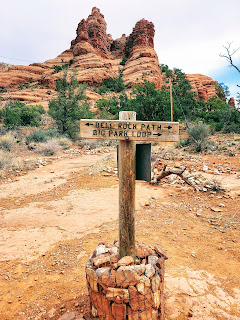
Do these rocks ring a bell?

Dear Husband and I took one day to drive exactly 2 hours north of Phoenix to visit an old friend from Illinois. DH used to accompany her husband's choir(s) and even visited them for a week after they moved down there and I was busy with medical school rotations. They had a couple concerts, did some local hiking, and visited the Grand Canyon.


The husband has since passed, so this time we picked up lunch at a local cafe for the three of us, and then she dropped us off to hike around Bell Rock and Courthouse Rock so she could keep packing to move to Dallas with one of their kids. (Her landlord has decided to sell the house where the landlord is currently living and move into our friend's little house; she says the housing market in Sedona is worse than the one in Pittsburgh due to its proximity to California.)  

The weather forecast called for rain or even snow, so we borrowed jackets from our hostess and set out on an easy hike circumnavigating the two large rocks.

There were some other hikers out, especially between the two parking lots; on the far side of the buttes we could walk for many minutes without seeing someone else. We enjoyed the colors and shapes of the rocks, including the white stripes in the picture at the top, which reminded me of Where's Waldo's? socks. This green and purple prickly pear cactus looked pretty. And we found a clutch of baby saguaro cacti under a mesquite tree (below), just like at the Desert Botanical Garden. It will be decades before they grow large enough for their root systems to steal all the water and kill the tree that sheltered them, however.

This was a particularly large and prickly agave plant. To stay on schedule, we decided not to climb any of the rock formations, which DH thinks he did back during his first visit, as he recognized some of the terrain. There was no inclement weather, and in fact the sun came out toward the end of the hike. Our hostess picked us up so we could have brownies a la mode with crème de menthe before we hit the road. Back in Phoenix we spent an extra hour in the car to drive back to the Air BnB in order to heat up leftovers for dinner so we wouldn't have to a) buy something else and b) throw away $20's worth of food. 

We made it back to the Musical Instrument Museum in time for a beautiful classical guitar concert. Attendance was light, so we basically had our own private box above the main floor to watch and listen to Miloš. The day was everything I had hoped it would be.

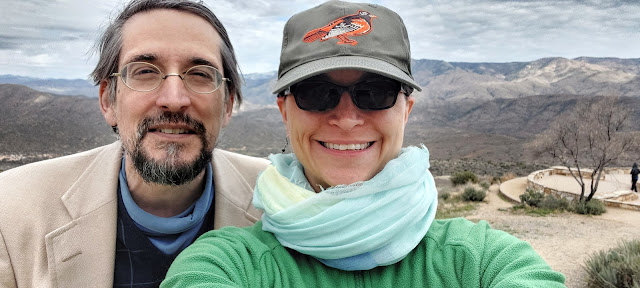
This was us at the rest stop on our way up to Sedona.