Welcome to my Album of Photographs and Memories of Travel, practicing Medicine, culinary Experiments, and other Exploits.
Monday, October 11, 2010
Food Culture Schock
Backstory for this post, which should be dated to last Wednesday: Traveling can be difficult for me, not because of language difficulties or having to navigate an unfamiliar system, but because it disturbs my usual eating routine. (Mom, you can stop laughing now.) The stress of a late train combined with a missed meal is enough to give me a sour stomach, so I try to pack snacks and Tums. Unfortunately, when traveling from Dortmund to Dresden at the end of September, I got very hungry for dinner well before my layover in Leipzig, when I had planned to grab a bite to eat. I normally try to avoid the train restaurant, as they overcharge. But the Tums weren’t working, so I broke down and ordered curry wurst and a large Sprite from the BordBistro. By the time I got to Dresden that evening, my stomach was thankfully no longer tying itself into knots.
However, when I woke up in the apartment the next morning, the only food I had was a couple of apples and some chocolate. Grocery shopping was therefore high on my list of errands to run. My landlady/roommate had recommended a general grocery store a little ways down the street, so off I set with my tote bag and a list in my head with four goals: 1) not to be hungry, 2) to have variety, 3) to have fresh fruits and vegetables, and 4) not to spend a lot of money, since I hadn’t received my first stipend payment yet.
I also didn’t want to buy a lot of food because of my limited capacity for storing it. The state of our kitchen was probably the largest food-related shock I received: first, we have only a minifridge + freezer, a third of which is mine. This probably amounts to a tenth of the cold storage I am used to (about the size of my fruit or vegetable drawer at home) and means that I will have to shop more frequently, as Europeans are wont to do. Second, the stove is electric--no helpful little flames to gauge the heat. In addition, there are two large frying pans and an assortment of pot lids, but apparently only two large soup pots. I had brought a steamer basket all the way from home, because I figured my roommate(s) wouldn’t have one; but once I got here I had to buy a vegetable peeler, too. Her kitchen may not be sophisticated, but boy, can she cook wild mushrooms!
Anyway, one way not to spend a lot of money on food is to buy in bulk. At home we tend to cook maybe twice a week and eat leftovers reheated in the microwave. Not only don’t I currently have much cold storage space for leftovers, but we don’t have a microwave, either. So what I do cook and store to eat later has to go back on the stove. Small wonder many Europeans shop, cook, and eat fresh food more than Americans. (Or in my roommate’s case, eat while out and about when working or visiting friends.) Probably I should learn to cook for one—I don’t say “re-learn,” because as a bachelorette, I either ate out of cans or cooked one large batch and ate from that. Raw ingredients tend to come in large packages, and it’s tough for me (who largely cooks without measuring implements) to figure out what a single serving will be while cooking. Probably I should buy a smaller pot to make preparing smaller meals easier.
Sooo there I was, in the grocery store. In the produce section I got some carrots, potatoes, lettuce, and a bunch of soup vegetables. So far, so good, although I paid something ridiculous like 2,50 Euros for the zucchini, because at the time I didn’t know where else in the neighborhood to shop—so much for the 50-cent beauties from my Farmer’s Market!
Then I hit the dairy case. I like dairy products, and at home, I have particular kinds and brands that I buy. Here was a whole new superabundance of choices, and I didn’t know how to choose what I wanted. For instance, the fat contents differ here: instead of whole, 2%, 1%, and skim, they have >40%, 1,5%, <0.3% fat. There were also different price gradients: organic foods were marked “Bio,” and although I sometimes prefer those back home, I didn’t think I could afford them on my pre-stipendium budget. I settled for “Fitness” or “Basis” when I could. While the pink “Basis” tags obviously marked budget items, I’m not entirely sure what makes a product worthy of the “Fitness” label. Baffled by the kinds, brands, and variety of milk, yogurt, cheese, butter, etc., I was happy to find one familiar product from previous trips, Kräuterquark. It’s sort of like cream cheese with herbs, and it’s particularly yummy on sandwiches or Brötchen.
Here you can see the results of my first shopping trip, for the grand total of EUR 32.19 (= $44.20), which is pretty good! Elsewhere I picked up a loaf of pumpkin seed bread, a little chocolate, and a small round of camembert for 85 cents. I planned on yogurt, muesli, fruit, and orange juice for breakfast; sandwich, carrots, and hard-boiled egg for lunch; apple, peanut butter, and Butterkeks (like graham crackers) for snack; and soup, bread, and cheese for dinner. Also planned dinners: a vegetarian Indian curry with chickpeas and potatoes, and a mixed-bean couscous dish I have yet to invent.
As a New Year’s Resolution this year I have tried to increase my repertoire of vegetarian recipes, and I specifically cut lunch meat out of my diet. Having so recently been quite hungry, I decided to go ahead and get a package of cheap lunch meat. In the US deli meats can already be something of a mystey as to their ingredients, but in German they are even more so. I settled on smoked chicken breast that came in an appealing package and wasn’t too expensive, but Michael Pollan would have had a conniption. While traveling for the Germany/Dutch history of medicine and science conference on food in Maastricht a couple of weekends ago, I finally got around to reading In Defense of Food, in which Pollan argues for the aphorism: “Eat food. Not too much. Mostly plants.” His rules of thumb for grocery shopping include no more than five ingredients in packaged foods, no unpronounceable ingredients, and no added corn or soy by-products like high fructose corn syrup. Alas, at home I discovered my chicken slices came with preservatives (duh) and Kartoffelstärke (potato starch). The highly artificial scalloped shape could have been another tip-off that this was not “food” I was buying... In the future I will either skip the meat or buy it from the Fleischerei (butcher shop). Even my Frucht-Muesli was not immune! The dried banana slices of this original health-food are made of "banana, coconut oil, sugar, honey, flavouring"; and the "apple powder" (??) consists of "apple, sugar, maize [sic--corn] starch". Guess I should splurge for “Bio” for that staple of my diet.
Interestingly, while on that gastronomically uncomfortable train ride from Dortmund to Dresden, I read an article in a great little book that anyone studying food history in Europe or the US really must read, from cover to cover. In their chapter in The Science and Culture of Nutrition, 1840-1940, David Smith and Malcolm Nicolson discuss the politics behind nutritional ignorance and welfare in England over the 20th century. When anyone complained that welfare reciptients suffered from poor nutrition, commentators largely on the right would argue that the poor just didn’t know how to shop wisely on a restricted budget and that they needed nutritional education, while voices largely on the left would argue that the governmental supplements were too low to healthfully feed a family. The authors were intrigued when, after World War II, left-leaning policy experts found it expedient to argue that workers didn’t know how best to eat on a shoe-string budget, because they were also arguing for the professionalization of the nutritional scientists who wanted to educate them. Here and elsewhere observers have pointed out that, sometimes, the food purchasing power of those at the bottom of the social ladder truly is restricted. Think of the fresh-food deserts in some American cities, and how a hamburger is cheaper than a head of broccoli almost everywhere. Despite knowing “what’s best for them,” those with little money to spend on food often choose to spend it on calories (hence my reversion to lunch meat) and the occasional comfort food (for me, peanut butter—more expensive than Nutella here!).
Those are some impressions from my first efforts at feeding myself here in Dresden. At the start of the next week, I happily discovered what amounts to a farmer’s market at Schillerplatz on Tuesdays, Thursdays, and (maybe?) Saturdays. That’s the public transit stop just on the other side of the bridge from my apartment. I had a steaming Rostbratwurst with spicy Senf (mustard) in a crusty Kaiserbrötchen there last week, and I’m pleased at the prospect of buying less from the grocery store and more from local vendors. Unfortunately, if I’m in the archives all day, I will probably end up buying most of my bread products and produce from the ubiquitous shops and stalls that seem to cluster around the tram stops. And of course, heaven forbid you should need something on a Sunday! Most shops here are still closed on Sundays, although sometimes the bakeries will be open. Once my finances are more stable and I get into a new routine, I will do another week-long food photo journal.
Addendum: in maybe my third shopping trip, I bought staples for 8 Euros + 10 Euros-worth of vegetables, which should last me most of a week. Add in a daily baked good (or 2), and it looks like I will be able to eat on about $30-40 a week, which sounds about right.
Wednesday, October 6, 2010
Der Über-Handy
Here’s a quickie while I work on a more thoughtful post about food culture shock. This is my new Handy, which I bought for calling and texting in Germany. It’s so much more complicated (for me) than the old candybar phone with the stiff nub antenna I have back home, that I had to switch the phone language to English to begin to make any sense of it. I don't like to speak German over the phone, because I can't respond to the other person's facial expressions (i.e. can they understand me?), so I might do more texting. However, this phone is so smart--not only will it tell you when its battery has been sufficiently charged--but it will also "help" finish words as you type them. Although it doesn't do a very good job at that! So maybe I will have to discontinue that function and just spell things on my own. Another caveat: this cellphone doesn't have a qwerty keyboard, so there's a little more maneuvering to do with getting capital letters--you know, for the start of German nouns. It may just be easier to succumb to the dumbing-down of written/typed grammar... That having been said, should I ever get lost without a Stadtplan in a quiet quarter of Dresden on a Sunday morning again, I know who will rescue me! (In case you’re wondering, the Polizei are 110 in Germany and/or 112 throughout the European Union.)
Wednesday, September 29, 2010
Hop on the bus, Gus!
Thursday evening when I get to Dresden—“home” for the next 5 months—I will have been “unter Wegs” for 3 weeks: Champaign, Indianapolis, Baltimore, Heathrow, Copenhagen, Dortmund, Maastricht, Aachen, Dortmund, and then finally Dresden. The grand total of vehicular transport in that time (not counting intra-city travel) includes, in alphabetical order, 3 airplanes, 4 buses, 1 cab, 4 cars, 1 ferry, 1 Metro, 1 Strassenbahn, 9 trains, and 1 U-Bahn. Makes your head spin, doesn’t it?
Correction: since posting this, I have made the 9-hour journey, and it turns out I required both an S-Bahn and a bus to get from the train station to my new apartment, so the tally has been edited accordingly. Makes the post title that much more applicable!
I have been trying to come to grips with the fact that I will be living here, in Germany, in Europe, for the next 10 months. I look at the people on the train or on the U-Bahn and wonder if they look particularly “German”? Or could they be Americans until they start talking? But appearances aren’t everything, and I know there are other Weltanschaaungen over here, too.
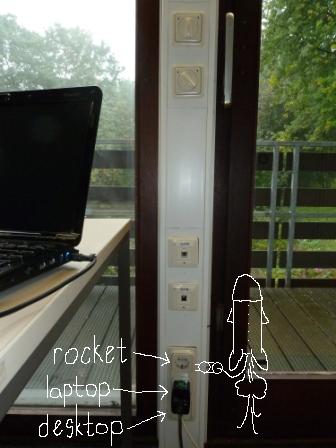
One of the most immediate things to get used to is the built environment. For instance, the wall sockets. Because I live on my computer, these are a crucial part of my daily life. For one, they run 240V over here instead of 110V. Translated: my laptop would get its dear electronic brains fried if I were to plug it into one those.* IF I could plug it into one of those. See, there are two problems: 1) public places like cafes and train stations are not built for laptop users. I spent a long four hours in Aachen’s train station and managed to finagle one hour of plugged-in-ness from a café by buying a pastry, a hot chocolate, and dinner from them, and scramming 15 minutes after the barista scolded me that I couldn’t have my laptop plugged in the whole time. (All this was before a 2-hour train ride, so I admit I was trying to get while the getting was good. I’ve been spoiled by the café culture in the US—don’t even think about free wi-fi here!) The sockets are round and take two round prongs instead of the two round and one flat prong on my conventional grounded American plug. I had forgotten this until the weekend I spent in Baltimore, when my dad reminded me. I was able to find a converter/surge protector at Walgreens for under $15; but since I have only the one I can’t lose it Thankfully I almost never want to plug in both of my electronics at the same time (the other being my digital camera). Here is an illustration from “my” desk at the Deutsches Kochbuch Museum in Dortmund.
The light switches are different, too. At first I was a little confused, although they are very easy to work: obviously, just push the other side of the button if the lights aren’t on or off the way you want them to be. But I experienced some cognitive dissonance because in the US, up = on and down = off. But it works the other way here.
Since I took those photos in my hostel here in Dortmund, I thought I would share something else that is different. This is how to make your bed in this part of Europe. The flat sheet goes on the matress. On the right is the pillow, big and fluffy, just the way I like it! On the left is the Bettdecke, which is basically a comforter that you have to wrestle into an enormous pillowcase. These ones are squarish, but the one at the hostel in Maastricht was much longer and quite difficult to maneuver (especially with two European roommates watching me!). Also in Maastricht I encountered “Presto,” bane of hot water hogs! You have to push it in to get water, which then runs out after a set period of time. I didn’t measure it here, but I noted it was longer than at one hostel I used in Berlin a couple years ago, which had cruelly short bursts. The idea is to encourage you to soap up with the water off and then rinse off under the water. Makes good environmental and economic sense, so I’ve actually been showering like that at home for a couple of years. I figure I might be off-setting some small part of DH’s long hot showers. ;-)


Next post: Dresden!
*--Since posting this, a few friends have pointed out that my laptop can probably withstand 240V, and they're right. So the problem remains the shape of the plug. Thus, if I do lose my converter/adapter/surge protector, I really only need a plug adapter, which should be quite cheap. Thanks!
p.s.—I might be on DVW, German public radio! At least, a reporter came to do a piece on the Kochbuch Museum, and she interviewed me briefly (as a Benutzerin [user]). Although three Germans have said this week that I have “sehr gutes Deutsch,” I’m afraid the reporter probably didn’t think so. Ah well. I will keep you updated if/when it airs!
Correction: since posting this, I have made the 9-hour journey, and it turns out I required both an S-Bahn and a bus to get from the train station to my new apartment, so the tally has been edited accordingly. Makes the post title that much more applicable!
I have been trying to come to grips with the fact that I will be living here, in Germany, in Europe, for the next 10 months. I look at the people on the train or on the U-Bahn and wonder if they look particularly “German”? Or could they be Americans until they start talking? But appearances aren’t everything, and I know there are other Weltanschaaungen over here, too.
| "on" |
| "off" |
The light switches are different, too. At first I was a little confused, although they are very easy to work: obviously, just push the other side of the button if the lights aren’t on or off the way you want them to be. But I experienced some cognitive dissonance because in the US, up = on and down = off. But it works the other way here.
Since I took those photos in my hostel here in Dortmund, I thought I would share something else that is different. This is how to make your bed in this part of Europe. The flat sheet goes on the matress. On the right is the pillow, big and fluffy, just the way I like it! On the left is the Bettdecke, which is basically a comforter that you have to wrestle into an enormous pillowcase. These ones are squarish, but the one at the hostel in Maastricht was much longer and quite difficult to maneuver (especially with two European roommates watching me!). Also in Maastricht I encountered “Presto,” bane of hot water hogs! You have to push it in to get water, which then runs out after a set period of time. I didn’t measure it here, but I noted it was longer than at one hostel I used in Berlin a couple years ago, which had cruelly short bursts. The idea is to encourage you to soap up with the water off and then rinse off under the water. Makes good environmental and economic sense, so I’ve actually been showering like that at home for a couple of years. I figure I might be off-setting some small part of DH’s long hot showers. ;-)
Next post: Dresden!
*--Since posting this, a few friends have pointed out that my laptop can probably withstand 240V, and they're right. So the problem remains the shape of the plug. Thus, if I do lose my converter/adapter/surge protector, I really only need a plug adapter, which should be quite cheap. Thanks!
p.s.—I might be on DVW, German public radio! At least, a reporter came to do a piece on the Kochbuch Museum, and she interviewed me briefly (as a Benutzerin [user]). Although three Germans have said this week that I have “sehr gutes Deutsch,” I’m afraid the reporter probably didn’t think so. Ah well. I will keep you updated if/when it airs!
Thursday, September 23, 2010
Copenhagen, Part the Second -- In Which I Admire Sparkly Things
This is my second story about my stay in Copenhagen. The first one, about my trip to Tivoli, is posted here, and this is the second one, about my visit to Rosenborg Castle. Both have a lot of photos, so I apologize if the load time is long!
Christian IV built Rosenborg Slot (Castle) between 1606 and 1624. Three kings lived there, until Friedrich IV built Friedrich Slot around 1710. Rosenborg then became a ceremonial location, the Skatkammer (treasury), and—in 1838—a museum of contemporary history open to the public! Before the castle opened, I took photographs of some of the sculptures in the adjacent Kongens Have (King’s Garden). Maybe you can tell the weather was regnerisch (rainy) again.
It was one of the more interesting royal residences I’ve toured, probably because the styles ranged from 17th-century hunting lodge through roccocco villa to Empire mansion. The free map they offer helpfully includes a list of the Danish kings and queens and gives a few details about each room. I was curious about the cryptic description of “the king’s bloody clothing” in Christian IV’s bedroom, so I asked the guard standing in the doorway. (Almost everyone in Copenhagen speaks fair to good English, and they don’t mind using it, when it’s evident you know about 3 words of Danish.) He explained that the king had gone to war against Sweden, and when a cannonball hit the deck of the ship where he was standing, it blew to pieces, taking out the king’s right eye. Hence the rips and blood stains on the various objects of clothing in the glass display case. The guard went on to say that Christian lived in much pain for the last three years of his life, because the physicians didn’t have much medicine that actually worked. He showed us the “everyday” crown with a green silk patch that would have hung over the hole in Christian’s face; and also the pair of earrings made of gold hands holding two pieces of schrapnel pulled from the king's eye socket. Apparently the queen actually wore them—but they were so small that I wouldn’t have seen them otherwise. I’m glad I asked!
My roommate was particularly interested in the wax busts (I forget who this is). On the top floor was the Knight’s Hall, with 12 beautiful, hand-made tapestries. I overheard a guide telling a group of East Asian tourists that Denmark had fought 7 wars with Sweden, and lost 6 1/2 of them. The tapestries were to celebrate the 1/2 war they won! I didn’t take any pictures of those, but these are the thrones.

I was particularly interested in the treasury: so many beautiful things! I felt like I ought to judge the royals for expecting such opulence (and paying for it with taxes on the common people), but everything was just so pretty that I could hardly hold their wanting such objects against them. Although I don’t suppose they actually used or wore the half of what I saw—at least that was my understanding after seeing a similar collection in Dresden (the Grüne Gewolbe). As with the pantomimes at Tivoli, I just wanted to look and look and look. After seeing the size of the gems on this crown, and having just gotten out of a conference on medical objects and museums, I wondered where premodern Europeans got the precious metals and jewels they used for all this finery. A few semi-useful Google searches later, I was left with “Asia,” “Africa,” and “the New World.” Ah well. At least no blood must be shed or peoples brutalized or oppressed to bring you these (blurry) images.
p.s.—From Copenhagen to Dortmund I took 1 cab, 2 trains, 1 ferry, and 1 U-Bahn.
Christian IV built Rosenborg Slot (Castle) between 1606 and 1624. Three kings lived there, until Friedrich IV built Friedrich Slot around 1710. Rosenborg then became a ceremonial location, the Skatkammer (treasury), and—in 1838—a museum of contemporary history open to the public! Before the castle opened, I took photographs of some of the sculptures in the adjacent Kongens Have (King’s Garden). Maybe you can tell the weather was regnerisch (rainy) again.It was one of the more interesting royal residences I’ve toured, probably because the styles ranged from 17th-century hunting lodge through roccocco villa to Empire mansion. The free map they offer helpfully includes a list of the Danish kings and queens and gives a few details about each room. I was curious about the cryptic description of “the king’s bloody clothing” in Christian IV’s bedroom, so I asked the guard standing in the doorway. (Almost everyone in Copenhagen speaks fair to good English, and they don’t mind using it, when it’s evident you know about 3 words of Danish.) He explained that the king had gone to war against Sweden, and when a cannonball hit the deck of the ship where he was standing, it blew to pieces, taking out the king’s right eye. Hence the rips and blood stains on the various objects of clothing in the glass display case. The guard went on to say that Christian lived in much pain for the last three years of his life, because the physicians didn’t have much medicine that actually worked. He showed us the “everyday” crown with a green silk patch that would have hung over the hole in Christian’s face; and also the pair of earrings made of gold hands holding two pieces of schrapnel pulled from the king's eye socket. Apparently the queen actually wore them—but they were so small that I wouldn’t have seen them otherwise. I’m glad I asked!
My roommate was particularly interested in the wax busts (I forget who this is). On the top floor was the Knight’s Hall, with 12 beautiful, hand-made tapestries. I overheard a guide telling a group of East Asian tourists that Denmark had fought 7 wars with Sweden, and lost 6 1/2 of them. The tapestries were to celebrate the 1/2 war they won! I didn’t take any pictures of those, but these are the thrones. 
I was particularly interested in the treasury: so many beautiful things! I felt like I ought to judge the royals for expecting such opulence (and paying for it with taxes on the common people), but everything was just so pretty that I could hardly hold their wanting such objects against them. Although I don’t suppose they actually used or wore the half of what I saw—at least that was my understanding after seeing a similar collection in Dresden (the Grüne Gewolbe). As with the pantomimes at Tivoli, I just wanted to look and look and look. After seeing the size of the gems on this crown, and having just gotten out of a conference on medical objects and museums, I wondered where premodern Europeans got the precious metals and jewels they used for all this finery. A few semi-useful Google searches later, I was left with “Asia,” “Africa,” and “the New World.” Ah well. At least no blood must be shed or peoples brutalized or oppressed to bring you these (blurry) images.p.s.—From Copenhagen to Dortmund I took 1 cab, 2 trains, 1 ferry, and 1 U-Bahn.
Wednesday, September 22, 2010
Copenhagen, Part the First -- In Which I Amuse Myself in a Park
I will tell you two stories about my stay in Copenhagen. The first one is about my trip to Tivoli Gardens, and the second is about my visit to Rosenborg Castle. Both have a lot of photos, so I apologize if the load time is long!
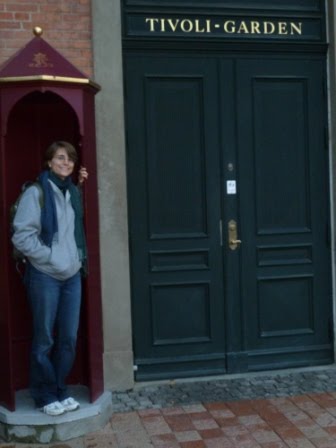
Tivoli Gardens, the second oldest amusement park in the world (est. 1843), is located across the street from the main train station, right in the center of Copenhagen. (The oldest one is outside Copenhagen and is [generously] dated to 1583!) Tivoli consists of rides for all ages, indoor and outdoor performance venues, eateries, four casinos, Europe's longest saltwater aquarium, exhibit space (currently hosting dinosaur skeletons), and interspersed gardens. The first thing I saw when I got into the park was the famous Peacock Theater, which shows pantomimes based on Hans Christian Andersen stories as well as more modern dance performances. The first and last thing I did at Tivoli was to watch parts of two pantomimes, and I was completely hooked. The sets and costumes are colorful, there’s a live orchestra, and the dancers are really very good. I didn’t know either fairy tale, but I mostly followed along. Disney wishes it were this cool.
Left: casino; center: pantomime; right: Peacock Theater
It cost about 95DKK ($17) to get into Tivoli, and I splurged 75DKK ($13.50) for three tickets to get on one of the biggest rides. Apparently the park is famous for the Rutsjebanen, one of the oldest wooden roller coasters still in use today. (Wikipedia informs me it was built in 1914 in Malmö, Sweden.) But because I’ve always liked carnival swings, I chose the Himmelskibet (The Star Flyer). I have just learned from Wikipedia that this, the world's tallest carousel, was built in Austria in 2006 and is eighty meters high (that's 262.5 feet for you metrically-challenged readers). It took us up so high that, not only could we get a bird’s eye view of the entire park, but we could see for miles in all directions. It was quite chilly all the way up there, but totally worth it.
After such a cold ride, I needed a warm drink, which I acquired at a nearby Konditerei. Have I mentioned that’s one of my favorite Germanic words? Or maybe, it’s one of my favorite Germanic meanings.
I had hardly finished my hot chocolate before the Tivoli Boys Guard could be heard approaching. It consists of dozens of boys from eight to sixteen playing instruments and marching in “lobster-back” uniforms around the gardens. They accompany a horse-drawn carriage with a small prince and princess inside. Quite the spectacle.
Thereafter I wandered around and experimented with my camera. I’m no photographer, but the light was poor on account of the rain clouds, so I got a crash course in “exposure time,” “shutter priority,” and “aperture priority.” With some trial and error I was able to get pictures like this one. One of the interesting features of Tivoli is that it is almost possible to forget you’re in a major city in some parts of the gardens. Below you can see the tourist attraction probably most commonly associated with the capital of Denmark: den lille havfrue. The “real” version of The Little Mermaid is usually found in Amaliehavn, but “she is on vacation” at an expo in Shanghai until February 2011. This version is sculptor Edvard Eriksen’s family’s copy, on loan to Tivoli so visitors won't have to go without a photo of Hans Christian Andersen's tragic beauty. By-the-by, the sculpture was commissioned in 1909 by Carl Jacobsen, of the dynasty that founded the popular local beer, Carlsberg. It was unveiled in 1913.
When I left the amusement park two hours after I came, it was dusk and had started to drizzle. I imagine all the lights are quite pretty at night.
p.s.—For those of you scoring from home, from Champaign to Copenhagen I took 3 car rides, 3 airplanes, 1 bus, and 1 Metro.
Tivoli Gardens, the second oldest amusement park in the world (est. 1843), is located across the street from the main train station, right in the center of Copenhagen. (The oldest one is outside Copenhagen and is [generously] dated to 1583!) Tivoli consists of rides for all ages, indoor and outdoor performance venues, eateries, four casinos, Europe's longest saltwater aquarium, exhibit space (currently hosting dinosaur skeletons), and interspersed gardens. The first thing I saw when I got into the park was the famous Peacock Theater, which shows pantomimes based on Hans Christian Andersen stories as well as more modern dance performances. The first and last thing I did at Tivoli was to watch parts of two pantomimes, and I was completely hooked. The sets and costumes are colorful, there’s a live orchestra, and the dancers are really very good. I didn’t know either fairy tale, but I mostly followed along. Disney wishes it were this cool.
Left: casino; center: pantomime; right: Peacock Theater
It cost about 95DKK ($17) to get into Tivoli, and I splurged 75DKK ($13.50) for three tickets to get on one of the biggest rides. Apparently the park is famous for the Rutsjebanen, one of the oldest wooden roller coasters still in use today. (Wikipedia informs me it was built in 1914 in Malmö, Sweden.) But because I’ve always liked carnival swings, I chose the Himmelskibet (The Star Flyer). I have just learned from Wikipedia that this, the world's tallest carousel, was built in Austria in 2006 and is eighty meters high (that's 262.5 feet for you metrically-challenged readers). It took us up so high that, not only could we get a bird’s eye view of the entire park, but we could see for miles in all directions. It was quite chilly all the way up there, but totally worth it.After such a cold ride, I needed a warm drink, which I acquired at a nearby Konditerei. Have I mentioned that’s one of my favorite Germanic words? Or maybe, it’s one of my favorite Germanic meanings.
I had hardly finished my hot chocolate before the Tivoli Boys Guard could be heard approaching. It consists of dozens of boys from eight to sixteen playing instruments and marching in “lobster-back” uniforms around the gardens. They accompany a horse-drawn carriage with a small prince and princess inside. Quite the spectacle.
Thereafter I wandered around and experimented with my camera. I’m no photographer, but the light was poor on account of the rain clouds, so I got a crash course in “exposure time,” “shutter priority,” and “aperture priority.” With some trial and error I was able to get pictures like this one. One of the interesting features of Tivoli is that it is almost possible to forget you’re in a major city in some parts of the gardens. Below you can see the tourist attraction probably most commonly associated with the capital of Denmark: den lille havfrue. The “real” version of The Little Mermaid is usually found in Amaliehavn, but “she is on vacation” at an expo in Shanghai until February 2011. This version is sculptor Edvard Eriksen’s family’s copy, on loan to Tivoli so visitors won't have to go without a photo of Hans Christian Andersen's tragic beauty. By-the-by, the sculpture was commissioned in 1909 by Carl Jacobsen, of the dynasty that founded the popular local beer, Carlsberg. It was unveiled in 1913.
When I left the amusement park two hours after I came, it was dusk and had started to drizzle. I imagine all the lights are quite pretty at night.
p.s.—For those of you scoring from home, from Champaign to Copenhagen I took 3 car rides, 3 airplanes, 1 bus, and 1 Metro.
Tuesday, September 14, 2010
An American in Dresden
“The use of traveling is to regulate imagination by reality,
and instead of thinking how things may be, to see them as they are.” ~ Samuel Johnson
I like to travel, probably most of all because I like to be out of my usual, hectic routine. While traveling I can leave a messy room, a stuffed schedule, and most of the books that I'm supposed to be "reading." Alas, I now have the technology to scan books or download pdfs onto my laptop and edit them (ie. highlight, underline, scribble notes in the margins--if you're not using PDF-Xchange yet, let me put in a plug for them; it's free and so much more agile than Adobe!). Anyway, I will never be without my "must-read" list by virtue of its physical bulk again. Ah, well. Perhaps this crush of reading can now be accomplished on trains--my favorite method of travel--or in foreign cafes, which improve upon their American counterparts by virtue of lower pastry prices and by offering me Sahne with my hot chocolate. Mmm...so cultured.
Does travel really make you a better person? Some people say yes, because it broadens your horizons, lets you see how other people live in other places. Personally, I have found that "Germans" are more real for me now that I have seen them go about their daily lives in person, than when I first read about them in my high school German textbook (the one from the 1980s with pictures of Jungen named Hans and Uwe playing Fussball in short-shorts). Some say no, because it is too easy to find only yourself when traveling (cf. Eat, Pray, Love and the second Sex & the City movie). I believe this was often the case for both my fellow American students and our aloof South Korean roommates the summer I spent at the Goethe Institut in college. Others don't like the question, because answering it, especially in the affirmative, may make it sound as though travel is the only way to improve yourself; or that the supposed benefits of travel (an open mind, new experiences) can only be acquired by physically going there, wherever there is. This discriminates against those of lesser means, but not those of lesser minds.
A few weeks ago, I came across the line (above) by famous British author Samuel Johnson (1709-1784) while looking for some travel quotations with which to spice up my posts. I chose it because it sounded familiar...probably because I wrote something similar on my Fulbright application. On retrospection, I also find it interesting because one of the historical intellectual conflicts I will address in my dissertation is the nature of evidence--namely, what kind of evidence about nutrition and digestion did early-twentieth-century Saxons find convincing? What did you have to tell them to get them to change their behaviors one way or another? Many proponents of alternative medicine and food fads spoke from the authority of personal experience. While many food gurus today still hold up their own weight-loss or recovery from illness, other experts (namely the medical establishment) insist on the gold standard of evidence-based medicine, the double-blind randomized and controlled trial. (Or even better, a meta-analysis of double-blind randomized and controlled trials!) Johnson is advocating for the importance of "autopsy" (eye-witness) for moderation of personal intellectual growth; I don't know what he thought about convincing others with one's own experience. Travel literature and testimonials have long been popular genres, I guess because at the very least they are entertaining.
I study a topic in a time period for which many published sources by a wide range of experts are available and can be obtained from an academic library. But there are still some institutional records, rare books, and handwritten documents that require me to go to Germany. More importantly, I believe, my dissertation research needs to be done in Saxony, and not via Inter-Library Loan from the comfort of home, because I am writing the history of people who lived (and ate) in a particular place (and time). So I need to ground my scholarly understanding of food history in the realities of Dresden, and Leipzig, and Chemnitz, ideally through personal experience. Not only will I be living with Germans, but I hope to travel some around Saxony and to learn to cook some local dishes. Could this project be done from home? Sure. The result would be different, but it could be done. I'm lucky I received funding to taste Saxony for myself, while you are subjected to my travel-blog!
And now I am about to embark on this adventure. My flight leaves at 9pm, I have a 3 hour layover at Heathrow in the morning, and I arrive in Copenhagen at 3:40pm local time. My next post (hopefully) will be from Denmark, in the city of Hans Christian Anderson.
p.s.--I've included a photo of me with all my gear, so you can judge for yourself whether I was successful in my attempt to "pack lightly." That's one rolling suitcase (carry-on size), one stuffed backpack with laptop, and one LLB tote bag for over-flow. We'll see if I'm still smiling in 18 hours...
Monday, September 6, 2010
Wie ist das Wetter?
Caveat lector: in this long post I muse about the weather, clothes, shoes, and packing. If these subjects do not interest you, come back in a week or so, when I write about traveling!
Maximum Minimum
Dresden weather in January 2°C / 36°F 3°C / 27°F
Dresden weather in February 4°C / 39°F -2°C / 28°F
Dresden weather in March 8°C / 46°F 0°C / 32°F
Dresden weather in April 13°C / 55°F 4°C / 39°F
Dresden weather in May 18°C / 64°F 8°C / 46°F
Dresden weather in June 22°C / 72°F 11°C / 52°F
Dresden weather in July 23°C / 73°F 13°C / 55°F
Dresden weather in August 23°C / 73°F 12°C / 54°F
Dresden weather in September 18°C / 64°F 9°C / 48°F
Dresden weather in October 14°C / 57°F 6°C / 43°F
Dresden weather in November 7°C / 45°F 2°C / 36°F
Dresden weather in December 3°C / 37°F -1°C / 30°F
Wie ist das Wetter in Deutschland? On the whole, it will be cooler than here, as Saxony lies farther north than most of the US. For comparison, the northernmost town in Maine is Estcourt, which lies on the 47th parallel; Winnipeg in Manitoba is on the 49th parallel; Dresden lies on the 51st parallel. From the table you can see that the warmest Dresden typically gets is in the low 70s in the summer, although the text from the website actually says that because of the climate of the Elbe River valley, summer temps often reach the low 80s. The coldest is usually just below freezing. Compared with negative temperatures here the last two winters, it should be relatively mild! An umbrella or two will be a must.
I will spend this, my last week at home, cleaning out my study and trying to maximize my packing capabilities. In preparation for my preparations, I solicited advice from grad students who have already completed their foreign research. I was particularly interested in what kind of clothes to bring. The general refrain was that while some locations (notably university libraries) have more relaxed sartorial standards, some archivists equate one's wardrobe with the seriousness of one's project; and that to be on the safe side, I should dress more formally the first day or so, and then relax as I gauge the expectations of the people who will be answering my thousand questions and fetching me more or less obscure materials. The problem is that I am planning on visiting both libraries and archives, and since I can't know the unspoken dress codes ahead of time, it seems I should pack a wardrobe that ranges from "graduate student" (= jeans and hoody; read: comfortable) to "conference presentation" (= suit or equivalent; read: uncomfortable, not to mention not very travel-worthy). This advice clashes with another sage saying I heard: pack twice as much money and half as much clothing as you think you will need.
A friend of mine with apparently heroic self-discipline got through the usual year of dissertation research with three shirts, two pairs of slacks, a pair of jeans, and a winter coat. He always looks proper; but I am afraid I could do no such thing. I know, I know: you can only wear one pair of pants at a time, etc. But at the end of the winter I always despise my (admittedly ample) sweater collection--but perhaps it is more the drudgery of the cold weather that has worn thin my patience than "nothing to wear. On the other hand, I can't pack the way I used to when I went home for the month of winter break back in college. Whereas my friend took only a backpack for a year, ...I used to lug home two suitcases, a toiletries bag, and a backpack. For one month. At home. So it's not like I was trying to avoid the cost of laundry! I just couldn't help but think, "What if I want to wear that shirt?" Of course, I probably didn't wear half of what I lugged on the airplane. Checked baggage fees and some travel maturity have largely cured me of that bad habit. But what to bring for 10.5 months living in Europe?
One factor befuddling my packing is that I have only ever experienced Europe (Germany, Czech Republic, England, Ireland) in the summer. With the exception of a heatwave one July in Prague, my impression is of cool and rain. I only got through the two months of a supposedly atypical but by subsequent experience standard summer at the Goethe Institut in Göttingen by appropriating a sweatshirt from a classmate; thank goodness I had included one pair of jeans with all my shorts and t-shirts. This time, however, I will be arriving in the middle of fall, with a long winter ahead of me. For instance, this week in Dresden daytime highs are in the 60s with fog or rain, and nighttime lows are in the lower 50s. By the time I arrive there October 1, it should be in the 50s during the day and the 40s at night. The final complication of this sort is my brief stop-over in Baltimore, where the temps are still in the 80s!
Another piece of advice I have received regarding packing for this trip is that "Germany is a civilized country, after all"--meaning, if I forget something, I can just buy a replacement when I get there. Several people have suggested buying everything from shampoo to a bike helmet once I get to Germany. However, the frugal me doesn't see why I should spend money over there for something I already own (over here), especially something like a helmet that isn't consumable. We'll see if I change my tune once the packing begins.
One thing that will improve my preferred wardrobe (jeans, tees, sweatshirts), is that my favorite comfy tops are printed in English, with med school and other slogans. There are any number of reasons not to want to stand out as an American, but probably prime among them is my personal desire not to repeat an episode from that summer abroad during college. Despite the suggestion not to bring clothing with English words (it was 2002, after all), my attire at the time largely consisted of Dance Marathon t-shirts. While walking through the town center of Göttingen wearing one of them, I was accosted by a boy, probably 10 years old: "Do you speak English?" he asked. "Vielleicht [maybe]," I replied, indicating my preference to speak in German. "Vielleicht," he repeated, mocking my accent. I had been revealed as a double impostor: an American who wouldn't speak English but couldn't speak German. Then he and his friend ran away.
With the weather and a rough dress code of "nice graduate student" in mind, I am planning to bring only (unprinted) tops that I can wear for more than one season--i.e. pieces that layer well. I am often cold, so in addition to my winter coat, I will bring at least one hoody for all those chilly archives, plus some leggings to wear under my pants like longjohns. (Leggings and herbal tea were about the only way I recently survived a very cold winter of classes in the basement of the hospital!) Speaking of pants, I suspect the limiting factor will be the bottoms, or more precisely, the shoes. Most of my nice tops can be worn with either dress pants, khakis, or jeans. So far, so good. But what shoes to bring?? I don't consider myself a shoe-horse (is that the equivalent of a clothes-horse?), but the volume of the provisional list I'm made of footwear already alarms me: sneakers, 1 or 2 of the 3 pairs of nice shoes I own, probably one pair of sandals, and boots. Maybe also my slippers? Probably I will leave the black shoes and bottoms home, but then I have to choose between the gray shoes that make my feet look small and the practical but boring brown ones. Oh woe, the decisions!
One "cheat" I may use is asking DH to bring me a small bag of clothes (probably sweaters, maybe the boots?) when he comes to visit in November; he can take them away again in March, and I will have gotten through the winter with an expanded wardrobe. Similarly, my parents hope to visit next spring; maybe I'll pack a bag of summerish clothes and sandals for my stopover next week, leave it there, and ask them to bring it with them?
Either way, perhaps from the undue length of this post you can tell that I've thought a lot about packing--but not really as much from worry as from my secret glee at problem solving. Packing is like three-dimensional Tetris (my favorite two-dimensional computer game): how can I get all this stuff to fit in that little space? I relish the challenge. Hopefully my send-off photo from the airport will prove that I was up to the task!
Maximum Minimum
Dresden weather in January 2°C / 36°F 3°C / 27°F
Dresden weather in February 4°C / 39°F -2°C / 28°F
Dresden weather in March 8°C / 46°F 0°C / 32°F
Dresden weather in April 13°C / 55°F 4°C / 39°F
Dresden weather in May 18°C / 64°F 8°C / 46°F
Dresden weather in June 22°C / 72°F 11°C / 52°F
Dresden weather in July 23°C / 73°F 13°C / 55°F
Dresden weather in August 23°C / 73°F 12°C / 54°F
Dresden weather in September 18°C / 64°F 9°C / 48°F
Dresden weather in October 14°C / 57°F 6°C / 43°F
Dresden weather in November 7°C / 45°F 2°C / 36°F
Dresden weather in December 3°C / 37°F -1°C / 30°F
Wie ist das Wetter in Deutschland? On the whole, it will be cooler than here, as Saxony lies farther north than most of the US. For comparison, the northernmost town in Maine is Estcourt, which lies on the 47th parallel; Winnipeg in Manitoba is on the 49th parallel; Dresden lies on the 51st parallel. From the table you can see that the warmest Dresden typically gets is in the low 70s in the summer, although the text from the website actually says that because of the climate of the Elbe River valley, summer temps often reach the low 80s. The coldest is usually just below freezing. Compared with negative temperatures here the last two winters, it should be relatively mild! An umbrella or two will be a must.
I will spend this, my last week at home, cleaning out my study and trying to maximize my packing capabilities. In preparation for my preparations, I solicited advice from grad students who have already completed their foreign research. I was particularly interested in what kind of clothes to bring. The general refrain was that while some locations (notably university libraries) have more relaxed sartorial standards, some archivists equate one's wardrobe with the seriousness of one's project; and that to be on the safe side, I should dress more formally the first day or so, and then relax as I gauge the expectations of the people who will be answering my thousand questions and fetching me more or less obscure materials. The problem is that I am planning on visiting both libraries and archives, and since I can't know the unspoken dress codes ahead of time, it seems I should pack a wardrobe that ranges from "graduate student" (= jeans and hoody; read: comfortable) to "conference presentation" (= suit or equivalent; read: uncomfortable, not to mention not very travel-worthy). This advice clashes with another sage saying I heard: pack twice as much money and half as much clothing as you think you will need.
A friend of mine with apparently heroic self-discipline got through the usual year of dissertation research with three shirts, two pairs of slacks, a pair of jeans, and a winter coat. He always looks proper; but I am afraid I could do no such thing. I know, I know: you can only wear one pair of pants at a time, etc. But at the end of the winter I always despise my (admittedly ample) sweater collection--but perhaps it is more the drudgery of the cold weather that has worn thin my patience than "nothing to wear. On the other hand, I can't pack the way I used to when I went home for the month of winter break back in college. Whereas my friend took only a backpack for a year, ...I used to lug home two suitcases, a toiletries bag, and a backpack. For one month. At home. So it's not like I was trying to avoid the cost of laundry! I just couldn't help but think, "What if I want to wear that shirt?" Of course, I probably didn't wear half of what I lugged on the airplane. Checked baggage fees and some travel maturity have largely cured me of that bad habit. But what to bring for 10.5 months living in Europe?
One factor befuddling my packing is that I have only ever experienced Europe (Germany, Czech Republic, England, Ireland) in the summer. With the exception of a heatwave one July in Prague, my impression is of cool and rain. I only got through the two months of a supposedly atypical but by subsequent experience standard summer at the Goethe Institut in Göttingen by appropriating a sweatshirt from a classmate; thank goodness I had included one pair of jeans with all my shorts and t-shirts. This time, however, I will be arriving in the middle of fall, with a long winter ahead of me. For instance, this week in Dresden daytime highs are in the 60s with fog or rain, and nighttime lows are in the lower 50s. By the time I arrive there October 1, it should be in the 50s during the day and the 40s at night. The final complication of this sort is my brief stop-over in Baltimore, where the temps are still in the 80s!
Another piece of advice I have received regarding packing for this trip is that "Germany is a civilized country, after all"--meaning, if I forget something, I can just buy a replacement when I get there. Several people have suggested buying everything from shampoo to a bike helmet once I get to Germany. However, the frugal me doesn't see why I should spend money over there for something I already own (over here), especially something like a helmet that isn't consumable. We'll see if I change my tune once the packing begins.
One thing that will improve my preferred wardrobe (jeans, tees, sweatshirts), is that my favorite comfy tops are printed in English, with med school and other slogans. There are any number of reasons not to want to stand out as an American, but probably prime among them is my personal desire not to repeat an episode from that summer abroad during college. Despite the suggestion not to bring clothing with English words (it was 2002, after all), my attire at the time largely consisted of Dance Marathon t-shirts. While walking through the town center of Göttingen wearing one of them, I was accosted by a boy, probably 10 years old: "Do you speak English?" he asked. "Vielleicht [maybe]," I replied, indicating my preference to speak in German. "Vielleicht," he repeated, mocking my accent. I had been revealed as a double impostor: an American who wouldn't speak English but couldn't speak German. Then he and his friend ran away.
With the weather and a rough dress code of "nice graduate student" in mind, I am planning to bring only (unprinted) tops that I can wear for more than one season--i.e. pieces that layer well. I am often cold, so in addition to my winter coat, I will bring at least one hoody for all those chilly archives, plus some leggings to wear under my pants like longjohns. (Leggings and herbal tea were about the only way I recently survived a very cold winter of classes in the basement of the hospital!) Speaking of pants, I suspect the limiting factor will be the bottoms, or more precisely, the shoes. Most of my nice tops can be worn with either dress pants, khakis, or jeans. So far, so good. But what shoes to bring?? I don't consider myself a shoe-horse (is that the equivalent of a clothes-horse?), but the volume of the provisional list I'm made of footwear already alarms me: sneakers, 1 or 2 of the 3 pairs of nice shoes I own, probably one pair of sandals, and boots. Maybe also my slippers? Probably I will leave the black shoes and bottoms home, but then I have to choose between the gray shoes that make my feet look small and the practical but boring brown ones. Oh woe, the decisions!
One "cheat" I may use is asking DH to bring me a small bag of clothes (probably sweaters, maybe the boots?) when he comes to visit in November; he can take them away again in March, and I will have gotten through the winter with an expanded wardrobe. Similarly, my parents hope to visit next spring; maybe I'll pack a bag of summerish clothes and sandals for my stopover next week, leave it there, and ask them to bring it with them?
Either way, perhaps from the undue length of this post you can tell that I've thought a lot about packing--but not really as much from worry as from my secret glee at problem solving. Packing is like three-dimensional Tetris (my favorite two-dimensional computer game): how can I get all this stuff to fit in that little space? I relish the challenge. Hopefully my send-off photo from the airport will prove that I was up to the task!
Subscribe to:
Posts (Atom)