Showing posts with label Verkehr. Show all posts

Saturday, July 21, 2018

That's So Pittsburgh: Pittsburgh International Airport


There once was a farm...that became an airport. In 2017, Pittsburgh International Airport was named Airport of the Year, the first US airport to win the distinction, behind Hong Kong, London Heathrow, and Singapore's airports -- for its design and usability, I guess. The little airport that could. Mostly I associate it with running to catch (and sometimes miss) early morning flights. On a recent Saturday afternoon, however, getting through security with quick, even with my usual "full body massage." So I had some time to poke around.

There's this large black and gold medal statue, called Arc, by Glenn Kaino. It was originally installed in downtown Pittsburgh in 2008 for the city's 250th anniversary and was so popular it's stuck around for 3 years instead of 6 months. It was restored and  moved to the check-in counter area at the airport in 2013@. It's supposed to be part transformer, part bridge - I think it looks like a hockey goalie, which would be totally appropriate for a town that loves its Penguins team. That's so Pittsburgh.


Then I had a chance to actually read the signs in the room-sized Western Pennsylvania Tuskegee Airmen Memorial. Apparently 932 men finished the training program, and 355 actually served. A large contingent were from Western Pennsylvania and Pittsburgh, including the only three who died, two on active duty and one in a training accident.


Editor's Note: If you enjoyed this blog post, just search "TSPGH" on this blog to find other entries!

Tuesday, May 30, 2017

Scotland: Cairn Gorm Mountain

On Monday of our Scotland trip we drove into Cairngorms National Park so we could take the funicular railway partway up Cairn Gorm Mountain and then take a guided hike the rest of the way to the top. That's us on the summit! (Click for short videos set to inspirational music; the funicular one is pretty cool for any transportation buffs.) In the winter and spring there's skiing, and during the rest of the year hiking. They try to keep the foot traffic low by requiring hikers either to walk the entire distance from the parking lot or else pay for the funicular and guide. For our first time we chose the tour.


Cairn Gorm comes from the Gaelic An Càrn Gorm, for Blue or Green Hill. It is the sixth highest mountain in the United Kingdom. It has given its name to a mountain range that used to be called Am Monadh Ruadh (the Red Hills), for the red feldspar and/or glow of the setting sun.

Here we go, heading for the clouds. I don't think you can see the clear mountain stream in this shot, but water bubbles up from the rock and runs down, where it is caught, purified, and used in the visitor centers.


The Cairngorm Mountain Railway replaced the older chair lifts in 2001. It's easily accessible from the parking lot and takes you 5 minutes up the slope from the lower visitor center to the higher one, with an exhibit, gift shop, restaurant, and the UK's highest post box. The exhibit covers geology, biology, history, and mountain-climbing technology. You can just see the higher visitor center, above the clouds, with some chair lifts visible. During the ski season, the mountain is often covered by several feet of snow.

Before we started the hike, Dear Husband and I felt inadequate in our preparations. Everyone else was wearing hiking boots and waterproof pants, with backpacks, and hiking poles. I just had my little day bag. DH did run back to the car to grab his extra jacket before we started up the mountain, but it proved to be unnecessary. The sun shone so much, in fact, that I got sunburned and wished we had a backpack to hold all the extra layers of clothes that we weren't wearing!

Our guide told us about snow rescues, the rocks, and the flora and fauna. There are apparently more species of lichen on the mountain than all the other kinds of plants put together!

Here is the origin of one of the streams. Our guide drank from it, but all I could think of was my medical school microbiology professor telling us about the parasite Giardia lamblia that lives in "clear mountain streams." I abstained.

Shortly thereafter we had the neat experience of seeing a small family of dotterels, a bird on the endangered species list. With my camera zoom I was able to capture a few photographs. After that little break, we continued up the path. Unfortunately, the reportedly gorgeous vista into the valley on other side of the mountain was shrouded in mist, which proceeded to crest the summit, which is why the photo above looks so cloudy. We then joined our little group in descending the stone path back to the visitor center. It was quite the experience. I'll leave you with a poem by Rafael Campo and a view toward a lake as we came back down below the cloud cover. This might have been my favorite experience of the trip.


Dotterel on land.
Dotterel on water.
"The View from Here," by Rafael Campo

The view from here is breathtaking; the air
Is stratospheric, absolutely clear.
It's nearly operatic, what I hear
When sunlight strikes the headlands, hillsides bared
By drought across the bay. I wonder what
It's like, to be so timelessly extant,
To have been formed by processes one can't
Imagine--shakings of the earth, the weight
Of polar icecaps, lava boiling in the sea--
The faintest outlines of creation, here.
The wind begins to rearrange my hair,
Reminds me of my presence. Willfully,
I write this down, trying to record
The truth. "The view from here is breathtaking."
I pause, and hold my breath until I sing
This opus, made entirely of words.


Saturday, May 27, 2017

Scotland: Sunday Driving

In order to see more of Scotland, Dear Husband and I rented a car. I had driven on the left before when in South Africa, but it was DH’s first time. Knowing us, a predictable comedy of errors ensured from which, thankfully, we and the car survived more or less intact. The first bit of fun was just finding the car rental place, which according to its website was located within walking distance from the airport, or they would send someone to pick you up. We considered getting off the double-decker bus one stop early and trying to find it ourselves but didn't. At the airport, we asked for help in finding a courtesy phone to call the company, and the volunteer mentioned he thought they had moved to the airport, but I stuck to my online instructions. However, the phone number posted online and on the pillar didn’t work, so I called the hotel—the car company had in fact moved its office to the airport. So we just walked up the ramp. There we discovered that the little automatic I had reserved had been returned the night before damaged. Our options were to wait half an hour for a similar car to be cleaned or to pay an extra 150 pounds for a fully protected new little BMW. I didn’t want to wait, and DH wanted the insurance coverage, so we opted for the beemer with the integrated GPS. 

Sweet, right? Except first we had to figure out how to work the toggle/dial navigation system. (Thankfully it was not stuck on trying to direct us to Seattle.) Then we had to ask how to actually, you know, start the car. It was one of those new-fangled fob and button deals. Next we had to figure out where we were going. Street signs seem to be at a premium in Scotland, such that they are typically small and posted sparingly, but after a few wrong turns, we managed to get on the path indicated by our polite, female voiced guide...which led us right to a pile of dirt that might or might not eventually become an entrance ramp onto the A96. Thankfully I still had Google maps up on my phone to get us to the airport, so DH used that to find me the correct turns onto the highway.


Alas, the reprieve was short lived, for no sooner had we gotten on then She directed us to get off again onto a little road. You might ask why we believed her this time, and DH did ask, but I had typed out general directions into our itinerary, and they seemed to match, so we continued along the long and winding road. The GPS was otherwise helpful—maybe too helpful with her repeated cheerful instruction to “Please leave the roundabout at the second exit to continue to follow” the highway we were on—until we actually needed her to help us find our AirBnB houses. To our consternation, She was 0 for 2. This meant numerous wrong turns while we circled around until we finally happened upon them, both times thankfully well before dark.

DH and I each found that driving on the left was not as difficult as the curvy, narrow, rural Scottish roads. Whenever one of us made a turn, we would sing a little ditty to remember where to put the car: “Left, left, left, LEFT, left,” intoned DH. “To left, to the left,” I sang with Beyonce ("Irreplaceable"). It was some of the most careful and defensive driving either of us have ever done, although we each jumped or bumped the curb once or twice. Thank goodness for the full warranty, as we managed to damage one of the rear tires.


But wait, it gets worse. After we had finished touring Balmoral Castle, we took one of the B roads north through Cairngorm National Park. This one was, no joke, a one-lane road, sometimes with stone walls on either side. Occasionally there would be a “passing spot” like the one above for one vehicle to crowd into while (an) other(s) passed by—even a motor home! With all the turns and vegetation, the sight lines were terrible, so it was only with great luck that DH managed to squeeze us by. The one time I was happy to be “stuck” behind a logging truck on one of those little roads was because I knew that it was wide enough that no other vehicle could pass it and surprise me coming around a bend. As it happens, driving on the highway, in towns, and in cities was no easier. Highway frustrations included construction, farm equipment, and slow drivers (see below). Town obstacles included cars parked in the driving lane, a mail truck, and a garbage truck. City obstacles included buses, traffic lights every 50 yards, and endless roundabouts. You know how they say putting together furniture is a good test of the strength of a relationship? I think that driving in a foreign country is another.

Whoever was driving had to pay very close attention to the road, but whoever wasn’t driving got to enjoy the gorgeous views of rolling Scottish countryside, with trees and moss in every shade of green; cattle, sheep, and occasionally horses grazing in green fields that swept up into hills; and mountains that were patchworks of rock, sedge, and the brilliant gold of gorse bushes, all dappled with sunlight and shadows. We were extraordinarily lucky with the weather on our trip, which only added to the beauty.


If you made it this far, you might enjoy the "Sunday Driver" song by the Scottish folk group The Corries [click for YouTube video of them singing it at what looks like a house concert].

Well I've been a Sunday driver noo for many's a happy year
And I've never had my Morris Minor oot o' second gear
I can drive at fifty miles an hour on motorway or track
With me wife up front beside me and her mother in the back

There was me and my daddy and my daddy's mammy
And her sister's Granny and four of her chums
And Auntie Jean

In a crowd of fifty trippers you can always pick me oot
By my "Don't blame me, I voted Tory" sticker on the boot
Wi' my bunch of heather stickin' in ma radiator grille
And me stick-on transfer bullet holes and licence for tae kill

There was me and my daddy and my daddy's mammy
And her sister's Granny and four of her chums
And Auntie Peg

I've a hundred plastic pennants for to tell you where I've been
And my steering wheel is clad in simulated leopard-skin
Up front fae the drivin' mirror hangs a plastic skeleton
And in the back a dog wi' eyes that flicker off and on!

There was me and my daddy and my daddy's mammy
And her sister's Granny and four of her chums
And Auntie May

I always drive as though my foot was restin' on the brake
And I weave aboot the road just so's ye cannae overtake
I can get ye sae frustrated that ye'll finish up in tears
And the sound of blarin' motor horns is music to my ears!
There was me and my daddy and my daddy's mammy
And her sister's Granny and four of her chums
And Auntie Liz

Now if ye wonder how these weekly trips I can afford
It's because I'm on a stipend from the Scottish Tourist Board
You're supposed tae enjoy the scenery, the finest of its kind
And that is why I have a convoy followin' behind!

There was me and my daddy and my daddy's mammy
And her sister's Granny and four of her chums
And Auntie Rose

There's just no way of escaping me, no matter how ye seek
For the simple fact that I'm a traffic warden through the week
I'm boostin' my efficiency, and here's my master plan
I'm savin' up my pennies for to buy a Caravan

There was me and my daddy and my daddy's mammy
And her sister's Granny and four of her chums
And Auntie Gertrude

There was me and my daddy and my daddy's mammy
And her sister's Granny and four of her chums
"Yer gaun too fast!"

Friday, May 26, 2017

Aberdeen: On the Water

Aberdeen lies on Scotland's northeastern coast. From its large free Maritime Museum, Dear Husband and I learned that it was a trading post in the Middle Ages, then became a fishing center, later added shipbuilding, and--since the discovery of oil and gas in the North Sea in 1964--has hosted those energy industries. We happen to have approached the museum from its rear entrance, which is hidden down an alley (below). The displays are an amalgam of traditional maritime objects (parts of ships, models of ships, paintings of ships, photographs of ships, hand-colored photographs of ships, documents about ships, things that used to be on ships) and more contemporary exhibits about the North Sea and the fishing and drilling industries. We piloted a little submersible, watched a 3D video about working on an oil rig, and marveled at the variety of objects pulled out of the mud of what used to be the harbor's edge during an archaeological dig in the 1970s: coins, the sole of a shoe, most of a barrel, a little golden brooch, crockery.


Congrats, you found the museum! One of the first things we saw was this exhibit on the strange and powerful environment of the deep see, the weight of which compressed these styrofoam heads. Below is a model boat constructed in 1829. It was gifted to a church. There were a number of these, but my favorites were probably the half models made for display. We learned that plain half models were used when designing actual ship, with geometric methods of scaling up the hull once the client had approved it. Another thing I learned is that clipper ships were so fast because of their elongated bows' ability to cut through the water; as a side benefit, cargo stored in that compartment fell outside the taxed space of the hull and so was "duty free."


The museum does a good job including the perspectives of both women and men. While men built ships and trawled, women finished the models, mended the nets, and gutted the fish. The men went to war, and the women took their places in the factories. On one floor was a diorama of a fishing family's home. On another floor was an interactive dollhouse whose appliances could be powered by turning cranks to power wave or tidal turbines. We were both intrigued by the short cartoon film nearby from Greenpeace about the necessity of abandoning oil for renewable sources of energy.


I know you won't believe this, but I was silly twice in one day. While at the museum, in the shipbuilder's office, I "explained" to DH the features of the steamship I was designing. Then, after lunch, another museum, and a false start, we walked to the beach so we could wade in the North Sea. The water was, unsurprisingly, very cold. It had been an unseasonably warm day, but by late afternoon, the warmth was rising, and a cooler wind blew in. We wanted to walk on the sand all the way to the end, but the tide was too high. So we put our shoes and socks back on and walked along the esplanade. We looped around and back into town just in time to eat dinner with a friend and colleague at one of Aberdeen's premier Indian restaurants, Nazma Tandoori. We ended the day by visiting the Botanical Gardens (click for separate blog post).

Wednesday, May 24, 2017

Copenhagen: the Medical Museion

I am giving a paper at the Gut Feeling: Digestive Health in Nineteenth-Century Culture conference at the University of Aberdeen this weekend. My rotation schedule left me with some flexibility in my travel time, so I invited Dear Husband to come with me for a working vacation. We finally made it to Europe, since last June's choir tour had to be cancelled. (DH estimates that at this time last year he was tossing his cookies, poor thing.)

It took close to 24 hours to get from our home on the eastern side of Pittsburgh to an AirBnB in the southern part of Aberdeen, Scotland. We survived a 1.5-hour drive to the airport through three slow-downs in rush-hour traffic; the farce that is sleeping in an economy seat on a trans-Atlantic flight; and lines in four different airports. The first best part of the trip was being awoken by the smell of freshly baked rolls as part of Scandinavian Airlines Continental breakfast. (Seriously, I would fly SAS again just for that.) The second best part was escaping the Copenhagen Lufthavn for a few hours to take in fresh air, warm sunshine, and the Medical Museion (details below). Copenhagen itself was a wonderful combination of old and new architecture, the newest still being a dirty hole in the ground. The third best part of this trip was sitting together on our bed in Aberdeen, with a window open toward the canal; yes, we were hooking up to the internet for the first time in a day, but we had arrived and were happy.

I first discovered the Medical Museion in 2010, when I kicked off my dissertation research year by attending a conference there about science in museums. It really is a hidden gem down Bredgade Street, as they combine good history, good science, and  good museology. We were greeted in the entranceway by Femme Vitale (above), a dress made out of the 27,774 pills that a middle-aged woman with Metabolic Syndrome would swallow over 10 years. But the big draw was "The Body Collected: The Raw Material of Medical Science from Cadaver to DNA." The exhibit considers how scientists have collected bodies and body parts in the name of knowledge and research for the last 300 years. It begins with fetuses in glass jars, like Martha and Marie, conjoined twins born in 1848 who lived 10 days. Their parents abandoned them, so after they died, their bodies were dissected. Here you can see their skeletons, organs, and preserved skin.

The exhibit next considered wet and dry pathology specimens of everything from a leprous jaw to a tubercular spine to the larynx of a man who was stabbed to death in his apartment.


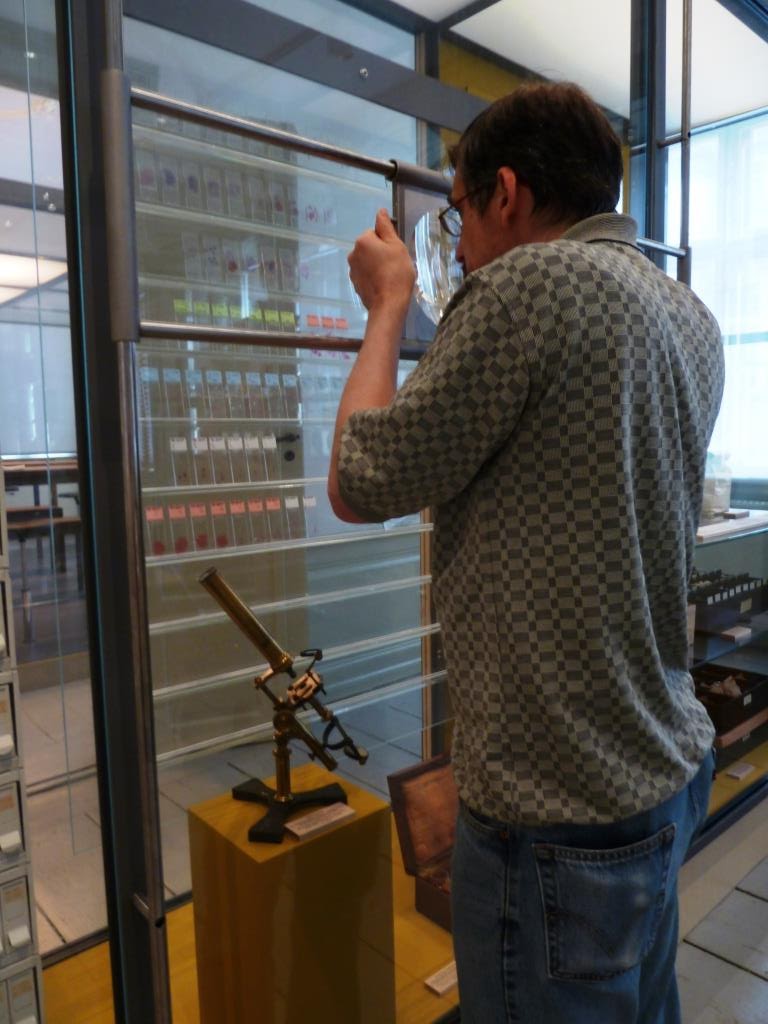
Then the pieces of the body got smaller: microtomed slices of tissue on glass slides, then cells grown in culture, and finally bits of DNA. The 3D objects were supplemented by a few patient stories printed (in Danish and English) on small boards, some computer simulations, and occasional short video recordings. I was fascinated by the one that follows hospital blood samples to the lab--that's what's inside the "black box" that is ordering tests on my patients! Here's me at the exhibit entrance and DH using a magnifying glass to look at histological specimens.


Sunday, March 19, 2017

That's So Pittsburgh: the Duquesne Incline

Editor's Note: If you would like to have a sound track while you read this post, click below.


Dear Husband's parents came to visit, so we decided to ride the Duquesne Incline 400 feet up to Mount Washington and eat dinner at one of the restaurants there. DH says Mr. Rogers originally wanted to have a funicular in his set, but purportedly for reasons of design the little red car was put on a horizontal track rather than an inclined one. Being a city of hills as well as of rivers, Pittsburgh once had 22 different inclines for coal, freight, and passengers. (Click here to see an interactive map.) (Click here for a before/after picture of the now-defunct Penn Hill Incline.)


This was our cloudy view of the Point and Downtown. Coming from the right is the Monongahela River; above is the Allegheny River; they come together to make the Ohio River, which flows off to the left. We observed the EMS lights of a traffic accident on the Fort Duquesne Bridge (nearest bridge on the left) and, after the sun set, the "Energy Flow" LED light display on the Rachel Carson Bridge (way in the background). Just down and to the left, we could watch the bright red funicular cars riding up and down the 794-foot tracks. The Duquesne Incline opened for business on May 20, 1877. Its two cars are pulled on parallel tracks at 6 mph at a grade of 30.5 degrees. The cabins are enclosed but not insulated, so it was a chilly ride. Dinner took just long enough that we could see the sun go down and all city lights come on. Touristy but worth it.

If you are interested in other Pittsburgh landmarks, check out my posts on the Cathedral of Learning or the Motor Square Garden.

Saturday, September 17, 2016

Marriage Metaphors from Cheat Lake


The metaphors practically wrote themselves.

Dear Husband and I had decided to go canoeing on Cheat Lake*, West Virginia, after my pediatrics intern retreat had concluded. Renting a canoe for an hour was $5 cheaper, but the rental guy warned us there was a slow leak in the boat that would let on about a gallon of water in the time we would have it on the lake. With 80-degree weather, an overcast sky, and gentle rain when we started, neither of us was interested in getting particularly wet, so we opted for the kayak. After clipping on our life jackets, I volunteered to sit in the back and steer (of course), while Dear Husband folded himself into the bow of the kayak. And off we went.

The last six months of cancer, Matching, graduation, moving, and internship have been stressful, but DH and I have tried hard to stay positive and connected. That fell apart the last two weeks, as I changed to a very busy in-patient service on which there were only "long-call days"--no one went home early because there was too much to do. After seeing me only long enough to serve me dinner and tuck me into bed three days in a row, DH asked that if I had to work late on Wednesday, could I please do it from home, so at least I would be ignoring him from the same room. (!) My senior resident and co-intern agreed to send me home from the hospital "early"--whereupon I proceeded to spend the evening (sans an hour for dinner), writing notes and discharge summaries in one corner of the study, while he worked in the other. Thursday was a busy half day at the hospital followed by a quick 45 minutes of changing and packing before my ride picked me up for the retreat. Friday DH drove down to join us, and a late lunch was the first time we got to have uninterrupted time together in nearly a week.

So the state of our relationship was at the forefront of my mind this weekend, and you know where I'm going with this kayak metaphor, right? Unsurprisingly, paddling together and steering were intermittent problems for us to solve on the lake today. Occasionally we found a rhythm and stroked together with power and efficiency. Other times I hit his oar or life jacket with my oar. Or one of us was pulling us to one side or the other. Just as in our relationship, we had to communicate our desires to each other with patience and without blame.

It occurred to me at one point that I might be more of a canoer than a kayaker. Kayaking requires you to make even, shallow strokes well-timed with your partner. Canoeing allows you to paddle deeply, now on onside, then on the other, as the situation demands. Two nights before, the first exercise the interns did on our retreat was to rate ourselves according to personality traits: I scored myself highly on curiosity and analysis and was surprised at how accurately the text description of this personality (for whom the worst thing is to be wrong) fit me. When DH heard the categories later (curiosity, empathy, order, and spontaneity), he pointed out that I probably wanted to be a “methodical planner” (aka a kayaker), but that this rarely worked out in real life.

Maybe twenty minutes into our trip, I observed that the heels of my sneakers were sitting in puddles of water, and that my socks were wet. Leaning forward to see if I could bail some of the water out, I realized it was coming in and out of the kayak through holes in the hull. I sang,

“There’s a hole in the kayak, Dear Husband, Dear Husband, there’s a hole in the kayak, Dear Husband, a hole!”

But unlike Liza and Henry, nobody demanded that the other “fix it.” Instead, we rested in the middle of the lake and admired the mountains. At this point we met up with the other canoe in our party and agreed to paddle to the bridge crossing the lake before turning around. Then I realized that the person at the front of the kayak sets the rhythm; unlike canoeing, steering in kayaking has a lot less to do with anything. An excellent reminder that it takes two to paddle both literally and metaphorically.

On the way back, it rained again, and I picked the wrong landmark to follow. When I realized my error, we redoubled our efforts to work together, so as to make it back to the marina before incurring a late charge. Not to mention that DH was wet, top and bottom, and my shorts were soaked through. (So much for picking the "dry" boat.) Plus, it was nearly lunchtime. Like the end date for each period of long-distance relationship in our 18 years together, we were glad to have a concrete goal in front of us, something on which to concentrate rather than the vast expanse of lake. By contrast, marriage seems open ended. With no particular goal in sight, maybe that permits us to try to get by on inertia. Hopefully chances to re-charge like this mini-vacation remind us to actively work on our relationship with each other, to set short-term goals, and always to be kind and flexible.

Back on shore, we changed into dry clothes and shared a burger and fries at the lakehouse before hopping in the car for the 1.5-hour return journey home. One of us even got a bit of a nap in. All in all, a worthwhile adventure. The best part was that we did it together.


*Officially named Lake Lynn after West Penn Power president Albert Lynn from 1925-1976, Cheat Lake got its moniker from the locals, either because of the surrounding "cheatgrass," because the treacherous river/lake "cheated" people out of their lives, or because they didn't like having the dammed lake named after a corporate bigwig.

Sunday, July 3, 2016

Trail, the conquering heroes!

Listen, my children, and you shall hear
of a misadventure of spoke and gear...


Pittsburgh from across the Monongahela River

As luck would have it, I got a three-day weekend for the Fourth of July. My Awesome Parents were in town and staying at the Waterfront on the south shore of the Monongahela River, so we decided to bust out our bicycles and go for a ride along the famous Great Allegheny Passage (GAP) that runs all the way to Washington, D.C. (with the help of the C.&O. Canal Towpath). I proposed the eastern route to McKeesport, PA, which Google Maps predicted would take 45 minutes to go 8 miles. There's not much to do in McKeesport, but I thought it might be nice to stop and snack in Renziehausen Park, whose rose garden is supposed to be one of the top 10 public rose gardens in the country. Thinking it wouldn't be much of a trip, I suggested we ride along the edge of town, for a grand total of about 12 miles and 1 hour in each direction. The only hindrance might be the mile-long hill at the end, but we could always walk that if necessary. The best laid plans...

In the background, the blue Duquesne Bridge into McKeesport, PA.
First, Dear Husband discovered that his bicycle tires wouldn't hold air. But he could rent one next door to my parents' hotel. He couldn't find his helmet, but they would have one of those, too. And I needed to adjust my brakes, but they would surely have wrenches. Mom needed a refresher on how to change gears, and after that we were off!


Unfortunately, it soon became apparent that Google Maps had calculated our trip based on my usual cycling speed, which is twice what DH and Mom can tolerate. The weather was warm but not oppressive, and the bike path alternated between railroad/industrial areas and a cool green tunnel. After an hour we were still riding. I had to pull out my phone with increasing frequency to check the route through McKeesport. I missed the last turn, we doubled back, and the route led us to a major street with businesses (most closed on Sunday). By now we were tired and hungry and still one mile and a large hill from our destination. Mom and I reasoned we could find someplace to sit and eat before turning back, but Dad and DH campaigned for attempting the incline. We got about three fourths of the way up before we had to stop to wait for DH to walk his bike to us. We sat on someone's raised garden bed to snack while we debated how to proceed. Unfortunately, there were no cross streets on this road. Our choices were to go down the way we had come and ride the long way home or, if we could crest the hill, take the shorter way back. We decided to walk the rest of the way up, and boy are we glad we did.


We actually weren't that far from Renzie Park. I snapped the shot above of the fountain on our way to the rose garden...which we almost didn't get to visit. The main gate was closed and locked (despite an optimistic sign to the contrary). Dad finally found an open side gate, which let us into this charming garden. It was a little past the high season for roses, but enough were still blooming.


The ride home was a comedy of errors, from an incredibly steep incline through town, to having to ride on the sidewalk along a major street without a bike lane, to inconsistencies on Google Maps. The piece de resistance was the rear tire of my bicycle popping flat 3.5 miles from the hotel. Mom and I walked most of the way back, until the path intersected with the road, and Dad and DH could pick us up with the car and put the bikes on the rack. We paid the guy at the bike shop to change the tire, but he put it on backwards the first time. We decided we had earned burgers and shakes from Burgatory, but we waited half an hour for a table, and then half an hour for our food, while MUSIC BLARED IN THE BACKGROUND and someone turned down the air conditioning to "freezing." Our little 2-hour jaunt turned into a 3.5-hour (mis)adventure, but we'll always have the stories and the pictures. 


Friday, January 29, 2016

My Medical Grand Tour, Part 4 of 4

Wealthy graduates of American medical schools from the eighteenth to the early twentieth century often traveled to Europe to amplify their training in the medical and clinical sciences. I am sure they partook of the local culture, as well. Current fourth-year students have the opportunity to do something similar when they visit hospitals to interview for residency positions. Some applicants try to do something fun or unique in each city. I was not that ambitious; instead, these are the small moments I captured during the weeks I spent at my parents' or in-laws' houses, the apartments of friends and acquaintances, Air BnB digs, or the occasional hotel. Click here for Part 1, Part 2, and Part 3.


Still in Baltimore, I helped My Awesome Parents (MAP) decorate for Christmas. Because they were traveling, they did not get a tree this year, but we did buy a plain wreath that I decorated with swag left over from previous Christmases and hung on the front door (above). My father wove cut branches from fir trees  (free from the nursery!) into the rails of the staircase, from which I hung red beaded garland and straw ornaments (right). It was very festive and made the front hall smell fantastic.

Between holidays I popped up to Cleveland, OH, for 24 hours. I stayed at an Air BnB across the street from the hospital and unfortunately had no occasion to take any pictures. But I will always remember that the house was a pretty shade of lavender with white trim.

Back in Pittsburgh, PA, for the third time this interview season, I snapped a shot of the sapphire and diamond earrings I wore for my interview. They were a gift from my father, and unfortunately, the necklace didn't work with my collared shirt, or I would have worn that, too. The traveling jewelry case was a Christmas gift from my mother-in-law.


I also enjoyed some of the art at the children's hospital in the Steel City, such as "Hat-trick Hero," a statue celebrating the Pittsburgh Penguins' Stanley Cup wins in 1991, 1992, and 2008. After spending a month in Madison, WI, where University Hospital has fantastic local art decorating its hallways, I decided that if this medicine gig doesn't work out, I would want to become the person who makes the art selections for a hospital.

In Cincinnati, OH, I had three days of interviews plus one day of shadowing but somehow neglected to pack enough black knee-high stockings. One of the pairs that did make it into my bag was actually two unmatched rejects. I borrowed extra from my MIL for the next two days.

My very last residency interview was at my home institution in Urbana, IL. There is a picture of my playing ping-pong with one of the other applicants in between interviews; unfortunately, I can't get it off the internal memory card of my camera without the cord that I lost while traveling. You'll just have to take my word for it.

And there you have it, a photo essay of my residency interview travels. If I stayed with you or we met up along the way, I'm so glad. And if we didn't, maybe next time. For now, I'm happy to be home with Dear Husband, sleeping in my own bed and wearing not-a-suit every day!

Tuesday, November 17, 2015

My Medical Grand Tour, Part 1 of 4

From the 18th into the early 20th centuries, it was not uncommon for wealthy American medical school graduates to travel to Europe for a mixture of advanced training and extended cultural vacation. In the 1700s they tended to go to England and Scotland, in the early 1800s Paris, and from the late 1800s Germany and Austria. Here is my own version of a medical grand tour.

Out of a combination of discretion and superstition, I tried to be circumspect online while I was traveling for residency interviews, but now that they are over and I have Matched, I want to share the pictorial travelogue I kept while on the trail. You probably don’t want to read about the nitty-gritty details of call schedules, research tracks, and clinical electives, so here are some snapshots I took along the way. (Apologies for the low quality of the cell phone images, as my camera went missing at one point and/or I didn’t have it with me on the interview day.)


On my very first interview, in Indianapolis, IN, I made the rookie fashion faux pas of bringing the wrong purse; for future interviews I swapped the brown corduroy for a professional black Kate Spade bag.
  

My second interview, in Columbus, OH, was the day before Halloween, so I decided to dress up for the holiday. After conducting a Facebook poll about which pair of earrings to choose, I wore an orange collared shirt under my standard black suit and the black spiders you see here. Much to my disappointment, nobody remarked on them, although I did bring them up during my interview with the Program Director.

The night Dear Husband gave his big scary organ music recital, I was staying with relatives in Cambridge, OH. He set up his laptop to livestream the performance for us. You can read all about it here.


Despite having grown up in Baltimore, MD, on interview I finally, finally got to visit Johns Hopkins—I mean Jesus—in the rotunda.


In Boston, MA, a friend took me out for a fancy seafood dinner, complete with raw oysters. (I think it was the first or maybe second time I had ever tried them.) My favorites were the Pemaquid, ME, oysters because they had just the right briny taste of ocean.


The weather in Rochester, NY, was unseasonably warm, and I did not appreciate having to lug around my heavy winter coat on shuttles and through airports. However, we were able to take an applicant group photo in front of the upper falls in just our shirt sleeves.


After interviewing in Newark, NJ, I took the PATH train to Manhattan to have dinner with a friend from graduate school and hear the famous, brilliant, and humble medieval historian Caroline Walker Bynum give a talk about these two objects: the Beguine cradle (?1460s) and the Burgundy creche (2nd half of the 1400s). Bynum ranged from the identity politics of monks versus nuns to the material culture of medieval worship to the cults of Mary and Joseph. I began my historical training as a medievalist, mind you, so I knew just enough about the topic to have been properly awed.

This series continues with Part 2, Part 3, and Part 4.