Friday, August 26, 2011

Poland, Day 2: Warsaw

I liked Warsaw. I formed my first impression of it while walking around the center of the city, looking for my hostel (I had written the address down incorrectly). An hour and a half later, I arrived, tanned from so much sun, and itching to get started with some real sight-seeing. An hour later I had showered, changed, and found a castle open on a Monday. Off I went.

One neat feature of the city I had to get used to was the underground pedestrian passages. Instead of having to cross large streets and deal with the traffic, pedestrians go down some stairs, along a hallway, and up again to re-emerge on the next corner. Some of the tram stops are accessed this way. Meanwhile, the passages are lined with shops for computer parts, books, baked goods, etc.

I figured Warsaw was too big and cheap to resign myself to walking everywhere--not mention the blisters from legging it around Poznan--so my first day I rode a streetcar and a bus to the Old City and took the subway home at night. The public transit system seems pretty extensive, and the website comes in English. But there are few ticket automats, so I ended up riding schwarz (black, i.e. illegally) on the first leg of my journey, because I couldn't figure out where to buy a ticket. (It turns out most of the sidewalk newspaper and cigarette kiosks sell them.) There are no maps or schedules or signs or announcements in the buses or streetcars, so I nearly missed my stop once. And riding on a weekday at rush hour meant squeezing into a bus with a LOT of Poles. But I got where I was going:


I took a tour of the castle in the Old City. After the Warsaw Uprising of 1944 (not to be confused with the Warsaw Ghetto Uprising of 1943), the Nazis leveled what was left of the city and blew up the castle in retribution. It has since been rebuilt in its original style and grandeur. I marveled as I always do at the money and effort that went into the artwork and decorations--like the beautiful ceiling painting above--that only a small percentage of the population ever got to enjoy. All of the signage here also came in English, as it is a popular tourist spot.

I wandered around the Old City, looked at the Vistula River, and treated myself to a traditional Polish meal of summer soup and compott (water in which prunes and other dried fruits have been steeped). I drank my compott cold, but it also makes a tasty warm drink for cold days. For some reason it reminded me of apple butter.

Warsaw is a big, busy, international metropolis. From the viewing platform on the 30th floor of the Palace of Culture and Science the next morning, I could see signs on buildings for Coca-Cola, Siemens, Peugeot, and other foreign companies.

Stalin gifted this enormous building (first photo above) to the Polish people in 1955, and it is still the tallest building in the country (42 stories). Its several wings house a cinema, a museum, a conference hall, and even a university. The techno mermaid to the right wields her sword outside the Museum of Science and Technology. I was really looking forward to seeing their Glass Woman, but the ticket lady in her limited English didn't offer an explanation for why I couldn't buy a ticket for that. Instead, I looked at a charming set of sometimes witty model train vignettes; at some mining equipment; and at their collections of phones, computers, cars and motorcycles, washing machines. Maybe half of the labels were also available in English, so I had an even more extreme reaction of glassy-eyed wonder/stupor to these context-less objets d'science. They did translate a couple of paragraphs about the Enigma machine the Poles used to break the Nazi's code during WWII, which was cool. And I got to bid farewell to the United States' space-travel program at the museum's display on the Apollo missions. In one room, an elderly gentleman explained hands-on physics experiments to me (in Polish).

My last stop was to the Frederic Chopin house and museum. It opened at noon that day, but it was free, so I figured it was worth trying to spend an hour or so there before picking up my luggage from the train station and heading to the airport. Unfortunately, they only had spots left from 4pm (my plane took off at 4:30!). Thankfully, the girl working the ticket counter took pity on me and gave me a pass anyway. Like the Museum of Science and Technology, the Chopin Museum stakes its claim to fame on its collection of objects and memorabilia. Unlike the MST, however, the Chopin institution recently reopened with a glitzy, new, high-tech exhibition. You can see a draft manuscript of an etude and then touch your pass to the nearby computer screen for a video about Warsaw or Paris when the composer lived there (with subtitles in your language, too). It was pretty neat. Dear Husband would have loved the room in the basement on Chopin as a composer. Soon it was time to go.

A woman from Barcelona and I snapped each other's photographs
on the observation deck of the Palace of Science and Culture.

I'll spare you the details, but suffice it to say I had frustrating and sweaty experiences traveling from Berlin to Poznan, from Poznan to Warsaw, and then to the airport for my return journey. The two days I spent in the capital of Poland were warmer than I had expected, and my luggage really was quite heavy. So more than once I found myself in a bathroom, taking a sponge bath so as not to offend my fellow travelers. Good thing I remembered to pack my towel!

Wednesday, August 24, 2011

Poland, Day 1: Poznan

When my visa was up in Germany, I took a little detour through Poland on the way home to the States. I figured I should take advantage of my time-limited proximity to this country to experience something new and different. My two-day trip was neither as wet nor as cold as I had expected. I brought the rain with me from Berlin, as if the train were towing the rain clouds behind it. Two and a half hours later, I got out at Poznan, "the historical capital of the Wielkopolska Region, where the Polish State was born 1000 years ago," according to the city's website. "Posen" was also once the capital of a Prussian province, after Poland was divided between Germany and Russia in 1815. Unfortunately, a wet Sunday afternoon was probably not the best time to try to get a feel for Poland's fifth largest city (pop. 550,000). 


I had not planned an extensive itinerary for this trip, hoping rather to have good weather to wander about and take photographs. On account of the rain, however, I decided a museum visit would be a better/drier way to learn about the city, so I paid 5 zloty (no Euros!) to see the Museum of the History of Poznan. Alas, it turned out to be a stereotypical small-town museum of objects arranged more or less chronologically by theme (guilds, portraits, books and artisanal products, "19th century"). Maybe 1/2-3/4 of the little printed labels had been translated into English. Although the paragraphs about each room explained the groupings of the pieces, there was no real narrative. So I finished early at the museum. Little more educated than when I went in, and with several hours of somewhat drier daylight and visiting hours at other attractions ahead of me (until 6pm, according to what I could find online), I decided to go ahead and walk around. I usually have a pretty good sense of direction, but between the rain and a hodgepodge of streets, my mental compass utterly failed me, and I got lost twice in three hours. On the upside, I saw a little bit more of the city, which is on a river and which has an impressive amount of green space.


From the train station to the emperor's castle to various dilapidated buildings, much of Poznan is under construction. Because the city is known for its architecture, this state of being half-finished is probably a common one in its 1000+-year history. For instance, the Rathaus (left) was first constructed in the 1500s in a northern Italian Renaissance style; the main hall with its creative ceiling is original, but other parts were renovated just before WWI or after WWII. The emperor's castle has a medieval exterior and a New Objectivity interior dating to the 1930s. Across a wide meridian stands the building for the Prussian Academy of Arts and Sciences with a stepped facade (think Amsterdam). On the meridian stands a monument to the "Poznan Uprising" of 1956 (first image above); what is remarkable is that the monument was privately funded and opened already in 1981, at a time when Poles were pushing back against the one-party system, but well before the official end of socialism. It combines two important national symbols, the cross and the eagle. Eagles also appeared in a memorial to those who died defending Poznan during WWII (bottom image). 

Despite the fact that I had developed blisters already (my German sneakers rubbed right on my pinky toes), I figured I had enough time to walk 2km across the city center and over the river to the Cathedral Island. That was actually worth the visit. The main attraction, the cathedral (right), was first built in 698 and since revised, destroyed, and updated. In its current incarnation, some new artwork tempers the very old art and architecture. Outside stands a life-sized statue of the late Pope John Paul II. Then it was home to the hostel, where I took a hot shower, ate the leftovers I had brought for dinner, and enjoyed the free wireless internet.


Poznan was nice. It felt like a small city. I only wish that I could have had some company while I was tramping around it (the student who invited me out to visit her family there was actually on vacation at the same time I was). Next day: Warsaw.


Tuesday, August 16, 2011

Monkey Rock

When I went back to Dresden in July to finish up some archival work and to celebrate my birthday, I stayed with German friends. One of them grew up just outside Dresden during the DDR and has fond memories of hiking with her family in the "Saxon Switzerland" (Sächsische Schweiz), so after a leisurely breakfast on Saturday we caught the train out to Bad Schandau, a famous spa town on the Elbe River. We took the ferry across the river and then rode on the only Strassenbahn in a German national park, the Kirnitzschtalbahn, to Beuthenfall. At exactly 1pm we set out into the woods and up.


Our first goal was the Affenstein: Monkey Rock. In the 1960s Rudolf Hänztschel cobbled together a(n unauthorized) climbing route that quickly grew in popularity. The government tried to shut it down in 1998, but after local hiking groups complained--Germans take hiking very seriously--the park district relented and agreed to repair the "Häntzschelstiege" (link has video). Among those attempting the 160m (525ft) ascent that afternoon, we were the only ones without helmets, harnesses, or gloves. My friend had made this climb so many times that she finds such accouterments unnecessary: the key was to hold on tightly and to only move one hand or foot at a time.

I won't lie: the climb was heart-pounding. It was, as my mother's family says, "truly dangerous." The edited, eight-and-a-half-minute video in the link above gives you an idea of the climb up the cliffs and crevices to the plateau above. Once on top, however, the paths were more or less level and the views were gorgeous. We took some photographs to celebrate our achievement and then hiked to a popular lookout point to eat lunch (left). It's hard to believe that whole area used to be under water.

Next on the agenda was the Idagrotte, a cave carved out of the sandstone first by water and then by wind. Eventually we came to the "never-ending" wooden staircase dooown off the plateau. We hiked across the valley and then up to the second largest arch in the park, known as the Kuhstall (Cowpen). After stopping for ice cream we clambered up the Himmelsleiter (Heaven's Ladder) to one more vista point, where a medieval castle once stood. (They apparently kept their cows in the formation below, hence the name.) I found the sight of so much green beautiful. Then it was time to walk down the windy slope back to the Kirnitzschtalbahn stop from which we had set out 4 hours earlier. It was 5pm, and we were spent, but what a wonderful afternoon it had been!


Tuesday, August 9, 2011

Connect the Dots!


View European Travels 2010-2011 in a larger map


Travel is still on my mind, so while I sort photographs and write up posts about my various summer adventures, I thought for my first entry since returning to the United States, I would share this map of my European peregrinations. If you click on the link, you can see the entire map and also descriptions of what I was doing in each place. First stop: Copenhagen (September 2010). Last stop: Warsaw (August 2011).

Saturday, July 30, 2011

I ate that! Take 3

German Home-Cooking 1
Blutwurst + Kartoffeln + Sauerkraut (+ Salat)

When I mentioned my experience with calf liver to a chatty old lady at church the next day, she told me that she thinks the apples and onions are the best part. And actually, she prefers chicken liver. And had I tried another Berlin dish, Blutwurst, yet? When I was in England last month for that food and drink history conference, we were served black pudding one evening, which is the same thing. I also found that tasty. So I agreed to take her suggestion to purchase some fresh blood-sausage from a butcher, as the packaged ones are supposed to be relatively tasteless. She recommended I pair it with boiled Kartoffeln (potatoes) and Sauerkraut “verfeinert” (“refined”) with Lorbeerblatt (bay leaf) and Speck (bacon). Because I am cleaning out my pantry in preparation for returning home, instead of buying white sauerkraut I used some of the Rotkohl (red sauerkraut) I already had. I cooked the basil potatoes with their delicate skin on (even my sources from around WWI suggest that). And I served the warmed sausage slices with a green salad without the typical German dressing of lots of oil and vinegar. The meal was very delicious! I would eat that again.


American Home-Cooking
Shrimp Couscous + Mixed Green Salad

While I was back in Dresden for a quick, one-week research trip, I stayed with two sets of friends, and of course we cooked and ate together. To thank the first couple for their hospitality, I offered to make an “American meal” from a personal recipe, which is as follows:
      Shrimp Couscous
Shrimp, thawed (+/- shells)
Broccoli, with long stems
Boxed coucous, any flavor
Craisins
Pine nuts, toasted if you like
Olive oil
Garlic, minced
Start boiling the water for the couscous. When the olive oil and garlic are hot, begin cooking the shrimp. When the water has boiled, add the couscous. Meanwhile, steam the broccoli. Just before the couscous is finished cooking, stir in the craisins and pine nuts (if you toast them, put them in the oven at the very beginning of the cooking process). When everything is cooked, spoon the couscous mixture into individual bowls, arrange the broccoli around the edges, and top with shrimp.

This is a very fast meal that you can prepare in about 15 minutes once you’ve got the rhythm of the individual ingredients down. My hosts found it an unusual combination but they liked it very much. They are born and raised Saxons, and Saxony lies miles from the East Sea, so salt-water seafood is a relative rarity for them. Apparently they hadn’t had Garnelen (shrimp) before. We ate this with the usual German salad with oil and vinegar.


German Home-Cooking 2
Pellkartoffeln + Quark + Leinöl

The next night, my hostess cooked a traditional mitteldeutsche (Middle-German) meal for us of Pellkartoffeln (boiled potatoes) and Quark mixed with red onion and linseed oil, the way she used to eat it in the Mensa (cafeteria) at her university in Thüringen (a state next to Saxony famous for Martin Luther and Wolfgang von Goethe). The red onion is pungent and the linseed oil is nutty, making for an interesting flavor combination.


German Home-Cooking 3
Spiegeleier + Kartoffeln + Spinat

At my next hostess’s home, I got to try a combination I often came across in my research in Leipzig on women’s journals from the 1910s to early 1930s. For all its reputation of being meat-heavy, much German cooking uses other sources of protein and calories...like blood sausage, quark and linseed oil, and eggs. This meal is really well balanced: protein from the egg, carbohydrates from the potatoes, and balast from the spinach. I don’t know about its vitamin content, however, as the spinach is usually boiled, chopped, and then cooked again with butter and/or cream and maybe some nutmeg (my hostess used packaged frozen spinach). If I make this at home, I will cook the spinach less, if at all. I added some fresh cherry tomatoes for color.


Czech Restaurant Food
For my birthday, my friends took me out to Goldenes Prag, a Czech restaurant in Dresden with a good reputation. I ordered a traditional Czech meal of pork and dumplings with gravy, because it reminded me of my family’s two trips to the Czech Republic. When I asked if it came with any vegetables, the waiter said yes, Preiselbeeren (think cranberry sauce). Anything green, I asked? He suggested a salad. So in the picture you can see the cucumber salad I got, which consisted of mostly peeled and thinly sliced cucumbers in a creamy dressing. That’s a nice white wine from Thüringen behind my plate.


“German” Restaurant Food
Salat + Gebratene Pfefferlinge

Last dish: one day I met my Doktorvater (dissertation adviser) for lunch at the famous Markthalle in Bergmanstrasse. We ate at a vaguely Italian restaurant. He had a salad with goat’s cheese, I a salad with lightly cooked mushrooms. Fresh lettuce plus toppings is a combination I enjoy, but it is not a German formulation. However, the little mushrooms called Pfefferlinge are a national favorite, so I thought this was a nice fusion with which to conclude my food posts.

As always, I wish you, Guten Appetit! Lass es Euch schmecken! (May it taste good to you!)

Sunday, July 24, 2011

I ate that! Take 2

This post is dedicated to the memory of my Aunt Sue, who shared my interest (obsession?) with food.


This is the companion post to one I put up last summer, about my usual diet while in the United States; like the next one I will post, however, it is sparsely illustrated. This is because I was waiting for “a typical week” to take the series of photographs, but between frequent moves (4 times in 10 months, not counting traveling to and from Germany) and a changing schedule depending on my research, it never seemed to work out. Instead, I decided to practice my vocabulary by making up a typical Tagesspeisezettel (daily menu) and offering it to you in German and in English.

Tagesspeisezettel
1. Frühstück (immer mit Obstsaft)
Winter: Haferflocken mit Birnen, Rosinen, und Milch gekocht + Zimtzucker und manchmal Nüsse
 Sommer: Joghurt und Müsli + Obst oder Beeren
Wochenende: Eierkuchen + Obst + Zimtzucker oder Rühreier + Gebackenes + Obst

2. Frühstück
Banane + gekochtes Ei


3. Frühstück 
Gebackenes + Obst (gewöhnlich eine Apfelsine)

Mittagessen
Belegtes Brot: 1 oder 2 Scheiben Brot, Senf und Käse oder Frischkäse, Gurke, Fleisch
+ Möhren + Etwas Schokolade (besonders Ritter Sport) + Chips (ab Berlin)

Snack
Apfel + Butterkeks mit Erdnusscreme oder Nutella oder Studentenfutter oder Salzstangen oder Keks

Abendessen
Gebratene Kartoffeln oder Reis + Gemischte Hülsenfrüchte oder Linsen + gefrorene Mischgemüse
Nudeln + Tomatensoße (manchmal mit Kapern) + Gemüse
 Dosenfisch + Reis oder Kartoffeln + Salat + Rotkohl
 Gebratene Kartoffeln + Kirchenerbsen + Kokonußmilch + Curry + Gemüse

Nachtisch
Apfelmus (nicht gezuckert) oder Gummibären oder Reiskeks mit Apfelmus (oder Nutella)


Daily Menu
1. Breakfast (always with fruit juice)
Winter: Oatmeal cooked with pear, raisins, and milk + cinnamon-sugar and sometimes nuts
Summer: Yogurt and muesli + fruit or berries
Weekends: Pancakes + fruit + cinnamon-sugar or Scrambled eggs + baked good + fruit

2. Breakfast
Banana + hard-boiled egg


3. Breakfast
Baked good + fruit (usually an orange)

Lunch
Sandwich: 1 or 2 pieces of bread, mustard and sliced cheese or spreadable cheese, cucumber, deli meat
+ Carrots + Some chocolate (especially Ritter Sport) + Chips (as of Berlin)

Snack
Apple + Butterkeks with peanut butter or Nutella or snack mix or pretzels or cookies

Dinner
Pan-fried potatoes or rice + Mixed beans or Lentils + Frozen mixed vegetables
 Noodles + Tomato sauce (sometimes with capers) + Vegetables
 Canned fish + Rice or Potatoes + Salad + Red cabbage sauerkraut
 Pan-fried potatoes + Chickpeas + Coconut milk + curry + Vegetables

Dessert
Applesauce (unsweetened) or gummy bears or rice cakes with applesauce (or Nutella)


The Gebackenes (baked goods) sometimes included treats like Mohnschnecken (poppy seed spirals) and Pfannkuchen (jelly donuts, aka Berliners), but usually I bought some kind of roll and either made a peanut butter-jelly sandwich with it or spread it with mustard and cheese or maybe butter and Lachsschinken (prosciutto?). To illustrate how serious the Germans are about their baked goods, the rolls I could choose from included plain wheat, whole wheat, pumpkin seed, sunflower seed, mixed seeds, something with carrots in it, rye, and Dinkel. Dinkel—as one of the ladies at the German Cookbook Museum in Dortmund explained to me—is unripe wheat. It’s a common enough result of trying to grow wheat this far north that it often can’t fully ripen. So someone decided to market it as a specialty product that is supposed to be particularly good for you. I don’t know if the health claims hold up under scrutiny, but it’s yummy enough.
 
You may notice that the dinners are largely meatless. I was trying to eat vegetarian for reasons of health, finances, and environment. I had a hard time getting enough calories while bringing my meatless dinners to the library (to eat and then keep working), so I introduced canned fish, mostly for the sauces, which are a tasty alternative to the Kräutersalz (herb-salt) and Basilikum (basil) that has been my main seasoning here. Here’s an array of fish dishes:


The produce selection has been quite good. Italy and Spain are to Europe what Florida and California are to the United States, although some fruit also comes from as far away as South Africa and Peru. I have tried to buy German and/or organic where possible. When I lived in Kreuzberg I had the option of joining an organic co-op, and if I had been living in the area longer than a month I would have. But I didn’t think it was worth the trouble for so short a stay and just tried not to look at the difference between the member and non-member prices.

Basically, my diet is very similar to what I ate in the United States. I still graze throughout the day, and I eat mostly the same variety of foods. What is different is that there have been more baked goods and less meat and variety at dinner. I have also started eating some foods that I didn’t used to, like kiwi, eggs sunny-side-up (Spiegeleier), and tomatoes (especially cherry, grape, or other small varieties). I also now know I like some less common foods, like rote Grütze (basically a sweetened mixture of various red berries like Stachelbeeren), calf liver, and blood sausage. Probably what I eat back at home won’t change very much, but I am definitely looking forward to a change in how I eat, namely sharing the cooking and eating of dinner with DH!

Friday, July 22, 2011

I ate that! Take 1

Technical difficulties have caused publication delays and a backlog of posts, so please bear with me. As I only have one week left in Germany, I will probably continue putting up new (old) posts throughout August, at which point teaching and dissertation reading/writing begin. This post is about my recent culinary adventures in Berlin. The title plays off the name of a flickr group (I Ate This) that encourages people to upload photographs of the dishes they’ve eaten, with particular interest in those that are different, creative, or unusual. Unfortunately, most of the food experiences I will describe here remain undocumented, as I either did not have my camera with me or did not want to take photos. So you will have to use your imagination for this one!

Food from the Land
Quark mit Erdbeeren

The lead photo is from the field trip I took one beautiful afternoon to Domäne Dahlem, a working organic farm and museum on the site of a very old manor estate in Dahlem, once a village outside of Berlin and now a chic suburb. I biked past the (Embassy of) the Republic of Morroco while getting lost on my way there [!]. I rested after the trip from the archive with a refreshing snack from their outdoor café. Quark is an untranslatable dairy product similar to yogurt but thicker. Maybe you can tell from the photograph that the advertised strawberries were accompanied by Himbeeren (raspberries)—not that I was complaining! Their tastiness reminded me that I hadn’t had any yet this summer. So on my way out after seeing the exhibits in the manor house I bought 5 Euros worth, enough for dessert that night and for breakfast for the rest of week. In the name of participatory research I probably should have chosen something new to me, like Stachelbeeren or Johannisbeeren, but I wasn’t sure what to do with them, and the raspberries looked so plump that I knew they would taste delicious. “Excuses, excuses,” said DH when I told him. I should have responded that they reminded me of him. Or at least, of the yummy raspberry pies he bakes!

Street Food
Currywurst ohne Darm (mit Curry und Ketchup) + Pommes Frites (mit Curry und Ketchup) + Fanta + Magnum Gold

The day I moved across Berlin, I used the necessity of eating on the run to sample the local street food, namely the famous curry sausage stand down the street from my old apartment. I opted for the skinless sausage, which was rather tubular and wrinkled. It came on a little paper tray, chopped in pieces, and covered in curry powder and ketchup. The french fries received the same treatment. Other options included Bockwurst (a sausage with skin) and “Pommes rot-weiss,” or “french fries red-white.” That refers to the sauces: ketchup and mayonnaise. As the really well-conceived Freilicht Museum Domäne Dahlem exhibit “In Bewegung--Wie Alltag sich verändert" (In Movement--How the everyday has changed) noted, even the language of street food has been abbreviated, like the preparation time and eating time. I rounded out my meal with a rare soda and an ice cream stick, which I discovered only after purchasing it was coffee-flavored (I’m not really a coffee fan). If you know me you know that I would never eat like this on a regular basis! Still, it was worth it for the experience. I may yet try a Berlin Bockwurst, if I make it to the Currywurst Museum, which is very close to the library I use here. But I think I’ll pass on the mayo-covered fries.


Restaurant Food
Gebratene Kalbsleber “Berliner Art” mit Kartoffeln, Zwiebeln, und Äpfeln + Salat

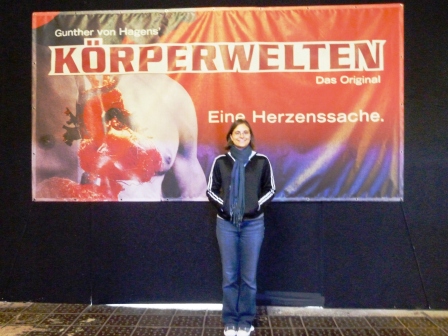
The first weekend after I moved I was facing Saturday evening and Sunday after church home alone and without internet. The family I’m renting from was gone on vacation, and the other subletter’s girlfriend was in town. How was I going to entertain myself? I decided to visit the Körperwelten (Body Worlds) exhibit after the library had closed, but I hadn’t packed dinner. At a local restaurant down the street (Jedermanns, or Everyman), I jumped at the chance to order Berlin-style fried calf liver. I’ve actually been looking for an opportunity to try kidney, too, after a friend of my roommate in Dresden talked them up. The liver looked like a dark-brown Wiener Schnitzel and tasted mostly firm (like meat). I thought it was good. It came with a puree of butter with some potato for consistency, a lot of onions, and two apple rings. The portion was big enough that I was able to bring half home for dinner the next night. Meanwhile, the Körperwelten exhibit showed all manner of body parts, with a particular emphasis on the heart and circulatory system, but the most sensational piece was a plastinated giraffe, clinging halfway up a palm tree, its rib cage opened like a pair of wings. I'll let you in on a little something I learned while taking anatomy in medical school: the dissecting lab turns some people off from food, but some times certain tissues can look like various foodstuffs and some people hungry! I fall into neither group. Maybe because my stomach clock is a law unto itself. :-)