Showing posts with label Kansas City. Show all posts

Sunday, May 19, 2024

National War War I Museum & Memorial, Part II of II

 Part I of my visit to the National World War I Museum & Memorial is here.

After the history of medicine conference ended, I took a quick second trip back to the National World War I Museum and Memorial across the street. I went up the elevator to the viewing tower and saw the special exhibit on children's experiences.


It's a small elevator, built in the space allocated for the original lift in the 1920s, but with more modern mechanics. A volunteer runs the elevator, which only fits 6-8 people. 
Below: looking south from the top of the tower.
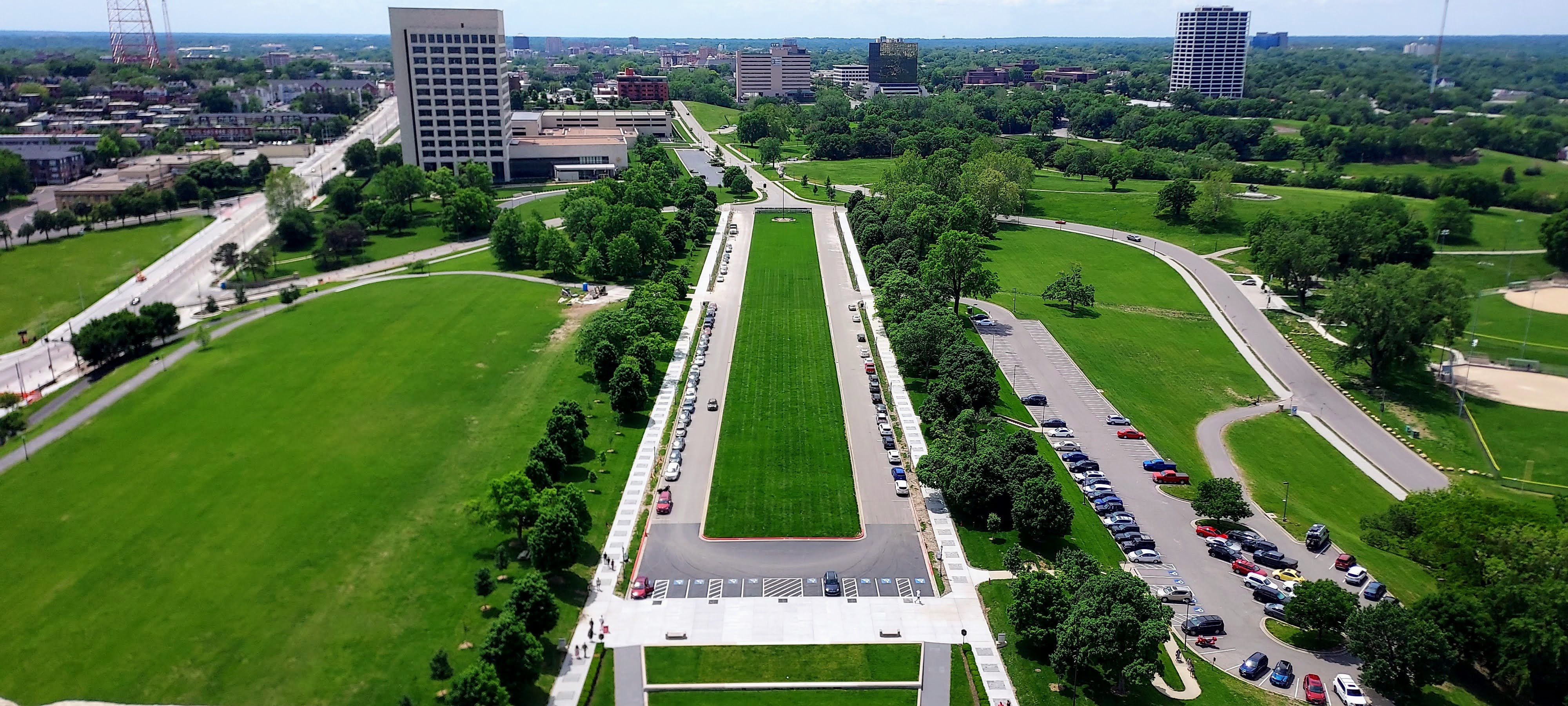

Downtown Kansas City, with Union Station in the foreground and the Crown Westin Hotel in the bottom right.


Close-up of downtown.


Looking at the lawn at the foot of the tower.


One of the more interesting features of the special exhibit hall was the mural entitled the "Pantheon de la Guerre" painted by French artists Pierre Carrier-Belleuse and Auguste Gorguet. I believe the figures represent real and idealized members of the Allies. At 40 feet tall and almost 400 feet long, it was first displayed as a cyclorama in Paris in 1918. It was shown at the Chicago Exposition in 1933 but then forgotten outside a warehouse in Baltimore for more than two decades until restauranteur William Haussner bought it. Some pieces were donated to the Liberty Memorial in Kansas City, while others returned to Baltimore. Although I ate at Haussner's Restaurant once before it closed in 1999, I can't remember if the WWI mural scraps were on display.


Above right: a child's American Red Cross dress-up outfit. Below x2: German embroidery cards with  patriotic designs and messages such as a Zeppellin and "Through conflict to victory."


Below: a Black American family remembers their war hero
(along with George Washington, Abraham Lincoln, and Woodrow Wilson.


There were a number of artefacts from the Boy and Girl Scouts,
such as this leader's trench coat with many patches on the arm.


Above: a child's set of toy soldiers parading through a farming village.
Below left: a German poster. Below right: view of the display hall with the mural on the back wall.


Wednesday, May 15, 2024

National World War I Memorial & Museum in Kansas City, Part I of II


With the annual history of medicine conference happening at the Westin Crown Center Hotel (named for the world Hallmark headquarters next door) and literally across the street from the National World War Memorial and Museum, how could I not go? I found a hole in my panel schedule one morning and navigated through a construction site to reach Penn Valley Park.


On one side was Union Station, one-time railroad gateway to The City of Fountains and The City of Champions.


On the other side of the street, a grassy lawn gently slopes upward toward the memorial that had opened in 1926 as the Liberty Memorial. The museum followed in 2006 and has been expanded since then.


There's a bas relief below the stele that I didn't get very good photographs of.


If there is not yet more construction, apparently you can approach the museum from this direction, but I had to walk the long way around to the south to find the sunken entrance.


Above: The parking lot is behind me from this perspective.
Below: After buying my ticket and dropping my bag and jacket off at Guest Services, I entered the museum via this glass bridge over a field of poppies.


For a small museum, there is a LOT of stuff and information, and I don't think anyone could look at all of it. There are big things like posters and artillery as well as small things like postcards and personal objects. There are large panels with general information about the war as well as smaller panels with specific details. There's a comprehensive timeline in the center of the space as well as many glass cases of clothing, weapons, implements of various kinds, etc.


Hardtack!


There are life-sized dioramas of British, German, and French trenches,
as well as a one toward the back about the trench as "one long grave."


The photo below is part of a quotation about the experience of being shelled.
(Maybe from Ernst Junger? I forget.)


There are three well-done films about the beginning the war, the middle of the war with an emphasis on the American perspective (uniforms below), and the aftermath.


I was interested of course in the medical side, which had a lot of details on the American side, with several cases of women's experiences. I didn't see anything about the influenza epidemic until I got to the gift shop, however.


I buzzed by the gift shop to pick up a book on the history of food and the war that I somehow hadn't already read, as well as a poppy pin and a "food as ammunition" magnet before hurrying back to the conference hotel. Luckily, I was able to come back after the conference ended to see some of the special exhibits. (See Part II.)