Showing posts with label Pacific. Show all posts

Monday, April 15, 2013

The Poetry of the Pacific, Day 5

Editor's note: This blog was pre-written. In fact, we are traveling on Tuesday.

We woke up early this morning for a day of traveling, in order to get DH home in time for his rehearsals tonight. You could say I'm "putting out the light" on our trip and this Poetry of the Pacific series with this poem by San Francisco native Robert Frost (1874-1963). If all you know of Frost is "I took the Road Less Traveled," his verses may sound quaint to your jaded ears, but in fact he was a modern poet who used contemporary English to express a range of often dark emotions. This sonnet captures psychological dread at loneliness and at the destructive capability of nature. Found on Famous Poets & Poems.com.

Once By The Pacific (1928)

The shattered water made a misty din.
Great waves looked over others coming in,
And thought of doing something to the shore
That water never did to land before.
The clouds were low and hairy in the skies,
Like locks blown forward in the gleam of eyes.
You could not tell, and yet it looked as if
The shore was lucky in being backed by cliff,
The cliff in being backed by continent;
It looked as if a night of dark intent
Was coming, and not only a night, an age.
Someone had better be prepared for rage.
There would be more than ocean-water broken
Before God's last Put out the Light was spoken.
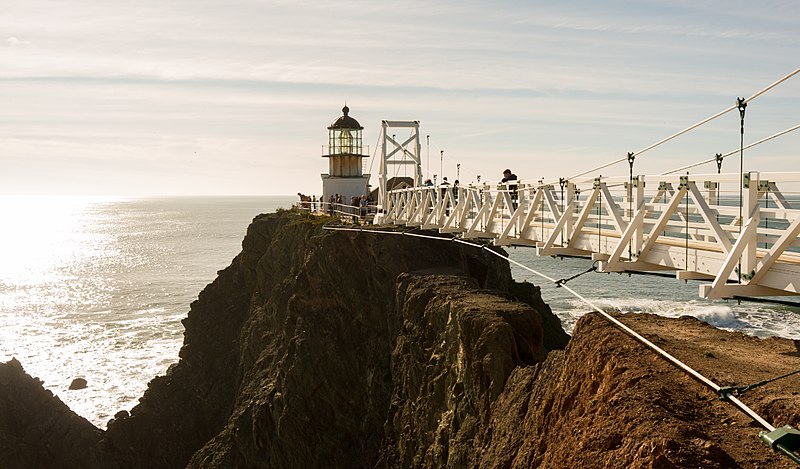
File:Point Bonita Lighthouse, January 2013.jpg
Point Bonita light house; the suspension bridge became necessary after strong
waves eroded the land bridge. Click here to read about this and other lighthouses
around San Francisco. Photo from Wikimedia Commons.

Sunday, April 14, 2013

The Poetry of the Pacific, Day 4

San Francisco is known as much for its neighborhoods and characters as it is for its sights, so I decided to feature one of them: Chinatown. It's supposed to be the oldest one in the Western Hemisphere, having been founded around 1848 for immigrants working on the gold rush and the transcontinental railroads. Due to the determination of its residents, it survived the destruction of the 1906 earthquake and plans to expand the Financial District into the area. Now it stands in the heart of a bustling, gritty urban center. More than just a collection of Chinese restaurants, Chinatown supports Asian-American art, culture, and activism.

paper lanterns chinatown san francisco free photo
Red lanterns in San Francisco's Chinatown, dwsmiley (pixabay.com)
Today's poem was written by San Francisco native, poet, playwright, and performer Genevieve "Genny" Lim (1946- ). It is the title selection from her book, Winter Place (1989). Whereas her more recent pieces have tackled more expansive or universal themes, her older work like "Winter Place looks at the world from my alley window." She is particularly known for Paper Angels, a play about Chinese immigrants incarcerated at Angel Island. Borrowed from Jaime Wright's website.

Winter Place


I live in this foghorn moon of a fishhole alley
Every night there's a derelict dog, mangy with a cataract stare
Lickin' the wounds of old North Beach
Leftovers, fish'n chips, upchucked cheesesteak, antipasti
Blasted against the antiseptic glare of trendy resaurants,
glossy Gelatos
Where MTV couples glide frozenly by
Catching in the corners of their ray-banned eyes
Their store-bought reflections 

It ain't so bad
Sundry hookers straining their fleshbait
out of windows, doorways
Orifices of the Europa glistening like fish
It ain't so bad
The winos and the refugees, bag can ladies and panhandlers
Eye-talians, Chinamen, tourists, punks, junkies
Boat people and runaways
Converging on this teeming waterhole
where the corporate buffalo roamed 

The city reeks of crab shells, fishheads, cabbages
Soiled pampers, cappuchino and Kotex
in shocking orange-and-pink
Day-glo shopping bags ripped and spewing out the
Guts of Chinatown 

They all come
The natives like homing pigeons
Midwesterners like homesteaders
Southerners like shipwrecked sailors
Eastcoasters like fugitives
Through the fog-laden cable cars plummeting
over Russian Hill backyards and
narrow chopstick alleyways
where camera-toting tourists
eat cheap chop-suey and
snap moon-faced babies wide-eyed on their mothers' backs
out of curiosity 

It ain't so bad
the Indians once said
They traded their land for horses 

It ain't so bad
the Coolies reasoned
as they jumped ship only to
Sweat in baskets
with pickaxes and dynamite
Twenty-thousand feet in the Sierras
like wet human laundry

copyright 2001, Genny Lim


p.s.--You should absolutely click here to watch Genny Lim perform a version of this poem.

Saturday, April 13, 2013

Poetry of the Pacific, Day 3

Editor's note: these were pre-written posts, but due to a comedy of errors (not on our part), we did not actually arrive in San Francisco Thursday afternoon. I will post the story at the end of this series. Until then, please enjoy the poetry!
Golden Gate Bridge in fog, from toptravellists.net.


Lonidier Rampant 
            As from a distance, watch yourself
            Disintegrate in foaming seas.
                              -- Weldon Kees

You are too near the bridge
To have such hair
Hair a man would love
To comb his fingers through
Lonidier 

Walking down the old familiar street
Doorways reappear
Shoe Repair New Soles
Smell of polish and leather
Where you sat in a chair
Swinging bobby soxed feet
Lonidier

Salvation waits on the corner of doughnut holes
Six to a bag
And in Mr. Bay's barber chair
Platinum bangs feathered on the floor
Lonidier

The bridge Lonidier and the sea Lonidier
And the dark morning hours
Chew through your brain
Looking for innocence
Lost Lonidier 

And the stab in your heart where the intersection
Of life and death is marked

Cool fingers of fog have been waiting
All these years
Lonidier
Knowing one day you'd be theirs
You are too near the bridge

To have such hair
So you'll cut it off
Leave its stories behind
Or if they stay
Whispering in the roots
You'll feel it pulled by the updraft
Of love you left behind
Wasted
Unbelieved
Lonidier Your hair
Will be the last of you
To hit the sea
The city that saved you again and again
Rising swiftly
To still you
To sleep


The Golden Gate Bridge celebrated its 75th anniversary last year. When it was completed in 1937, it was an architectural marvel in "international orange": 8,891 feet long, 6 lanes and 90 feet wide, 4,000 feet between towers standing almost 820 feet tall from top to bottom buried under the water. At 220 (or 245?) feet above the water, it sadly also presents an opportunity for suicide. Today's poem, courtesy of the literary group Big Bridge, considers the possibility. It was written by California poet Katherine Hastings, known for her   beautiful, haunting, often mythical poems. This poem is dedicated to Lynn Lonidier (1937-1993)--teacher, feminist, poet, cellist, lesbian, activist--who committed suicide by jumping off a cliff in San Francisco.

As a bonus, when researching Hastings I found out she had led a campaign among Californian poets to raise money toward saving some of the state's parks from being shuttered due to budget cuts. The campaign is over, but she still had a copy of the resulting anthology, What Redwoods Know, to send me. That is a far better souvenir than any trinket I could buy in a gift shop.

Friday, April 12, 2013

The Poetry of the Pacific, Day 2

Editor's note: these were pre-written posts, but due to a comedy of errors (not on our part), we did not actually arrive in San Francisco Thursday afternoon. I will post the story at the end of this series. Until then, please enjoy the poetry!

Image of California redwood trees from Picryl (2016, CC0)

This series of posts has an alliterative title, but as I alluded to yesterday, not all of the poems will be about the Pacific Ocean. Today's verse concerns a more terrestrial topic: the redwood forest. These evergreens are some of the tallest and oldest trees we know of. They reach more than 200 feet into the air, with a trunk diameter of 10-15 feet. In the wet and temperate climate of the Pacific coast (from central California up through Oregon), the trees can live for more than 2000 years. Redwoods are of course part of a larger ecosystem, as they support an impressive variety of plants, insects, and animals, from their roots up to their crowns. Unfortunately, between the Gold Rush and the founding of Redwood National Park in 1968, 90% of the forest in California was cut down for timber. (Click here for haunting black and white photographs of big trees, little men, and the horses and oxen involved old logging efforts.)

Dear Husband got a tip from a friend to check out Muir Wood National Monument (est. 1908), the result of early conservation efforts. So yesterday, on our first day in San Francisco, we rented a car and drove north, across the Golden Gate Bridge, to this old-growth forest nature preserve named for the founder of the Sierra Club, John Muir (1838-1914). He is supposed to have said of the gift of having the park named after him, "This is the best tree-lovers monument that could possibly be found in all the forests of the world." To mark the occasion, today's poem is courtesy of the Golden Gate Bridge Highway and Transportation District. Yes, you read that correctly. Chief Engineer Joseph P. Strauss (1870-1938)--a native of Cincinnati and the man who took credit for the building of the Golden Gate Bridge--penned these stanzas a few years before that architectural marvel connected Muir Woods in the north to the city of San Francisco in the south.

DH wants to know when we're visiting the Gulf stream waters?

The Redwoods (1931)

Here, sown by the Creator's hand.
In serried ranks, the Redwoods stand:
No other clime is honored so,
No other lands their glory know.

The greatest of Earth's living forms,
Tall conquerors that laugh at storms;
Their challenge still unanswered rings,
Through fifty centuries of kings.

The nations that with them were young,
Rich empires, with their forts far-flung,
Lie buried now--their splendor gone:
But these proud monarchs still live on.

So shall they live, when ends our days,
When our crude citadels decay;
For brief the years allotted man,
But infinite perennials' span.

This is their temple, vaulted high,
And here, we pause with reverent eye,
With silent tongue and awestruck soul;
For here we sense life's proper goal:

To be like these, straight, true and fine,
to make our world like theirs, a shrine;
Sink down, Oh, traveler, on your knees,
God stands before you in these trees.

Thursday, April 11, 2013

The Poetry of the Pacific, Day 1

This weekend I am giving two papers at a conference in San Francisco--and I managed to convince Dear Husband to take the weekend off to come with me. (SF was our first choice for a honeymoon, but we ditched it when the baseball schedules didn't jive, so it's been on our bucket list since then.) We're going a little early to do some sightseeing, and then DH will explore on his own while I'm attending panels. I'll post some photos later, but for now, I am so excited about seeing/standing in the Pacific Ocean that I found a series of poems about that great body of water (and the sights around it) and will post one per day. Also, April is National Poetry Month, so consider this my contribution to the celebration of verse.

Because we are traveling today, the first installment is "The Discovery of the Pacific," a poem by Anglo-American poet Thom Gunn (1929-2004), who followed his college sweetheart Mike Kitay to San Francisco. He taught writing at Stanford University and University of California-Berkeley and is most well known for his collection of poems entitled The Man with Night Sweats (1992). Although his work was often an autobiographical catalog of his bohemian lifestyle, this poem only partially fits that pattern. It involves a heterosexual couple, but one that finds its true nature as they move westward, toward and finally into the Pacific Ocean. Found on the blog Wandering Minstrels.

The Discovery of the Pacific

They lean against the cooling car, backs pressed
Upon the dusts of a brown continent,
And watch the sun, now Westward of their West,
Fall to the ocean. Where it led they went.

Kansas to California. Day by day
They travelled emptier of the things they knew.
They improvised new habits on the way,
But lost the occasions, and then lost them too.

One night, no-one and nowhere, she had woken
To resin-smell and to the firs' slight sound,
And through their sleeping-bag had felt the broken
Tight-knotted surfaces of the naked ground.

Only his lean quiet body cupping hers
Kept her from it, the extreme chill. By degrees
She fell asleep. Around them in the firs
The wind probed, tiding through forked estuaries.

And now their skin is caked with road, the grime
Merely reflecting sunlight as it fails.
They leave their clothes among the rocks they climb,
Blunt leaves of iceplant nuzzle at their soles.

Now they stand chin-deep in the sway of ocean,
Firm West, two stringy bodies face to face,
And come, together, in the water's motion,
The full caught pause of their embrace.


Jim Kucharek, Sunset at Trinidad State Beach, CA,Flickr (2015)