Wednesday, May 4, 2011

Native American Awareness Post

Dancing Indian
Meissen
(1907-1924)
It is a weekday morning while Dear Husband is visiting over Spring Break. We have had a relaxed breakfast, he is off to practice on a friend’s electronic piano, and I am at the busstop on my way to the archive. I usually walk this stretch (takes 8-10 minutes), but because I’m coming in late today, I decide to take the bus (1-minute ride). Suddenly there is a cheerful woman with a large microphone in front of me:

“HI! I’m So-and-So from Mitteldeutschen Rundfunk [radio]. Once upon a time there were cowboys and Indians. Completely anonymously, if you could choose, would you rather have been a cowboy or an Indian?” And she smiles encouragingly as she points the microphone at me.

I actually don’t understand her question until the very end of her Spiel, which gives me very little time to react. By the usual rules of conversation, it’s my turn to speak. However, my first reaction is to object to the question entirely, since what she’s really asking (historically speaking), is whether I would rather have been a resource-hungry, racist imperialist or a victim of genocide. But I'm not sure I possess the vocabulary to address that subject on the fly. And of course, that’s not what she’s asking. She wants to know what character I would want to play in the American West fiction Germans have consumed voraciously since Karl May’s (1842-1912) immensely popular novels began appearing in the 1890s.

Kary May--a native Saxon--had a rough life. As a young man, he spent eight years in prison for theft and fraud. He had trouble with his publishers that led to the dissolution of his first marriage. And at some point he began to believe he had experienced the exotic adventures he wrote about the American West and the Orient.

After getting out of jail the second time, and since his teaching license had been revoked, May tried to live on the straight and narrow by publishing short stories set in his native Saxony. Then he branched out to the genre of travel writing. Eventually he began writing allegorical narratives of the triumph of Good over Evil set in exotic locations: escapist fiction for Germany's nervous middle classes. Around the turn of the century May did actually travel across much of Asia from Egypt to Indonesia. A little while later he spent six weeks in the upstate New York area. But Germany's most famous portrayer of the American West never set foot anywhere near the Mississippi, much less beyond it. Rather, he discussed the human condition using archetypes like the "noble savage" (Apache Chief Winnetou) and Winnetou's white blood brother, Old Shatterhand. The Karl May Museum in the Dresden suburb of Radebeul is located in "Villa Shatterhand," named for May's alter-ego, who in the tales acts as a cross-cultural bridge from the amoral morass of Western Civilization to what May imagined as the purer society of the Native Americans.

These ideas were popular when May was writing and remained popular because of his writing. "Indian" themes are common in the popular literature I am looking at for my dissertation. For instance, while researching the posh Lahmann's Sanatorium, famous for its dietary cures and located in the wealthy neighborhood on the heights above my first Dresden apartment, I found the following image in a local newspaper in 1910. The sanatorium "guests" had celebrated Fasching (Carnival) "in an especially merry (or humorous) way" by dressing up as "Indians," complete with wigs and face paint. What fun to frolic in the woods! As long as we're back in time for Kaffee und Kuchen (coffee and cake)!
„Karneval im Kurort Weiβer Hirsch,“ Illustrirte Neueste. Wochen-Chronik der Dresdner Neuesten Nachrichten. Nr. 9. (Sonnabend, 26. Februar 1910), S. 8. Courtesy of Dr. Marina Lienert, Institut für die Geschiche der Medizin, TU Dresden.
May  has long been an influential figure in German literature; his books have sold 100 million copies in German and another 100 million copies in almost 40 languages. German author and Nobel Prize winner Hermann Hesse (1877-1962) once said, "He is the most brilliant representative of a truly original type of fiction--i.e. fiction as wish-fulfillment...." And that is precisely the difficulty I have with the radio interviewer's question on this morning. Isn’t it nice for 21st-century white Westerners to imagine themselves as "cowboys" and "Indians," while the reality was and is--at times grimmer, but certainly always more complicated.

So I could challenge the question. Instead, I use the vocabulary I do have to answer something banal along the lines of, "I would have been a cowgirl, because they had so many adventures." And the smiling interviewer moves on the the next busstop. Since then I have checked the MDR website a couple times, but I haven't found out whether my little blurb ended up on the radio or not. I did learn that one of the most popular German songs a year ago was Jörg Bausch's "Cowboy und Indianer," a pop love song: "Come, take out the lasso, we'll play cowboys and Indians! ... If you surround me, I'll give myself up to you."

Better are the lyrics the German pop band Die Prinzen sing in “Mein Bester Freund” (My Best Friend). The rollicking verses list Robin Hood, Sherlock Holmes, and Winnetou as "mein bester Freund." Why? "Because they fight/ against injustice in the world." At the last verse, the upbeat tune slows down as they sing,

"Unfortunately these friends are all dead
and that is very difficult for me.
Unfortunately, these friends are all dead,
they were in my imagination."

The music picks up again with the final chorus: "THERE-FORE, now I fight/ against injustice in the world."

There is nothing wrong with fantasy, unless it substitutes for knowledge about the real world. And in the real world, many Native Americans are marginalized members of American society; they still live with the consequences of decisions made a century ago or more. Not coincidentally, the United Methodist Church recognizes this coming Sunday (May 8) as Native American Ministries Sunday. I invite you to "fight against injustice in the world" with me by a) learning about these ministries and b) contributing (no amount too small!) to their scholarship fund. The link tells the story of one seminary student who has benefited from this fund and can take you to their secure line donation form.

"AND WE'LL fight/ against injustice in world./ Yes we'll always fight/ against injustice in the world!"

Tuesday, May 3, 2011

The River Elbe

Loschwitz as Winter Wonderland
Reorganization of the zodiac notwithstanding, I am a water sign (Cancer), and I loved living near the magnificent body of water that is the River Elbe here in Dresden. The first three months I lived on a central, low-lying Platz on the right/northern bank, but in general the terrain is elevated there, with scattered small vineyards along the higher slopes. I couldn't quite see the river from my bedroom window, but just around the bend in the road stood the famous Blaues Wunder ("Blue Wonder"--first suspension bridge in Europe without pylons in the river). The last four months I lived on the left/southern bank, a few minutes' walk from the Marienbrücke, with the Neustadt across the river. One of my favorite memories from this time will definitely be the sight of the beautiful, reconstructed baroque buildings of the Altstadt, seen from a Strassenbahn while crossing one of Dresden's many bridges over the Elbe.

There are currently seven major bridges. In addition to the Blaues Wunder and the Marienbrücke there are the Albertbrücke, the Carolabrücke, the Augustusbrücke, the Flügelwegbrücke, and the Autobahnbrücke. The controversial new bridge is the Waldschlößchenbrücke. The Dresden Elbe Valley had been listed as a World Heritage Site, but when Dresdners voted in a 2005 referendum to build another bridge to relieve traffic congestion, the valley was listed as "Endangered." The city backed away from the plans, but a court ordered that the referendum had to stand, and in 2009 the Dresden Elbe Valley was de-listed as a World Heritage site (only the second time that has ever happened). Many people are upset because the bridge will be modern-looking and quite long (probably one reason why a bridge wasn't built across that stretch of river before). But I can attest that it is necessary, because at the moment there is really only one Strassenbahn line that serves that stretch of city, and when it's late or not running, you don't have many options.


I decided to take a picture of the Elbe at the beginning of each month, as a memento of my time in Dresden. Below is a chain of images of the river, the first three looking toward my first apartment (Oct., Nov., end of Dec.) from the far side of the Blaues Wunder. In the first photo, you can see there was Hochwasser (flooding) when I arrived. I waited to take the November photo until after I had run my errands, and by the time I was ready to walk back across the river, the beautiful morning had clouded over. The early December photo is at the start of this post; we had snow on the ground continuously from the week of Thanksgiving into January. The third photo below I took on moving day the last week of the year.


The new views are from the near side of the Marienbrücke at the beginning of January (still snow). While I was gone on the East Coast in mid-January, the snow finally melted, as the February photo shows. The March image is unfortunately over-exposed, but the April one hints at the nice blue skies we sometimes had. The bottom image shows my last day, cloudy in Dresden at the end of April.

Of course, the Elbe isn't always beautiful. In 2002 there was terrible flooding. The stereotypical German Stube (hunting-themed pub) down the street from my second apartment had a mark at least waist-high on the wall, showing how high the water was then--and that wasn't exactly close to the river. Here's an image from the river-side amphitheater at Schloss Pillnitz with markings of historical floods; the 2002 deluge is the one off to the right, as high the epic flood of March 31, 1845.


I am in Leipzig now, which has a river (the Weisse Elster), but is somehow not as defined by it as Dresden, "the Florence of the Elbe," perhaps because as the river runs through the city, it is surrounded by parkland (a flood zone?). As it turns out, Leipzig has lots of parks and Schrebergärten (those little garden colonies), so even without direct access to the Weisse Elster, the big-city architecture is broken up by green space. I am finding Leipzig a prettier city than I had originally thought.


Editor's note: This, my farewell post for Dresden, was slightly delayed by the difficulty of having laptop, camera, cable, and internet all in one place at the same time.

Monday, April 25, 2011

Fastenzeit und Ostern

A few Sundays ago, while fixing breakfast, the people in my radio discussed the Third Sunday of Lent, called "Oculi" for its associated verse, "My eyes are ever on the Lord" (Psalm 25:15). That the Sundays in Lent have names was new to me; it must be a Catholic thing, I thought, as I am fairly familiar with the somewhat less common Protestant observance of Lent. So I was doubly surprised to hear the pastor at the church I attend here in Dresden read the same verse before the service a few hours later. Our little “store-back"* congregation isn't liturgical, which means that it does not follow any of the agreed-upon calendars for Scripture readings on a given Sunday of the year. Rather, whoever is speaking that day chooses a text or texts on which to preach. They celebrate Advent but not Lent—and I've really enjoyed singing "hallelujahs" without regard to it being the Fastenzeit (Time of Fasting, a.k.a. Lent). At any rate, here are my experiences (and a little research on) Lent and Easter in Germany.

Fasching is German Carnival (Karneval in some parts): the children (mostly) dress up and attend parties. It struck me as the original teutonic equivalent of Halloween, an increasingly popular American import here. My Bible Study decided not to celebrate Fasching; I had Eierkuchen (like a crepe) for dinner. I didn’t hear anything about Ash Wednesday (Ashermittwoch) services, which is unfortunate, as it's one of my favorite observances of the year. It's not very common, at least in circles I inhabit, but I learned on radio that fasting of various kinds is practiced: maybe a total fast on Ash Wednesday and Good Friday; or else a modified fast for a week; and sometimes just for certain things (like chocolate, or television). I also discovered that green is associated here at least as much with "envy" as with "hope"--what we call Maundy Thursday is "Grünfreitag" here. And on Karfreitag (Good Friday), I almost attended a service at our “mother church,” Oase, ... but I read the map wrong and got lost, despite asking for directions. It probably would have been a contemporary service of praise songs and prayer, much like our Sunday worship services.


Nothing much in particular distinguished Palm Sunday or Easter Sunday from any other day, except for the gist of the sermons. Easter was bittersweet for me, as it was also my last Sunday with the church I have been attending for the last 7 months. I don't know that we got to know each other particularly well, but they were familiar, friendly faces, and we were happy to see each other every week. I'm very glad to have been a part of Gott@Prohlis and hope that this little church plant continues to grow in that often neglected suburb. (The website is in German and under construction; eventually there may even be pictures of me.)

For most Germans, Easter is about the candy and chocolate rabbits that began appearing in the grocery stores a few weeks before Ash Wednesday. Even if they aren't religious, many people still dye Easter eggs, especially using the wax batik technique common in Central/Eastern Europe. (In the photo you can see the green egg ornament a member of my Bible Study gifted to me.) Probably my favorite custom is the decoration of bushes and trees with colored eggs. I've seen this in the US, but it was more common here and made the city colorful and festive. The most obvious manifestation of the Easter holiday(s) is that Good Friday and Easter Monday are both public holidays, so everything closes except the museums and the lone 365-day-a-year grocery store in town, at the Neustadt Bahnhof. Spring Break for the schools is happening this week, too, so many people use the time to travel, visit friends, etc. Soon I'll put up another post about my Holy Saturday visit to a famous Saxon castle, Schloss Moritzburg. For now I will wish you, Frohe Ostern!

* * * * *
For the curious (and otherwise unknowledgable), here are the named Sundays of Lent:
Invocavit (Invocation) – "Call upon me, and I will answer you." (Psalm 91:15)
Reminiscere (Remembrance) – "Remember, O LORD, your great mercy and love!" (Psalm 25:6)
Oculi (Seeing) – "My eyes are ever on the Lord." (Psalm 25:15)
Laetare (Joy) – "Rejoice with Jerusalem!" (Isaiah 66:10)
Judica (Justice) – "Vindicate me, O God." (Psalm 43:1)
Palmarum (Palm Sunday) – Jesus triumphant entry into Jerusalem (John 12:12–19)

In German you can remember the Sundays with the mnemonic: Irechter Ordnung lerne Jesu Passion,“ which translates as “Learn Jesus’ passion [story] in the right order."

Wikipedia tells me that Invocation Sunday is associated in Protestant tradition with Martin Luther’s eight famous “Invocation Sermons” given in Wittenberg in 1522, which immediately became classic formulations of his radical (but not too radical) new theology. Also, apparently current Catholic practice associates Psalm 27: 8 with Remembrance Sunday, “My heart says, search for God's face!,” which is also a good verse.

* * * * *


*--Presumably you've heard of "store-front" churches. Well, there's a bank in the front of our building, and we have two rooms in the rear. Ergo, "store-back" church.

Sunday, April 17, 2011

Was ist schön?


What is beautiful?

I’ve been waiting for some time to share photos of our new apartment until my roommate could fix the place up a bit—to make it schöner. We live in an old factory warehouse (left) that has been divided into apartments. Many of the tenants do their own renovations. For instance, with the help of some friends, my roommate knocked down a wall and a half to open up the space, hung the lights, painted, and put down carpet. She’s done a number on what used to be the questionable WC down the hall. (On the walls you can't see is art associated with her daughter.) Unfortunately, I think I will move out before she gets to the kitchen; she’s planning on putting up a backsplash of various pottary and glass shards that should look really awesome when it’s done.

ààà
Below-left is the kitchen/ bathroom/ playroom, with the (in)famous bathtub in the middle.* My roommate sleeps and works on the other side of the half wall. On the right is my room, which is quite large and has a door (with only one handle...long story). You can see that a lot of light comes in through the big windows. Our rooms look over the back "yard" (parking and a picnic table but no grass) and the recycling/composting bins behind the Umwelt Zentrum (Environment Center). I can also see the the auditorium of the music high school, which looks kind of like a large folded white napkin; if there's a performance, the neon lights in the "folds" glow pink, blue, purple, and green (bottom).


One of the things I noticed when I first moved in with my roommate is that the apartment is full of things found or otherwise collected: natural things such as rocks, shells, and minerals; also pieces she's picked up at local Flohmarkt (flea market), like two marionettes from India. Some of her paintings hang my room. It occurred to me that when one is surrounded by beautiful things, then it is easier to have beautiful thoughts, as it were.

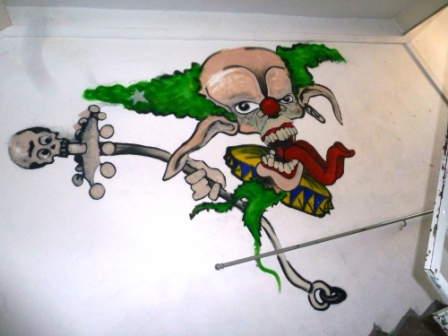
Not everything about this apartment is supposed to be “beautiful,” however. There’s an edgier, in-your-face aesthetic about the art in the stairway, for instance. Only one of the paintings is actually lewd; and after almost four months, even the grimacing clown is no longer shocking (perhaps to the dismay of its artist?).


In fact, not just the building but the neighborhood is full of characters. The "clay" figure on the left stands on top of a hotel building. The soldier on the right was spraypainted on the crumbling entranceway to the Herzogin Garten, destroyed during the 1945 bombing and since then an overgrown lot with various unfulfilled development plans. 

There is also classical beauty to be found. On the left is the old Yenidzi cigarette factory, built in 1907-1909 to look like a mosque--an architectural advertisement for the Ottoman tobacco they imported from Yenidzi (now Genisea, Greece). After standing empty for many years, it was renovated in 1996 into a commercial office building. Under the dome there is a restaurant ("Dresden's highest Biergarten") and space used for a children's storytime. On the right is the Dresdner Volkshaus, a non-commercial office building with a spa and fancy Asian restaurant on the first floor. Just to the right of this frame is a construction site, where they are enlarging the building by one-third with apartments. Unlike the genteel, settled area we moved from, this is an up-and-coming neighborhood. I can understand why my roommate wants to be a part of that; I've often said that my other other dream career would be investment real estate: purchasing/selling abandoned or under-used buildings to revivify urban spaces.


The original impetus of this post was the reminder at the “Was ist schön?” exhibition at the German Hygiene Museum that not all art is made to be beautiful. The collages, dioramas, performance art, and short films my roommate makes, for instance, are sometimes beautiful but mostly challenging. They force the viewer to ask questions: what kind of relationship do those people have? what is going on here? what does that symbol mean? I’ll leave you with a bit of 2D body art of my own:


*--There are two reasons the bathtub is in the middle of the "kitchen." First, this means the water pipes don't have to go far to join those from the kitchen sink. Second, we can lay in the bathtub and watch a movie projected on the far wall. Can you say that about your bathtub? There are a couple of screen we can pull down from the ceiling if we want privacy.

Thursday, April 14, 2011

Meissen's many treasures

My folks got here last Monday night, and they greatly enjoyed traipsing about Dresden while I was at the archives. They saw the Altstadt, Innere Neustadt, Hygiene Museum, and Schloss Pillnitz (the summer palace August der Stärke [the Strong] gifted to one of his mistresses). One evening we even saw the feierliche Eröffnung ("festive opening") of an art exhibit that my roommate is a part of at the Rathaus. A small band played while a tapdancer executed some impressive improvisation. Also there were some speeches. Below you can see my roommate and me in front of some of the collages she made for this show. To the left is a shot from a performance piece she did with the man playing the recorder. She rigged up a plexiglass trough on two overhead projectors, and then ran a constant stream of water across them while interposing various objects (like a chain) and images (like the eyes you can see on the ceiling). She does a lot of multimedia work in 2D, 3D, and film.

MAP (My Awesome Parents) and I spent last Friday in Meissen, which is a perfect daytrip from Dresden. Although the weather was a bit gray and chill, the porcelain factory was really really interesting, the church had a surprising amount of art, and Schloss Albrechtburg with its gorgeous murals and vaulted ceilings really missed its calling as a royal residence. (It was abandoned by the family and spent most of its history as the center of the porcelain manufacture.) It was a day of many beautiful things and of empty wallets, as we both decided to splurge on a little hand-painted porcelain: I bought two dessert plates at the outlet, and they got two soup bowls at an antique shop. See if you can find either of the two bobblehead figures in my photo album on flickr! Other fun finds include a porcelain organ; figurines of four of the senses (which is missing?); a baptismal font with faces carved on its "knees;" Duke Albrecht's "manly deed" and also getting his beard shaved; and an alchemy set.

Saturday MAP and I ran errands in the morning and then attempted to go swimming at a city Schwimmhalle. Unfortunately, they were having a meet that day instead of free swim. But after that we went to das Historische Grüne Gewolbe (the historical green vault), which is a series of rooms (re)decorated to look like they did in the early 18th century, when August der Stärke displayed his treasures of amber, ivory, bronze, rock crystal, precious stones, silver, and gold. Many of the rooms have mirrors, and the effect is quite dazzling. Then it was off to the Vespers service at the Kreuzkirche, where we heard the famous Knabenchor (boys choir). We finished the evening with dinner at the Sophienkeller, a kitschy medieval-themed cellar restaurant with suits of armor in the hallways and a wandering lute player who serenades the guests. Our table was a reproduction [?!] torture device on which the prisoner was locked in metal stocks and a cylinder with spikes could be rotated under the small of his back.


MAP came to church with me Sunday morning, and then I kissed them and sent them off on the train for a few days in Leipzig and a few days in Berlin. It was a lot of fun to see them, and to shirk my work to play tourist for two days. There's so much to see and do in Dresden that a week isn't even enough time. Others things on the list of possibilities were VW's Gläserne Manufaktur (glass auto factory); the Erick Kästner Museum; Gedenkstätte Bautznerstrasse (an old Stasi prison); the technology museum; and the traffic museum (I thought my dad would like their temporary exhibit of DDR motorcycles). My impression is that Leipzig has less overtly touristy attractions but a more vibrant contemporary art scene. I'll let you know soon, as moving day is only two weeks away!

Sunday, April 3, 2011

Sachsens Glanz


Wow, it’s hard to believe that it’s been more than a month since the last time I posted! I have been working overtime in order to get everything done here in Dresden before I leave for Leipzig at the end of April, especially since I wanted to make time for visits from Dear Husband (DH) and My Awesome Parents (MAP*). DH was just here for about 10 days, and we really enjoyed the time together going out to eat, watching American movies, and catching up with each other. There was also the requisite amount of exercise, sponsored by the local mass transit authority, in the form of sprinting for various trams and buses. We even got to watch the Super Moon rise while we ate dinner overlooking the Elbe River (above)!

“Sachsens Glanz, Preussens Gloria” is the name of a popular East German made-for-tv-movie shown in 1985 & 1987 that made familiar the bedroom pursuits of Augustus II (the Strong), Elector of Saxony and King of Poland; the court intrigues around his weaker son Augustus III; and Saxony's disastrous involvement in the Seven Years' War (1756-1763). The six parts are roughly based on Polish author Józef Ignacy Kraszewski's (1812-1887) "Saxon Trilogy" novels (Countess Cosel [1873]Brühl [1874], and From the Seven Years' War [1875]) and were largely filmed "on-location" at places like Schloss (Castle) Moritzburg (below). The film was a form of escapism into a “safe” period of German history (1697-1763) and is being released on DVD for those with nostaglia for the good old old days. I took the photograph at left at a tram stop.


The title captures in a pithy phrase the historical stereotypes of Saxony’s conservativism and preoccupation with art and high culture over against Prussia’s military aggressiveness. Augustus III was busy trying to keep up with his conniving ministers when, in 1756, Frederick II (the Great), Elector of Brandenburg and King of Prussia, preemptively invaded, thus sparking the Seven Years' War. (Saxony was diplomatically part of the French-Austrian axis that opposed the Anglo-Prussian axis.) Then, to salt the wound, Frederick forcibly drafted Saxony's army into his own! So, the film series does not have a happy ending, but it does idolize the period responsible for must of Saxony's (and especially Dresden's) great art and architecture.

Schloss Moritzburg
That's not all to the history of "Saxony's Glitz, Prussia's Glory." In 1806, Napoleon abolished the Holy Roman Empire. Elector Frederick Augustus III became King Frederick Augustus I and made the then-reasonable decision to side with the French emperor.** Unfortunately, history and the Russian winter were against him, and when in 1813 Napoleon received his comeuppance, Frederick Augustus I was also captured and dispossessed. Frederick Wilhelm III of Prussia thought, oh, ALL of Saxony would make a nice addition to his kingdom, but because the other attendees at the Conference of Vienna in 1815 feared such a strong Prussia, they pressured him to accept only HALF. This became the Prussian Province of Saxony, now part of Saxon-Anhalt and not to be confused with the Free State of Saxony, which is where my project takes place.

Saxony is still fairly conservative as a state, both politically and artistically. My roommate (an artist) complains that the capital city of Dresden just wants to rest on its laurels and promote the old art and cultural institutions, whereas more industrial Leipzig—since the 1100s a fair city, a publishing center since the 1400s, and a hot spot of the 1989 revolution—is both politically and artistically more forward thinking. DH and I will explore Saxony’s second city in May, so here are some of our high culture experiences in Dresden.


Last month I decided I wanted to attend a ballet performance at the famous Semperoper (known for its architect, Georg Semper). I invited some friends, but they were not able to get us good tickets at a good price in time, so on my way home from the archive one evening, I stopped by the ticket office on a whim, to see if they had anything under 50 Euros. The ticket lady said if I was willing to pay fifty cents more, I could have a front-row seat! It was a chance too good to pass up, so I paid up and thoroughly enjoyed the Dresden Ballet’s premiere of their reconstruction of George Balanchine’s Coppelia, the romantic comedy based on E.T.A.Hoffmann’s decidedly darker short story. The music was expressively conducted and beautiful, the costumes and sets—inspired by Meissen porcelain designs—were whimsical, and the dancing was very good. The inside of the Semperoper is really stunning (right), so I was disappointed when my roommate told me it isn’t really marble in the lobbies.

The organist sits in a loft above the altar.
When DH came for a visit over spring break, we heard two concerts. The first was an organ recital in the famous Frauenkirche, which hosts a cycle of 12 organ concerts with the Hofkirche (a.k.a. the Catholic Kathedrale) and the Kreuzkirche. ¼ of those are played by the Dom (cathedral) organist in Cologne, apparently one of THE top organist positions in the country. Indeed, Herr Winfried Bönig was at the manuals that night. DH pointed out that the only original organ music Bönig played was a piece he himself wants to master this year, Bach’s Fantasia and Fugue in G major. Transcriptions of works originally written for other instruments made up the rest of the program. Ironically, the only piece in which my untrained ears could hear mistakes was Bönig’s own transcription of Bach’s “Sheep May Safely Graze”! I found the version of Franz Liszt’s (1811-1886) "Funérailles" (Funeral March) rather peculiar, as it swings between somber honor and total melodrama—typical of Liszt, says DH. The reconstructed Frauenkirche is rather like an architectural Listz piece, then, as on the surface it is over-the-top, but on closer inspection one realizes most of the sanctuary is plaster painted to look like marble. The photo shows the high-baroque altar area.


The second concert, which we attended with a new friend in Dresden, was the Dresden Philharmonie’s Bratchissimo, which is a play on the Italian/German word for viola. I found Richard Wagner's (1813-1883) »Vorspiel und Liebestod« from his opera Tristan und Isolde to be very beautiful; he was a master of musical tension. Then we heard Sofia Gubaidulina's (1931- ) double-viola concerto »Zwei Wege« (Two Ways), which premiered in New York City in 1999. It's supposed to be a meditation on the two ways in which Mary and Martha loved Jesus, with a complicated set of seven variations. But even DH didn't hear that, and all I heard was discord. But the encore the soloists played was beautiful in a classical way. Arnold Schoenberg's (1874-1951) »Pelléas und Melisande«, a symphonic poem for orchestra (Opus. 5), almost put me to sleep--but maybe I just wasn't in the right mood for it. Altogether, a glamorous evening, as you can see!


*--I was going to refer to them as the Parental Units, but they deserve a more flattering acronym!
**--In the meantime, Poland got to be a state for 30 years but then was divided up between Austria, Prussia, and Russia. When Napoleon came along he gave parts of Poland (as the Duchy of Warsaw) back to Saxony, which was able to defend them against Austrian encroachment. In 1815, Russia got most of Poland, including parts that had belonged to Prussia, and Prussia got the northern half of Saxony as a consolation prize. Although Saxony had suffered the really bad geopolitical luck of being a central area of conflict (Battle of Leipzig, anyone?) and having to support 1 million foreign troops (native pop.: 2 million), it was in the process of successfully industrializing. So (half of) it wasn't such a poor acquisition. As usual, though, Poland got the short end of the stick.

Friday, February 25, 2011

19. February

This past weekend, Dresden was again thrown into turmoil. Whereas last weekend a large peaceful demonstration and a small, unwelcomed Funeral march by far-right extremists merely caused some traffic delays, on the first Saturday after the anniversary of the bombing of Dresden, the center of the city came to a standstill.

While I was correct in my previous post that the NSDAP (Nazi Party) is illegal in Germany, there has been since the 1960s a National Demokratische Partei (NDP), which is widely seen as a Neo-Nazi political group, since its party materials use anti-Semitic and xenophobic language, claim Germany is larger than its current political borders, etc. It is also well-known that the NPD has a three-pronged approach to increasing its influence in the public sphere: winning over the governments, the streets, and Köpfe (“heads,” or minds). Center and left Germans have complained that the group often hides its identity when sharing information about such seemingly neutral topics as employment, and that this has allowed its representatives to win elected office on several levels of government, including the Saxon State parliament since several years ago. Critics blame this government influence for the fact that far-right groups are allowed to demonstrate in Dresden.

For a while it was in fact an open question whether the Saturday-after-February-13th rallies would happen at all, considering the large number of police required to keep some semblence of peace (nevermind the question of politics). Three groups applied for permits for different parts of the city, presumably in order to increase their presence. Dresden countered with a single large permit, the Neo-Nazis sued the city for hindering their constitutional right to assemble, and they won—including one procession permit. Meanwhile, various center and left groups were organizing with the express intent to stop the march. However, the state declared that any such attempts were illegal, confiscated advertising materials, and tried to shut down a least one website. This opened a, well, fire-storm of protest: is it permissible to suppress one group’s right to express itself, if the statement it wants to make is to prevent another group from exercising its freedom to make anti-democratic statements?

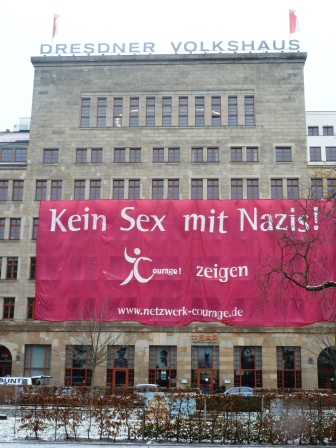
While I readily participated in the Menschenkette last Sunday, I hesitated to dedicate myself to civil disobedience in a foreign country. Plus, it was my off week for laundry, so as soon as I got the grocery shopping done, I was looking forward to a productive Saturday in the library before coming home to watch a movie with my roommate and some of her friends. Well, I should have known better. I had come home Friday night to see this sign hanging on the building across the Platz from us, and Saturday morning already there were signs of organizing. There was a heavy police presence when I walked to the grocery store, and by the time I got back, I had to ask permission to cross the police barricade before walking through a small but growing crowd of counter-protestors. The street where the trams run was blocked off in both directions, but I still made one futile attempt to get to the library. The public transit person at the main tram stop for my part of the city told me that not only were there no buses or trams running through there, but the university quarter was expected to be a major demonstration site.

Instead, my roommate and I stayed home, she painting furniture and I editing a manuscript. We listened to a local leftist radio station, which periodically interrupted its alternative music program with near-real-time reporting of the situation from participants calling in on their cell phones or using Twitter. From what I understood, the police had set up water canons, counter-protestors were occupying various intersections, and many of the expected, black-clothed demonstrators spent most of the day on their buses, not wanting to be inspected by the police. Nevertheless, there was violence, mostly by far-left extremists using the apparent provocations of the police—there to protect both sets of demonstrators from each other—to “stick it to the man.” I don’t if this was before or after the police stormed the offices of a left liberal group accused of organizing violence; the people who were arrested there got out of jail Monday morning. It strikes me that in the United States, the far-left is so small in numbers that it is not feared, but here it is a force to be reckoned with. More than 80 police were wounded. At the end of the day, there was no march in Dresden, and an attempted impromptu rally by Neo-Nazis who took the train from Dresden to Leipzig was prevented.

Obviously, I am glad I stayed home on Saturday. Sunday I head a German-Jewish community leader from München talk about life as a Jew in Germany as part of the well-respected Dresden Speaker Series. She briefly mentioned her doubts about not immigrating immediately after World War II—she survived forced labor—but went on to talk much more about the kind of politics that makes her feel like Germany really is home: namely, an open democracy in which violence of any kind of abhorred. Only since the reunification has she really been convinced that staying was the right choice. Today, German Jewry is the fastest growing diaspora population; they are finally training their own rabbis again; and still many synagoges and community centers have to make do with itinerant rabbis. She absolutely believes in the right of the state of Israel to exist, but as a German she exercises a certain amount of scrutiny, too. And she reminded the audience that if there is a “war” with Islam, it is really a war between pre- and post-modern Islam. Just as she, as an individual Jew, should not be held responsible for the actions of the Israeli state, so should peaceful Muslims not be held responsible for the violence of mis-guided Islamacist extremists. Unfortunately, since the reunification, far-right extremists in Germany have increasingly put aside their xenophobia just enough to team up with the anti-semitism of local Islamacists of Arabic origin. So the acceptance of Jews in Germany is still not assured, although now as before the Holocaust, their numbers have never amounted to more than 1% of the population.

I’ll close with an encouraging ad that has been playing on the street cars for the last week or so: a skinhead joins a group of people seeking shelter from a downpour under an overhang. He pushes the young black man next to him out into the rain to make more room. As the young man resigns himself to getting soaked, he looks up, only to see the umbrella a little old lady is holding over his head. Then all the other people from the overhang come out and put their umbrellas over and around him, too. They make sure he gets on the bus first, but the doors close just as the skinhead tries to get on too. This PSA is probably more wish than reality, but at least it’s an open step in the right direction.


[Editor's note: how did I get the name of this post wrong?? The events described happened in February, not September!]