Tuesday, June 18, 2013

"Chef Salad"

Upon my return from Germany, Dear Husband had an excellent idea for dinner: "chef salad." He had planned the week's menus so that I wouldn't have to cook while I was getting over the jetlag, and because our local farmers market offers so much wonderful produce--and then a friend had a bumper crop of garden lettuce--I have continued to include it in our rotation of meals for the summer. Now, the typical chef salad contains hard-boiled egg, meats like ham, cheeses like cheddar, and some veggies. In our household the term "chef salad" encompasses any entree salad, preferably although not always containing at least two of the classic ingredients. The really nice thing about our "chef salad" recipe is that the concept is so flexible: greens + toppings + protein + grain. The kinds we make tend to involve quite a bit of prep, so we usually fix these together. Here is a representative sampling:


lettuce, tomato, green pepper, carrot, radish, cheddar cheese, half a hard-boiled egg each, and a piece of French baguette


You can see my favorite mustard: 3 Monkeys sweet and spicy, which we discovered on our anniversary trip to Madison, WI, last summer.


This salad comes with a salad!


Greek salad: tomato, cucumber, feta cheese, olive oil, and dried oregano and basil


Entree salad: mixed greens, chunked ham, club crackers


(Sorry the photo is so blurry--I must have been in a hurry to eat!)


Next we have two variations of the same salad, because DH wanted to keep his tuna fish separate:

lettuce, tomato, carrots, cucumber, cheese, raspberries, pine nuts, whole-wheat roll, tuna fish drained and mixed with mayo and (in my instance) topped with sweet relish, because there is no other way to enjoy tuna fish


The cat was happy because he got to lick the extra tuna fish from my finger twice!


I generally don't use salad dressing, but I thought the French dressing on DH's salad made for a lovely combination of reds and oranges.

Instead of mustard, he ate his roll with raspberry jam (not pictured).


With chef salad, everybody can have his or her favorite condiments. Other popular toppings include grapes, blueberries, walnuts, strawberries, almonds, and sweet or dill pickles.

What do you like to put on your "chef salad"?

Tuesday, June 11, 2013

Wenn in Bayern...

...eat like the Bavarians do. At least, that is what the menu at the Hofbräuhaus in Munich promises tourists from in- and outside the country. I visited once with my family back in 2000 but don't remember anything except my parents drinking beer. I got another chance to appreciate this "cultural landmark" after the graduate-student German history conference I attended at the end of May/beginning of June. While an oom-pa-pa band led drinking songs downstairs, our group had two tables reserved upstairs, where it was quiet enough to hold (bi-lingual) conversations with one another.

Although we had a special, limited menu, I found myself overwhelmed by the choices. It all looked so good! Knowing the size of the entrees was likely to be bigger than anything I could eat on my own (and travel made leftovers impractical), I eventually opted to have two appetizers and share a dessert. A nice glass of white wine rounded out this three-course meal. (Ich trinke kein Bier.)

Rinderkraftbrühe mit großem hausgemachtem Leberknödel


First up, soup. I chose the "beef broth with large house-made liver dumpling." I wish I had thought to take a "before" picture, because the dumpling really was the largest ball of meat I have even seen. It was savory, delicious, and soon all gone.


Next was a cheese course of something I had never heard of before: Obatzda. This typical Central European biergarten food is a mixture of soft cheese, butter, and spices like paprika and cumin. Served with two slices of bread, onions, and a garnish of lettuce, it was almost too rich for me to eat by myself. Here I am, cheesing it up for the camera.


It's hard to go wrong with powdered sugar.


Despite the copious amounts of food and alcohol being consumed around the table, one of the conference organizers thought we would be able to polish off an order of Kaiserschmarrn, a sort of chopped up pancake served with powdered sugar and applesauce. Despite the promise of an "authentic" Bavarian experience, however, this dish originated next door, with Kaiser Franz Josef (1830–1916) of Austria!

Tuesday, June 4, 2013

Hochwasser in Dresden

In August 2002 I was finishing two months of language summer school at the Goethe Institut in Göttingen in the center of Germany. I hadn't expected the summer to be so cool and wet and ended up wearing the same pair of blue jeans and a gray flannel sweatshirt borrowed from a classmate pretty much the whole time we were there. I can still smell the rain-soaked mornings that came through the open, unscreened windows of the room I shared with a girl from Korea.

At the time, the Germans all said this was unusual weather, but when I was back in 2006 for pre-dissertation research and again in 2007 for the German Historical Institute's archive seminar and found similar weather, I wondered whether the Germans were familiar with their own summers? At any rate, those trips confirmed me in the belief that there is no time of year during which one should travel to Germany without an umbrella (ein Regenshirm).

Looking upstream from Carolabrücke, c. 4pm Tuesday
Anyway, in Göttingen we would read the newspapers in the mornings together, and I remember seeing pictures of devastating flooding in Dresden (among other places). Wikipedia tells me that "the Elbe River reached an all-time high of 9.4 meters (30.8 feet)" during this "Millenium Flood." 30,000 people were evacuated, and there was substantial damage done to residences, businesses, and landmarks like the Semperoper theater (click both words for previous blog posts).

Supposedly it was the kind of flooding that only happens every century or so, but some of my acquaintances in Dresden think climate change means more frequent flooding. They are now worrying whether two weeks of rain will mean a situation "as bad as ten years ago" [sic], when it rained and rained, and then after the rain stopped, the water came down from the headlands, leaving destruction and "all manner of junk" in its wake.

Thus far the famous Blaues Wunder bridge has been closed since Monday for fear that at 120 years old it could not handle both high water and modern traffic. That has meant serious transportation difficulties, as the ferry upstream has of course been stopped, the nearest bridge is under construction (causing delays and detours itself), and the next bridge (die Albertbruücke) well into town.

None of the more modern bridges have been closed yet, but everyone is carefully watching the official reports online. I bought some flowers for the family that hosted me for dinner tonight, and the shopkeeper said to me, "Es ist was los in Dresden." (There's something going on/happening in Dresden.) I agreed: all day sirens sounded as the fire department and army sped around town laying sandbags and erecting barriers to flooded low-lying areas. Even the Main State Archive had sandbags out front!

In fact, they've closed the archive for the rest of the week. Wednesday was supposed to be my last day, but to my complete surprise, I managed to finish what I needed to do on Tuesday. In fact, I got out a few hours "early" (i.e. before closing), so I wandered over the Carolabrücke to take photographs. Lots of locals had come out to look at the water, too.

They were still out on the bridges when I crossed the Albertbrücke at 6:15 pm on my way to dinner, and then again at 10:15 pm on my way home after Hauskreis (Bible study). There I found the scene less serene than at the other bridge earlier in the day. In the shallows, the water merely reached out wherever it could, but in the deep center of the river, the water gushed angrily around the supports of the bridge, making eddies and even some white caps. I found the noise and the sight of the speed of all that brown water angstproduzierend (alarming, fear-producing). It didn't help that the wooden foot-traffic bridge shook gently when a bicycle or jogger went by.

If you're curious what the situation looks like right now, click this link and then pick any one of the camera icons for "aktuelle" (current) images. This map is collecting data about problem areas where help is needed. These are probably better pictures than mine. Here is a graph of water levels (at 8.05 m = 26.4 ft as of this writing). This blog post shows what the Elbe River usually looks like. Editor's note: the river crested at about 8.8 m midday onThursday.

I should add that Dresden isn't the only city threatened by flooding; rivers around Germany are higher than normal. And of course, once the water passes us, it still has to pass Magdeburg and eventually Hamburg before exiting into the North Sea. Here you can see that the flooding was much worse in other parts of Germany, and in Austria and the Czech Republic.

In the right foreground stands a blue sign advertising where to pay to park. It is taller than I am.

Wednesday, May 22, 2013

How We Got There

Editor's Note: I was inspired to finally get around to composing this last scheduled post from our San Francisco trip by this online article, which has Shown Clover's composite then-and-now photos of the damage caused by the 1906 San Francisco Earthquake. They're pretty neat. After reading this post, go check them out!


Left: Dear Husband was excited to ride on the BART, since he remembered reading about how terrific the Bay Area Rapid Transit was in one of his elementary-school textbooks. BART is celebrating 40 years. When it endangers its unionized workers, however, it is not so great.


San Francisco is a public-transit dream or nightmare, depending on your tolerance for multiple tickets, lines, maps, time tables, etc. My dread began while I started researching our hotel and how to get around town when we weren't doing conference things. There's the light rail (BART), Muni buses and subways, cable cars, and the Market Street railway (streetcars). A Germanist accustomed to user-friendly public transit, all I wanted was a comprehensive map. None was to be had. The website 511.org claimed to show all the options, but it must have been designed in about 1996 and has terribly un-user-friendly maps. Google Maps has all the stops but none of the lines indicated!

The joy continued once we were on the ground. We bought cable car tickets with a friend (who was dragging a rolling suitcase) and literally ran around Hallidie Plaza trying to figure out which stop we were supposed to be waiting at. The ride to the waterfront itself was fun, if expensive.


We took the F-Market streetcar home in order to ride along the Embarcado. It was such a great idea that about 100 other people had the same one, and we squeezed in together before finishing our day's journey on the Muni subway the last few stops. I don't have any photos of the subway, just the streetcar:


Another day we wanted to a take the bus, somewhere but because we were trying to pick it up on place in its route where it turned a corner, and we couldn't figure out which direction we were facing, we ended up missing the bus. This is one reason why I have always preferred subways. (The other is the uncertainty in strange cities about where to disembark.) DH and I did manage to successfully take two buses to the car rental place, so that was a minor triumph.

Probably the most fun we had was by car. Besides hiking in Muir Woods, the other 'bucket-list" DH had was driving down Lombard Street, the steepest street in the US of A. He fulfilled that goal in our little rental car, while I took photographs.

Lombard Street
Somewhere in Presidio Heights or Pacific Heights
This concludes the scheduled posts about our trip. There is one more coming, around Christmas, since I discovered another local poet I want to feature. For you public transit fans, here are a few more pics:

cable car
streetcar
bus, electric bus, bicycle
(Hats off to bikers in SF; that and a boat are about the only
modes of transportation we didn't use to get anywhere.)

Monday, May 13, 2013

Where We Went

Editor's Note: This is the second-to-last scheduled post from our trip to San Francisco, of the places we went. If I can find the time I will add the final post, How We Got There.


Giants Stadium: While I was at my conference, Dear Husband visited the home of the San Francisco Giants. It was something of an anti-pilgrimage, as the stadium is practically a shrine to Willie Mays (1931-). One of the reasons Mr. Mays is known as such a great baseball player is "The Catch," an awesome over-the-shoulder catch of a long fly ball during Game 1 of the 1954 World Series between the New York Giants and the Cleveland Indians at the Polo Grounds in NYC. The Giants ended up sweeping the heavily favored Indians. An Indians' fan by birth, DH holds a minor grudge against Mr. Mays. Here is a statue of the moment. (The Giants moved to 'Frisco in 1958.)


Cable Car Museum: DH also visited the barn and powerhouse for the famous historic cable cars. He got to read about their history and see the wheels that turn the cables that run underneath the streets. The cable cars have pincers underneath to grab onto the cable and be pulled along.

To get there, he had to hike up Nob Hill (right). That's the view from the top!


Muir Woods: This was on DH's Bucket List. We did a 4.8-mile hike in 2.25 hours along the Ocean View --> Sun Trail --> Dipsea Trail. DH took lots of pictures, and I brought alone our new What Redwoods Know to read some poems as we sat on a wooden bridge over a rivulet while the tall trees swayed and whispered in the wind high above us. Yes, it really was like that. However, there wasn't much of an ocean view, as they're doing some wildfire prevention work, and the sun trail was no joke: I came back with a lightly burned face. But we got plenty of tramping in, with occasional wildlife sightings, especially "leezards." (I think that pronunciation comes from a cartoon we watched as kids, but for the life of me I cannot remember which one.)


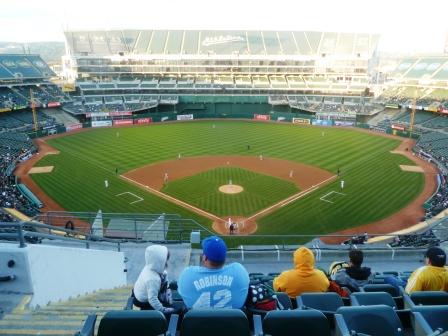
O.co Stadium/Oakland Coliseum: We have been trying to see a Giants game since we got married and wanted to honeymoon in SF, but it was not to be. So this time we took the BART across the Bay to the Coliseum, now known as O.co Stadium. Because it was Jackie Robinson Day, all the players wore a 42 on their uniforms and no names. That's okay: we wouldn't have known any of the Athletics or Astros players anyway. You can see the dad sitting in front of us was wearing 42 also.
Even these die-hard baseball fans couldn't stick it out in the cold for teams we don't
follow; we left around the 6th inning.

Friday, May 10, 2013

Pechakucha

A few years ago a friend invited us to dinner and then out to a PechaKucha Night. Pronounced the way it's spelled, pe-CHA-ku-cha is Japanese for "small talk." It is an event model created in Tokyo in 2003 as a way for designers to get together and show their work: 20 images for 20 seconds each. The tradition quickly came to our area and has been going strong for 8 years already.

If you go to one, you'll see a little bit of this and a little bit of that--just like this mild bean chili DM invented. I thought the corn and parmesan cheese were strokes of genius, but I take credit for the bed of spinach. Here it is: a homey one-dish meal.


2 cans chopped tomatoes (optional: with green peppers & onion)
2 cans whole kernel corn
1-2 cans black beans 
3-4 cans miscellaneous beans
2 bay leaves, broken in half
1 tbs chili powder
1 medium onion, diced
1 green pepper, chopped

Drain the corn and beans (mostly) and empty into crockpot. Add tomatoes with their juice, bay leaves, and chili powder. Cook on low heat 5-6 hours. Add onion and green pepper c. 15 minutes before done. Serve over spinach leaves with a healthy dose of dried or grated parmesan cheese.

If you're still hungry, this goes well with carrot sticks, garlic bread, and/or Triskets with tahini for a little extra protein.

Sunday, May 5, 2013

Vegetarian Quesadillas

Editor's note: I have such a backlog of "foodie photos" that I'm going to try to get some of them up here in between my usual travel or academia-themed posts. Here is Saturday's dinner--a homemade first for us--quesadillas. To fit in with our other meals (including the fact that we had ground beef burritos last week), I decided to cobble together some recipes online for "roasted vegetable quesadillas" as follows.

I told DH last night that I would eat just about anything if it were spread with this guacamole.

Heat oven to 400F. Wash and chop medium potato into thin quarter-rounds. Toss in olive oil, salt/pepper, garlic powder, and oregano. Roast 10-15 minutes. (Remove from oven once golden brown.)

Meanwhile wash and chop bell peppers and zucchini. I used parts of each and ended up with a small bowlful—maybe three cups’ worth? These I also tossed in the olive oil mixture, but you could skip that step. (I wasn't sure whether I was going to saute them or not; I choose to cook them in the tortillas to prevent them from getting mushy.) 

Grate cheese. (We had a cheddar from our favorite, the locally owned Cheese & Crackers).

Melt some butter in a pan and start to warm the first tortilla—flipping a few times—until it gets air bubbles. Put ¼ of potatoes and of other veggies + some cheese on one half of the tortilla, and fold closed. Let cook a few minutes—flipping once or twice—until the outside is crispy and the inside melted.

Top with guacamole and serve with refried beans and a salad. (Sour cream, too, if your household likes it.) We thought the 'dillas could have used a little more queso, but all in all, this was an extremely tasty and very filling meal.


Bonus points if you use your own garden-fresh veggies or make your own guacamole or refried beans!