Sunday, April 8, 2012

An Egg-stra Special Day

It's an egg-themed post for the holiday! Here is an Easter basket I made up for myself this year. It includes half-a-dozen eggs:


1) The green egg hanging from the basket handle is a blown egg painted in traditional, Central European fashion. It is a gift from a friend in Dresden that I was amazingly able to bring back with me.


2) In the basket are a couple of plastic eggs, one of which is full of pennies for the church youth going on the Appalachian Service Project (ASP) this July to Tennessee. They are collecting a mile of pennies (18,874!) to pay part of the cost of renting vans to take the whole team over there.


3) There are also one Cadbury Creme Egg and one Cadbury Caramel Egg. Sooo good but sooo sweet. Did you know Cadbury only uses cocoa that is certified to be slave-free? (70% of the world's cocoa comes from West Africa, where child and slave labor is rife.)


4) In this shot you can see two of the hard-boiled eggs we dyed (see below).


5) In the hollow pink rabbit are what's left of the bag of malted Robin's Eggs I have been eating all during Lent. I luuurv malted chocolate Easter eggs.


6) The big egg outside the basket was a present from a friend in Dresden. Made of lacquered paper and hollow on the inside, it came with the wooden bunny you see to the right, who is now gracing the window in our kitchen.


As to the dyed eggs, Dear Husband remembered a special dying process his family used when he was young. They added the dye to a big bowl of water, let the colors overlap, and dipped the eggs in and out. They would come out all swirled. Unfortunately, FIL told us that dye was discontinued, but he and MIL had found a work-around: hot water + white vinegar + food coloring + canola oil. You have to mix a tablespoon of everything else together before adding the water.
Because we didn't have any lighter oil, we substituted olive oil. Although it is slightly yellow, we didn't notice any difference with the coloring. We had to dip them three times, each time waiting for the dye to dry and wiping off the oil before dipping again. We only did nine eggs this year, so we just used the primary colors of yellow, red, and blue. Next year if we do more eggs, we may use more colors. And maybe glitter?
Here they are! Tie-dyed eggs. The couple on the bottom-right turned out the best. The two on the left are still raw, insurance, if you will, in case one of us wants to make scrambled eggs--or (better!) chocolate-chip cookies--this week. :-) We'll eat them for breakfast (with Kräutersalz), lunch (egg salad), and dinner (on green salad). Also, DH introduced me to the tradition of "egg battles," where the other person takes a crack at your egg with his or hers, and then you flip them around and do it from the other direction. Unlike when we play racquetball, sometimes I win!


Happy Easter from the three of us!

Thursday, April 5, 2012

Radfahrer-Doktorandin

Für meine deutschsprachigen FreundInnen habe ich diese Blog-Post übersetzt. Mein organges, in Karl-Marx-Stadt hergestelltes Fahrrad verkaufte ich, als ich Berlin verliess. Zu Hause besitzte ich ein blaues, männliches Fahrrad, das Ihr unten sehen könnt. Ich habe mich hier als Action-Figurin vorgestellt; hoffentlich kommt der Humor durch:


Radfahrer-Doktorandin kommt mit einem $50 renovierten Second-Hand-Mountainbike aus dem lokalen Radsport Co-op abgeschlossen. Angebracht über dem Hinterrad ist eine Kunststoff-Kiste groß genug für einen Rucksack mit Laptop, Bücher aus der Bibliothek, und benotenen studentischen Aufsätze gefüllt. Der Rucksack hat Taschen für einen Regenschirm und eine wiederverwendbare Wasserflasche (nicht enthalten). Kommt mit einem Fahrradschloss. Für eine zusätzliche $10 können Sie das quadratische Bungee-Netz erwerben--ideal um ihre Jacke oder Lunchbox wegen der holprigen Straßen ausspringen zu verhindern!


Der Helm und die Sonnenbrille der Action-Figurin warnen Autofahrer, sie ernst zu nehmen. Entfernen Sie die reflektierende Weste, um ein pfiffiges Sommerkleid und vernunftige schwarze Schühe aufzudecken. Sie ist bereit, quer durch die Stadt zu zippen, um den ganzen Morgen zu lehren und den ganzen Nachmittag zu forschen! Auch wenn sie spät auf dem Campus für Tagungen bleibtbeziehen die Fahrrads Sicherheits-Features so ein: abnehmbaren Front- und Rückleuchten, einen Kettenschutz, und ein fröhliches Glocke in der Form eines Frosches um Fußgänger zu mahnen, sich aus dem *$&#% Radweg zu bewegen!


Die anderen Blog-Posts sind natürlich auf englisch geschrieben, aber die Fotos versteht ihr sicher ohne irgendwelche Übersetzung. :-)

Wednesday, April 4, 2012

The Mighty Wurlitzer Theater Organ

Last Saturday evening Dear Husband and I went to an organ concert, but it was unlike any of the other organ concerts we have attended before. You see, DH is a pianist/organist/keyboardist, so he is always very interested to hear other organists play pieces on different instruments. You may remember that last spring he came to visit Bach's churches in Leipzig and stayed with me. This year we discovered a local campus church does a series of Thursday-noon concerts during Lent and attended two of those. He can tell the difference between "French" and "German" pipe organs, and even if he hasn't played a particular piece before, he often knows about the composer. Being a classically trained musician, he can follow all the melodies and variations and things. Me, I spend a lot of time looking at the decorations in the church. For instance, this is what I remember of the recital we heard in the Nikolai (katholische) Kirche in Leipzig (May 2011):

But Saturday's concert was different, because rather than going to a church to hear a pipe organ, we were at the Virginia Theater for the re-dedication of their "mighty Wurlitzer" theater organ. It's an old vaudeville theater (1921) that the local Park District currently owns and is renovating. DH had actually played this theater organ for one of The Chorale's New Year's Eve concerts about three years ago, but it was in such bad condition that it was hard to figure out what key and registration in which to play the songs so that enough of the notes would sound! So he was very impressed by the work the local Buzard organ company did in refurbishing the organ. Not only are all the bells and whistles working again (literally!), but they re-finished the console in beautiful, natural wood AND added two extra ranks of pipes that the original theater owners intended to install but never did for lack of funds.

To celebrate the re-dedication, the Park District invited nationally recognized theater organist Chris Gorsuch to play a concert--but not of traditional pipe organ works by Bach or Dupré. Rather, he showed us the different kinds of orchestral sounds and sound effects the organ can imitate, played some movie music and some Gershwin, and ended by accompanying a 1929 Laurel & Hardy silent film, Liberty--just what the Wurlitzer was originally intended to do. The short by "da boys" was a stitch, but for the first 3/4 of the evening there was little other visual stimulation. So I was amused to note how entranced our seat neighbors were by the wooden shutters used to control the volume. All the pipes are on the right side of the hall, behind this decorative lathed grill (left); the light-colored slats behind them opened and closed as Gorsuch pedaled. They didn't make much noise, but their constant movement caught the eye. I guess I'm not the only one who looks around a lot during an organ concert!

During his remarks at the start of the evening, John Paul Buzard twice referred to the Wurlitzer as "our municipal organ," and I confess I felt a bit of civic pride to have elected to spend a Saturday evening with other arts-minded citizens listening to a historical theater organ. It made me wonder, Is this what it feels like to live in a small town??

You can click here for a 2-minute video about the refurbishing process and actually hear the organ.

Sunday, March 25, 2012

It's good to be green, 2

The last post with this title was about holiday-themed fun with food coloring; this one concerns another kind of green: environmentalism. When we bought our house a couple of years ago, Dear Husband and I decided to try to reduce our carbon footprint. I built a compost heap behind the shed in the back yard for food scraps (egg shells, carrot peelings, apple cores...). We turn off our Christmas lights when we go to bed. I wash our laundry on "tap cold" and hang almost everything to dry on lines in the back yard in the summer and on drying racks in my study during the winter. We even hand wash dishes instead using the dishwasher (mostly!).

In warm weather we try to leave our car in the garage and use other means of transportation. We live just half a mile from the grocery store and so try to walk when we can. However, buying food for two people once a week, plus the occasional bag of cat food or kitty litter, is really too much to carry, even with each of us lugging a large LL Bean tote bag. So DH finally bought me a "bag lady cart." To the left you can see me adding a name tag to the cart after returning from my first trip with it. All of our groceries juuust fit. This will make going to the store so must easier. It's good to be green!

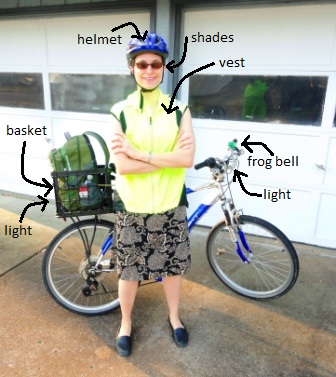
We are both functional bicycle riders (as opposed to biking for fun or exercise). When the weather is warm we bike the 2 miles to church, which is also work for him, and I try to bike the 3.5 miles to campus as often as possible. Here you can see my get-up:

Biker Graduate Student
Biker Graduate Student comes complete with a $50 refurbished, second-hand mountain bike from the local cycling co-op. Affixed over the rear wheel is a plastic crate large enough for a backpack stuffed with laptop, library books, and graded student papers. The bag has pockets for an umbrella and a reusable water bottle (not included). Comes with a bike lock. For an extra $10 you can get the square, hooked, bungee-cord net--perfect for containing her jacket or lunch bag over the bumpy streets!

The action figure's helmet and sunglasses tell motorists to take her seriously. Remove the reflective vest to reveal a snazzy sun dress and sensible black flats. She is ready to zip across town to teach all morning and research all afternoon! Even if she stays late on campus for meetings, the bicycle's safety features include detachable front and back lights, a chain guard, and a cheery bell in the shape of a frog for warning pedestrians to get off the *$&#% bike path!

Click here to view her companion, card-carrying union-member student action figure.

What do you do to be "green"?

Saturday, March 17, 2012

It's good to be green


The color isn't quite right, but here you can see the green cream of wheat I ate for breakfast Saturday morning--actually the only green-themed part of my St. Patrick's Day this year. I didn't even wear any green, but it's too late now, so you can't pinch me, even remotely. I enjoyed my farina with cut-up banana (it's under there) and a swirl of local honey.

A few years ago I sent one of my younger brothers a care package in honor of the holiday. I included some shamrock beads and homemade chocolate-chip cookies I attempted to die green. The color was a little odd (hard to do when the base is brown rather than white, like milk)--but the tragicomic thing about this attempt at sisterly love was that the cookies had come out rather flat and ugly. You see, DH and I were going through a rough patch. Yes, that's right: one of us had been buying el-cheapo flour at the grocery store, and our chocolate cookies were no longer rising. The first time this happened, I thought it was because I was talking on the phone while mixing the dough and had forgotten to add baking powder. MIL suggested I add more to the next batch, which I did, to no avail. Eventually, after much googling around and reading of random cooking threads, I discovered that other people had also had flat cookies and that the culprit was the unbleached flour. So we switched our flour and returned to chocolate-chip bliss.

What memorable green comestibles or potables have you ever consumed? What else have you ever food colored in honor of a holiday?

Saturday, March 10, 2012

It's a book!

Apologies for cross-posting! This is the official blog announcement.

I am pleased to announce that the book I co-authored with a neuroscience professor, neuroscience graduate student, and anthropology graduate student here on campus has just been released by MIT Press. Individual and Collective Memory Consolidation: Analogous Processes on Different Levels is an interdisciplinary monograph that offers a unified theory of memory formation.

Here is the blurb from Amazon: We form individual memories by a process known as consolidation: the conversion of immediate and fleeting bits of information into a stable and accessible representation of facts and events. These memories provide a version of the past that helps us navigate the present and is critical to individual identity. In this book, Thomas Anastasio, Kristen Ann Ehrenberger, Patrick Watson, and Wenyi Zhang propose that social groups form collective memories by analogous processes. Using facts and insights from neuroscience, psychology, anthropology, and history, they describe a single process of consolidation with analogous--not merely comparable--manifestations on any level, whether brain, family, or society. They propose a three-in-one model of memory consolidation, composed of a buffer, a relator, and a generalizer, all within the consolidating entity, that can explain memory consolidation phenomena on individual and collective levels. When consolidation is disrupted by traumatic injury to a brain structure known as the hippocampus, memories in the process of being consolidated are lost. In individuals, this is known as retrograde amnesia. The authors hypothesize a "social hippocampus" and argue that disruption at the collective level can result in collective retrograde amnesia. They offer the Chinese Cultural Revolution (1966--1976) as an example of trauma to the social hippocampus and present evidence for the loss of recent collective memory in mainland Chinese populations that experienced the Cultural Revolution. It is available in hardback and Kindle formats.

The book is the product of a research assistantship I got my third year of graduate school. We figured we would work for a year or two and write a couple of articles for a neuroscience journal. As the project ballooned over the first year, we thought bigger. Pat Watson and I researched and wrote the first two thirds of the book, under the direction of Tom Anastasio (and Lillian Hoddeson). When we discovered that GoogleDocs wouldn't let us simultaneously edit separate documents, we started to sit down together at a single computer to write. Pat is a great interdisciplinary collaborator, because he knows what he knows really well, and he respects what I know. He was able to synthesize our findings, and I found the words to say it. Working with him was the best part of the whole experience. The second year, Wenyi Zhang researched and wrote about religion and literature among Chinese on the mainland and refugees to northern Thailand and Taiwan, and I helped smooth the writing of the last third to match the rest of the book. The research is mostly based on published secondary literature, plus some computer modeling from Tom and Pat. And Tom did a bang-up job getting us contract offers from both MIT Press and Oxford University Press.

The book is really handsome, with white pages and wide margins. I love the verve of the black-red-white color scheme. And the cover really draws you in. Who is the man in the white tank top? What is his relationship as an individual to the crowd (the collective) around him? Plus, all the shades of gray suggests that memory is not something that can be restricted to black-and-white terms.

This project doesn't really have anything to do with my dissertation research, but it has shown me (again) that I can write on a large scale. (My undergraduate history honors thesis was 5 chapters and 125 pages long, and I researched and wrote it in one year!) In fact, that first dissertation chapter I am writing has now been split and one case study spun off into a whole new chapter. If that continues to happen, I will probably stop at five or six chapters and let the others become articles. Because, as they say, the best dissertation is a done dissertation. It need not include alllll the research and writing I have ever done or have yet to do on the subject. And I'm okay with that. I do hope that Individual and Collective Memory Consolidation is just my first book of at least two, as I would love to present to you my dissertation, the published book edition.

Friday, March 2, 2012

Soup for the servants' table, photo journal edition

It turns out I love the way cooked barley feels when I eat it. I can't post that sensation on my blog, so here's the visual version of a recent culinary adventure. This is a companion to my earlier post on trying out an old German recipe.

white turnip

greenish kohlrabi

garnet-red beet
brownish celery root
a little bit of onion
bright green leek--yummy!
young potatoes
cooking--with extra water for thinning

anachronistic serving suggestion


the last bowl. notice the color!