Thursday, August 30, 2012

Vacation Day 4

Whew! The lead-up to and start of the new school year has left me with no time to write the last post about our trip to Madison until now.

Friday night we went to the local minor league baseball stadium, Warner Park, where the Madison Mallards play. Amateur teams from around Madison had sent 1-2 players each for the Home Town All-Star Game. We struck up a conversation with the elderly gentleman in front of us, grandfather to one of the second basemen, so we rooted for his team. It was a decent ballgame that only got ridiculous in one of the middle innings, when the pitcher couldn't find the catcher's glove, much less the strike zone. I think he loaded the bases and let two runs score on wild pitches. All told, there was one homerun and a couple of errors. The game was tied into the bottom of the ninth, when someone hit a walk-off double. Even though we had no emotional stake in the outcome, the night was nice, and we enjoyed this little slice of Americana. I remember that the woman who sang the anthem had a beautiful voice.

Of course we had to sample the ballpark fare. Dear Husband paid a major-league price for a minor-league hot dog, soda, and fresh fruit cup (!). I opted for a veggie burger. I look so thrilled in the photo because of the thick layer of (iceberg) lettuce I got to add, in addition to the usual ketchup, mustard, relish, and onions.

Saturday morning was all about the condiments--or rather, a particular condiment: mustard. August 4 was the 21st Annual National Mustard Day. What? Weren't you celebrating?

First we met up for brunch with a historian of science friend of mine, then we all trooped over to the National Mustard Museum. This private collecting project has been Barry Levenson's hobby since the Red Sox disappointed him in the post-season in 1986. Hundreds of mustards and mustard containers are on display in the basement of the building in downtown Middleton, WI. There are even some real facts about the condiment sprinkled among the facetious news stories and curiosity pieces! A visit is supposed to be only marginally educational, and entrance to the museum is free, because the main floor is the shop, where you can sample every one of the hundreds of mustards for sale as well as purchase mustard/food-themed kitsch or swag from Poupon U. Basically, they're capitalizing on the novelty of the idea of a mustard museum.


The four mustards above are the ones we we tried at the tasting bar, from most (L) to least (R) favorite. Actually, we had already made up our minds to buy a jar of 3 Monkeys Mustard, a spicy-sweet spread concocted by a dad and his kids in their garage. It won the 2012 grand prize in the taste testing competition.

Outside, there was a stage for live music, games for the kids, the Oscar Meyer Wiener Mobile, various mustard vendors, and of course food. One tent was giving away free hotdogs with unlimited mustard; it was $10 if you wanted ketchup! Culver's was selling mustard ice cream, which we tasted. It's better than it sounds: the vanilla and caramel were sweet, with a kick of hot mustard after-taste. We also got our photo taken with the French's mustard bottle (above). DH wondered that we were received in such a friendly manner, although both of us had unwittingly dressed in the opposing colors that day!


Soon enough, it was time to hop back in the car and drive home again. We had a few other small adventures and interesting conversations this summer, and I hope to find the time to tell you a little about each of them soon.

Wednesday, August 22, 2012

Vacation Day 3: Taliesin

Hillside School
On the third day of our anniversary vacation, we took a day trip out of Madison to Frank Lloyd Wright's first estate, Taliesin, just south of Spring Green. It was a beautiful hour’s drive west along a mostly two-lane highway that cut through small towns and wound past farms nestled between wooded hills. The scenery was everything I wanted it to be, until we encountered the reality of farming nowadays. Some operations had irrigation systems and were weathering the drought fairly well, but we passed one farm whose corn stood stunted and yellow in the field. A few farms had “for sale” signs along the road, and one offered a building permit. “What would you build out here?” I asked Dear Husband. I dreaded the thought of a Big Box Store. Maybe bedroom communities for the small towns. There was at least one large industrial building with solar panels out front—hopefully that was a job creator.

We used some of my birthday money for the four-hour Estate Tour, which involved a shuttle ride and a lot of walking with a tour guide and about 15 other people. It was totally worth the expense: not only does that money go toward preservation efforts, but we got to visit most of the important structures on the 600-acre estate (Unity Chapel, Hillside School & Theater, the Windmill Tower, Tan-y-deri [a house for his sister], Midway Barns, and Taliesin house itself).

To the left is Wright's grave marker at the family chapel. Behind it stands the tree at the foot of which his mistress was buried after an estate worker "went postal" when she dismissed him for his erratic behavior while Wright was away. The worker hacked six other people to death with an axe after setting fire to the residential wing of the big house. He attempted to poison himself, survived, and eventually starved himself to death in jail.

Wright is not actually buried there, however. He died in 1959 during surgery for intestinal obstruction. When his third wife, Olgivanna, died in 1985, it was discovered that her will instructed that he, she, and her daughter from an earlier marriage (who died in a car accident) be cremated and interred together at Taliesin West, Wright's estate near Scottsdale, Arizona. Many people close to Wright objected, but apparently a crew came in the middle of the night, dug him up, and carted him off.

To the right is "Romeo & Juliet," the windmill Wright designed for his teacher-aunts to provide water for their residential school. Romeo is the skinny quadrilateral at the back, designed to "cut into" the wind. Juliet is the hexagon that actually held the workings. The children of the school sometimes used the structure as a play house.


DH had read a biography of Wright about a decade ago, but I knew next to nothing about him, so I found the tour very interesting. This is me on the crown of the hill behind the house, which is perched on "the brow" of the hill. (Taliesin means "shining brow.")


Afterward we ate lunch at the restaurant at the Visitors' Center overlooking the Wisconsin River. That's DH enjoying a slice of strawberry shortcake pie in honor of our anniversary. (We had strawberry shortcake as the cake at our wedding reception.) Then we started on the drive back to Madison. We considered detouring south to see the Cave of the Mounds, but our feet were tired and we figured we had maxed out our budget for the day, so we just stopped off at a local park with a scenic point overlooking the valley. We got back to the hotel in time for a brief rest before heading out for our evening entertainment, which I will describe in the next post. Any Frank Lloyd Wright fans out there? Have a favorite building or design you want to share with us?


Editor's Note: Dear Husband and I later visited Wright's house and studio in Oak Park, IL, as well as his famous Fallingwater vacation house and the nearby Polymath Park trio.

Thursday, August 9, 2012

Vacation Days 1 & 2

Dear Husband and I recently celebrated our 7th wedding anniversary much in the way we’ve celebrated the others: with a road trip to a city in the Midwest. We honeymooned in Denver with a botanical garden, an art museum, hiking (in Estes Park), good eats, and a baseball game. We’ve pretty much kept to that itinerary in the years since, as we’ve visited Chicago, Indianapolis, St. Louis, Kansas City, Milwaukee, Cincinnati, and now Madison. 

I am my grandmother’s granddaughter and my father’s daughter, and I love planning our trips. I always try to include something unique for the places we travel to. In Chicago we went to the Navy Pier. In Indy we visited a private super hero museum and the race track. In Kansas City we saw the Jazz Museum and the Negro Leagues Baseball Museum. In Milwaukee, we rollerbladed along Lake Michigan. On our Cincy trip, DH played the pianos that had been decorated and placed around the city.

In Madison, we rented a tandem kayak on Lake Wingra. I had hoped they might let us use a small sailboat, but the lake has had such large growths of seaweed recently that you have to take a special class before they’ll let you sail. As we paddled back and forth across the lake, I suddenly didn’t feel so guilty for missing PiYo class while our car was in the shop earlier in the week: it was quite the upper-arm workout! We saw gulls, ducks, a heron, and a very large fish that jumped near the boat. It was a hot day, so we even braved the seaweed and got out of the kayak to “swim” in the middle. I don’t like it when I can’t see my feet in the water, so actually I worked out my abs by holding a pike position so my toes stuck up out of the water while we rested in/on our life jackets and let the underwater current carry us.

I don't think a marriage is legal in Madison unless
the bride takes photographs at this gazebo.
After rinsing off under a hose, we drove into the center of town. We were too late for an official tour of the capitol building, but we ogled the marble and the cupola for ourselves. This was the site of the famous anti-Walker sit-in in 2011. On the mezzanine level was an exhibition of beautiful oil paintings by and about Falun Gong (Dafa) practitioners in China and the discrimination and torture many have suffered at the hands of the Communist regime. Unfortunately, my camera battery had died when we got to the lake, so I don’t have any pictures of this first day.

We were also there to meet a friend for the last Concert on the Square of the summer. From humble beginnings a few years ago, this free event has become a Madison staple. At 3pm you are allowed to leave a blanket on the grass around the capitol building to mark your spot. People start arriving at 5:30 or 6 o’clock with coolers, camp chairs, and folding tables, and food vendors line closed-off stretches of street. We bought some really yummy mint chocolate chip ice cream cones, DH had a hot meal that reminded him of Tafelspitz, and I ate cheese, crackers, and fruit. DH listened to the music/napped while the ladies chatted—apparently too loudly for the music snob behind us, who was shushing everyone around him. Then it was back to the hotel to watch some Olympics before bed.


The weather on the second day was supposed to be a doozy, so I had planned for the botanical garden in the morning and the art museum in the afternoon. The Olbrich Botanical Garden (free) is smaller than some of the others we have visited, but it is well maintained, and there was still plenty to see. The Thai temple and garden were particularly interesting. They've incorporated various cultural and artistic symbols, like water, topiary, lotus blossoms, and the Naga serpent. The temple (sala) was built in Thailand, taken apart, shipped here, and then reconstructed without nails or screws. The artisans happen to have been flying on September 11, 2001, and were on one of the last flights to land at O'Hare. You can't touch the gold leaf or else the oils on your skin can damage it. Then we paid for tickets to enter the conservatory to see the butterfly exhibit. Once a year they order hundreds of cocoons and hatch the butterflies in the tropical environment. You can see them up close, as well as enjoy orchids, banana trees, bamboo, canaries, and adorable little quail running around.

We ate lunch at the famous vegetarian/vegan restaurant, The Green Owl. Dear Husband had fake chicken with real parmesan cheese, while I ordered a filling BBQ jackfruit sandwich and kale chips. An...interesting culinary creation, kale chips: I tasted mostly oil, while DH tasted mostly kale. Go figure.

Kale chips!
Rather than continue our itinerary around Lake Monona, we repaired to the hotel for reading/naps due to tired legs. The Chazen Art Museum (also free) is open until 9pm on Thursdays, so I knew we weren’t trying to get everything in by 5pm and had plenty of time to see the exhibits.

The big draw was the current temporary exhibition of studio art glass. Apparently a faculty member at the University of Wisconsin Madison is single-handedly responsible for establishing the discipline, in that he made a workshop of all the different kilns and tools available to local artists, as well as training students. I love glass because of its versatility: it can be transparent, translucent, or opaque. It can be rough or smooth. It can be drawn out into delicate threads or cast in impressive hunks. It can be colored, have bubbles, and be made into a seemingly infinite variety of shapes. The display was impressive in its scope, and there was also a series of demonstration videos on various technique and on making tumblers, wine glasses, and other things.

No green owls, but I did find a green frog.
We spent so much time there that we were ready for dinner, so we headed down University Avenue toward the restaurant quarter. I had looked up a few places beforehand, and we quickly decided on Dotty Dumpling’s Dowry, which is only the best burger joint in Madison and no small irony, considering where we went to lunch! We shared a strawberry milkshake, a burger, fries, and a spinach salad. We thought the burger wasn’t done enough, but the salad came with bleu cheese, which made me think of my maternal grandfather, who could eat an inordinate amount of the stuff.

We returned to the Chazen for the second temporary exhibit, on the fan in Japanese prints. I would have liked more thorough descriptions of the historical or literary backgrounds for the images, but then maybe that’s just me. We finished off our visit with the room dedicated to twentieth-century African artwork. Then it was back to the hotel for—you guessed it—more Olympics. (Hey, people, don’t judge: it was gymnastics!)

Next time: a cultured day trip and a wacky museum.

DH: "Look where her hand is. I know why he's giving her a high five!"

Tuesday, July 17, 2012

Day 10: Homeward Bound


"Nastrovje!"
After the organ concert at Saint Giles, Dear Husband and I returned to our hotel. We had packed between returning from Terezín and heading off to dinner with the group, so all that was left to do was to prop up our feet and turn on the telly. You see, we were in Europe while group play for the European Men's Soccer Championship being held in Poland and the Ukraine, so every evening there were two games on. If you've never watched television in Europe, they only show commercials at the ends of programs, not in the middle. Can you imagine a ref having to stop the play of a soccer match for a tv time out? Us, neither. Now, DH and I are not soccer hooligans, but we are general sports fans, and unlike most Americans, we appreciate a good Fussball match. I frequently seem to be in Germany during World Cup matches, so I associate abundant soccer with Europe, and the Euro 2012 is one of the things that made this trip so enjoyable for me.

Something else, which gave me Heimweh (homesickness) for my time living in Germany to do research, was sleeping with a Bettdecke (comforter). DH is not a fan, because he frequently gets too warm when he sleeps, and these were the real deal. I, however, find them comfortable and snuggly and just regulate my body temperature by increasing or decreasing the number of appendages exposed to the night air.

We turned in early that night, because we had to pick up our boxed breakfasts in time to get on the bus at 6am to ride to the airport for our flight to our flight to a bus back home. The boxed meal (really more of a lunch, with a cheese sandwich, a meat sandwich, fruit, and juice) couldn't hold a candle to the excellent breakfasts we enjoyed at our hotels. I was actually rather amused at the surprise and delight our trip-mates expressed when they saw the spreads at each new hotel. There was typical cold/European fare: breads and rolls, whole and chopped fruit, meats and cheeses, veggies, yogurt and muesli, hard- or soft-boiled eggs. And there was hot/American fare: scrambled eggs, pancakes, bacon or sausage, hash browns, cereal with milk. We generally can't afford to stay at places with breakfasts as nice as these were--and I snub my nose at American hotels that call coffee, muffins, and some whole fruit a "Continental breakfast"--but I sure do enjoy them when we get the chance. The photo is from Prague, on a morning when I had orange juice, Bircher-Benner muesli with yogurt and rote Grütze (whole sweetened and preserved berries), pink grapefruit slices, and a piece of dark bread with spreadable cheese and a slice of ham. The roll, cucumbers, and salmon salad were for the bus ride to Terezín. DH generally had fruit and some kind of pastry or bread; he tried the pancakes one place and reported they weren't any good, unfortunately.


The other photos are from the evening of Day 8. After we got back from Ta Fantastica, in the lobby we met other group members planning their alternative day of touring (instead of the trip to Terezín). They had been interested in sampling the local liquors, and I just had to recommend sliwowice (slivovitz). DH and I shared a glass of this Czech plum brandy in honor of my paternal grandfather, whose voice we can both hear in our heads saying, "Nastrovje!" ("Cheers!") Oh, but it buuurns going down. (See before/after snapshots above.)

The journey home was pretty uneventful for us. We were able to find group members willing to trade seats so we could sit together, the plane was not unbearably hot, and no luggage was lost--although I did succumb to a nap between the airport and home. Nevertheless, I had no difficulty falling asleep that night, as I've always found coming back from Europe easier than going over. We've long since unpacked, done loads of laundry, cleaned the house, and moved on. Writing this blog posts was the last thing to do, to chronicle a really wonderful working-vacation.

In conclusion, thank you for reading! It was fun to relive our trip for you. Postings will definitely slow down now, as I'm trying to get a third dissertation chapter drafted by the time classes start in August. Or by Sept. 1. Or Labor Day... Please continue to share here or elsewhere how you and your family are doing. I love to keep in touch.

Monday, July 16, 2012

Day 9: Terezin

Ladislav Chochole, "nameless"
On our last full day in Europe, most of the group took a day trip on the bus an hour north of Prague to Terezín, originally a garrison town, then a Jewish ghetto, and now a tourist attraction. Emperor Josef of Austria did not trust his neighbor to the north, so from 1780-1790 he had a fort built on the OhÅ™e River near Bohemia's border with Prussia/Germany. You can see the grassy dry moat on the left; I think our guide said it would take 24 hours to completely fill the ditches from the river. He also took us through about a mile of some of the subterranean tunnels designed for communication, storage, and defense. However, the fort was never used defensively, because 15-20 years later, the enemy became France, first under the Revolution and then under Napoleon Bonaparte.

Instead, the fort was used as a military prison, all the way into the 1930s. The photo on the right shows Dear Husband exiting a dark, solitary confinement cell next to the famous one (#1) in which Gavrilo Princip died of tuberculosis in 1918. He did not survive the war he "started" by assassinating Austrian Archduke Franz Ferdinand and his wife in Sarajevo on 28 June 1914.

Sometime after the Anschluss of Austria into the Third Reich, the Nazis began using the fort at "Theresienstadt" as a concentration camp, mostly for political prisoners, later for POWs, and also for Jews. We saw the simple wooden bunks and scant toilet facilities dozens or hundreds of prisoners shared. The newer solitary confinement cells (which were lit) seemed positively luxurious by comparison. Below is the shaving room that was specially constructed for a visit by the International Red Cross and was used exactly once for that purpose.

We were also shown the embankment used for executing Gentile prisoners and the gallows for the Jewish prisoners. I found that extremely disturbing and chose not to take any photographs. I did leave a stone at the gallows, though, as I learned to do on my first visit to Buchenwald. 
Around the corner was the memorial by Ladislav Chochole, "nameless," the photo at the head of this entry.

Theresienstadt is of course most famous for the Jewish ghetto on the other side of the river from the fort. The SS removed the 7,000 Czechs who were living there and turned the town into a way-station on the way to the extermination camps. The population at any one time was easily 50,000 internees. Here are some other numbers:
Total number of inmates: 150,000+
Died of disease, malnutrition, mistreatment: ~33,000
Deported to Auschwitz, Treblinka, etc.: ~88,000
Survivors: 17,247


While at the visitors' center, we watched a documentary about the ghetto that included excerpts from the propaganda film the Nazis made about the village Hitler had given to all those happy Jews. The center also has a display of the children's artwork and poetry, and a very long list of the names of the ones murdered. The museum, meanwhile, displays artifacts, with one room set up like a women's quarters, one room devoted to the musical scene in the ghetto, and quite a few rooms showing artwork by prisoners, both that commissioned by the Nazis for reports and illicit artwork depicting the realities of life in Theresienstadt. One of the most chilling was an official illustration in the style like many I find in my research on the German Hygiene Museum, only this one champions the removal of unproductive mouths (i.e. those belonging to anyone over the age of 65). The children's opera Brundibar is only the most famous piece produced in the ghetto, as many talented artists passed through, as well as engineers, doctors, lawyers, and other educated Jews.

Back at the fortress across the river, one room has been turned into a chapel of sorts (left). I believe the statue in the background is of a grieving woman or mother. In each of the recesses along the wall, a little dish holds ashes from one of the six extermination camps: Auschwitz, Chelmo, Belzec, Majdanek, Sobibor, Treblinka--and Theresienstadt. I didn't notice it at the time, but the lighting and the gold lining produces the glow of seven furnaces in the photo. Finally, the cemetery: a large cross was erected shortly after the liberation, but the Communist propaganda erected after that has since been taken down. The star of David mounted on a pile of stones is relatively recent.


It was a short hour's ride back to the city, but DH and I were glad I had pilfered little sandwiches from breakfast that morning, as no plans had been made for lunch. I will conclude my narration of our trip in the next post.

Sunday, July 15, 2012

Day 8: Concert at St. Giles


When last I left you, Dear Reader, Dear Husband and I were scarfing down a decadent dessert and rushing off to the organ concert I had promised him. While I like organ concerts well enough, and he enjoys art museums, I won't rule out the possibility that our itinerary involved a bit of compromise.

Of all the churches we visited on our trip to Central Europe, St. Giles in Prague may have been the most decked out. We're talking seriously baroque here: gold, accents on everything; rich folds in the "fabric" of statues' robes; helical marble columns that must have been super expensive, because they had to purchase larger chunks of marble so that half of them could be chipped away to make spirals; fancy woods on the side altars; everything decorated with spirals and curlicues--and did I mention the gold? To the left is the view of toward the main altar from our seats in the back pew, whence we slipped, as quietly as possible, as the concert had already started while we wound our way through the streets of Old Town Prague to Husova street. Because we were running late, I did not stop to consider the price we paid for the tickets. Not only was it more than I expected, once I had done the math in my head, but it came out to about $23 for each of us. That much wasn't in my budget, so we hope the musicians were well compensated, after the ticket-taker, program printing costs, etc. Apparently the church has hired a company to promote these nightly concerts, which are supposed to raise money for renovations of the organ.

The evening we were there, we heard an organist, a violinist, and a wonderful soprano perform a variety of mostly religious pieces by a veritable Who's Who of Baroque, Classical, and Romantic music: Bach, Vivaldi, Albinoni, Mozart, Franck, Dvořák, Schubert ("Ave Maria"), Gounod ("Ave Maria"), Tchaikovski, and Widor ("Toccata"). All the musicians were quite talented, but we agreed that the flashy finale was really a let-down. You see, DH has taught himself to play the organ, he's very good at it, and he knows how to play the famous organ part from Widor's "Toccata." Lots of churches advertise organ concerts in Prague, and he noticed that they all seem to end with that piece, probably to impress the tourists. It's fast and sounds tricky. Unfortunately, St. Giles has lots of marble and not so much sound-absorbing material in it. So when the organist played the "Toccato" all fast and flashy like, the sounds just washed over and into each other, completely losing the momentum of piece. (We laughed about that on our way to the Metro later, that the organist had ruined the momentum of the piece by taking too quick a tempo!) In addition, he didn't play the coda, which has my favorite part, in the pedals. After the sound finally ebbed away, I turned to DH and said, "Grab your rubber ducky, and let's get out of this bathtub!"


The promotional literature boasts St. Giles has the "Greatest Classical Organ in the Town." It dates to 1733, with an extension in 1888 and more work in 1969. DH notes that much of the impressive music played on the organ probably required those improvements, so it's not exactly authentic. It's got 3 manuals, 50 ranks, and 3500 pipes and certainly sounded impressive. The wooden carvings on its casing are said to be very ornate, but it was too dark and back-lit for either of us to get a good photo after the music ended, and we could get up from our seats to look at the organ loft above and behind us.


While listening to the concert, of course I looked around a lot. For 641 years old, the Church of St. Jilji is looking pretty good. The flyer we got notes more than once that the church was founded in 1238, but of course the existing structure isn't that old. Consecrated in 1371, the building has Gothic architecture to go with the Baroque interior. Before he went over the bridge and into the river, John Nepomuk was probably active in this community, and there is a side altar to him. Since 1625, the building has belonged to the neighboring Dominican monastery (except during the Communist period). The most damage it has sustained was a lightning strike and fire in 1432 in the north steeple, which is still shorter than the south steeple. Click on the link above if you want to see more/ better photos of interior.

To the right you can see (sort of) the absolutely beautiful fresco work done on the ceiling, which was supported by striking white Romanesque pillars topped in gold work. The paintings show the celebration of the Dominican Order, the victory of faith over heresy, and the legends of Sts. Giles, Dominic, and Thomas Aquinas. As I learned later, St. Giles (c. 650-c.710) was a hermit of Greek extraction living in what is now the south of France. His only companion was a red deer, who may have supplemented his vegetarian diet with her milk. Anyway, one day the king was hunting in the forest, pursued the deer back to Giles's hermitage, and accidentally wounded the saint while aiming for the animal. Giles later founded a Benedictine monastery. His symbols are a deer and an arrow; his feast day is 1 September; and he is the patron saint of hunters, the shipwrecked, beggars, nursing mothers, and those with disabilities like leprosy and mental illness.

Our last full day in Europe was considerably more somber, as we took a day trip out to the prison and ghetto at Terezín/Theresienstadt.

Wednesday, July 11, 2012

Day 8: TRA la la la, LA la la la


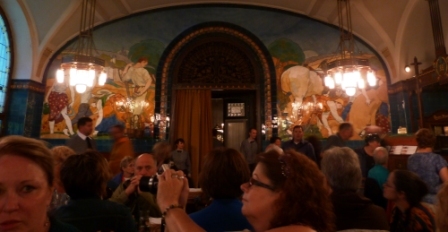
Having been set free to explore the capital of the Czech Republic after our afternoon concert, we gathered in the evening at an art nouveau-style restaurant. Hopefully above you can see part of a colorful mural of a bucolic rural scene. The windows were of beautiful stained glass, and there were decorations on the walls, which were blue below and white above. A strolling accordion player and "his wife" the bassist came around in "traditional costumes" to serenade us. At one point, Dear Husband and I and another couple got up to dance a polka in the aisle. When they figured out we were a singing group, they played a couple of tunes for us to sing along to. Funnily enough, even "You Are My Sunshine" sounds like a drinking song, when played on an accordion. For their last number, they invited us to "sing in Czech"--i.e., the "tra la la las" of the chorus of a popular folk ditty. Imagine my surprise when it turned out I had learned the song at Sokol gymnastics coaching camp in Barryville, NY, the summer I turned 13! I still remembered most of the first verse and then joined in heartily on the chorus, which DH captured (below, left). I dug my singing manual out of the closet to find the words again. They go like this:


Tancuj, tancuj, vykrucaj, vukrucaj, vukrucaj. Len mi piecku nesrucaj, nesrucaj. Dobra piecka na zimu, na zimu. Každy nema perinu, perinu. TRA la la la, LA la la la, ...

"Dance, whirl around. Just don't knock over the stove! The stove is necessary for winter. Not everyone has a feather quilt for sleeping. TRA la la la, LA la la la..."


Dinner began, of course, with soup. The entree was chicken, peeled boiled potatoes, and--gasp!--mixed vegetables (below). Dessert was a delectable crepe with whipped cream and chocolate sauce, and below is all that was left before I remembered to snap a photo. But we were trying to finish our food as quickly as possible, so as not to be late to that organ concert we had been trying to find the night before, and which is the subject of the next post.