Showing posts with label Austria. Show all posts

Tuesday, July 17, 2012

Day 10: Homeward Bound


"Nastrovje!"
After the organ concert at Saint Giles, Dear Husband and I returned to our hotel. We had packed between returning from Terezín and heading off to dinner with the group, so all that was left to do was to prop up our feet and turn on the telly. You see, we were in Europe while group play for the European Men's Soccer Championship being held in Poland and the Ukraine, so every evening there were two games on. If you've never watched television in Europe, they only show commercials at the ends of programs, not in the middle. Can you imagine a ref having to stop the play of a soccer match for a tv time out? Us, neither. Now, DH and I are not soccer hooligans, but we are general sports fans, and unlike most Americans, we appreciate a good Fussball match. I frequently seem to be in Germany during World Cup matches, so I associate abundant soccer with Europe, and the Euro 2012 is one of the things that made this trip so enjoyable for me.

Something else, which gave me Heimweh (homesickness) for my time living in Germany to do research, was sleeping with a Bettdecke (comforter). DH is not a fan, because he frequently gets too warm when he sleeps, and these were the real deal. I, however, find them comfortable and snuggly and just regulate my body temperature by increasing or decreasing the number of appendages exposed to the night air.

We turned in early that night, because we had to pick up our boxed breakfasts in time to get on the bus at 6am to ride to the airport for our flight to our flight to a bus back home. The boxed meal (really more of a lunch, with a cheese sandwich, a meat sandwich, fruit, and juice) couldn't hold a candle to the excellent breakfasts we enjoyed at our hotels. I was actually rather amused at the surprise and delight our trip-mates expressed when they saw the spreads at each new hotel. There was typical cold/European fare: breads and rolls, whole and chopped fruit, meats and cheeses, veggies, yogurt and muesli, hard- or soft-boiled eggs. And there was hot/American fare: scrambled eggs, pancakes, bacon or sausage, hash browns, cereal with milk. We generally can't afford to stay at places with breakfasts as nice as these were--and I snub my nose at American hotels that call coffee, muffins, and some whole fruit a "Continental breakfast"--but I sure do enjoy them when we get the chance. The photo is from Prague, on a morning when I had orange juice, Bircher-Benner muesli with yogurt and rote Grütze (whole sweetened and preserved berries), pink grapefruit slices, and a piece of dark bread with spreadable cheese and a slice of ham. The roll, cucumbers, and salmon salad were for the bus ride to Terezín. DH generally had fruit and some kind of pastry or bread; he tried the pancakes one place and reported they weren't any good, unfortunately.


The other photos are from the evening of Day 8. After we got back from Ta Fantastica, in the lobby we met other group members planning their alternative day of touring (instead of the trip to Terezín). They had been interested in sampling the local liquors, and I just had to recommend sliwowice (slivovitz). DH and I shared a glass of this Czech plum brandy in honor of my paternal grandfather, whose voice we can both hear in our heads saying, "Nastrovje!" ("Cheers!") Oh, but it buuurns going down. (See before/after snapshots above.)

The journey home was pretty uneventful for us. We were able to find group members willing to trade seats so we could sit together, the plane was not unbearably hot, and no luggage was lost--although I did succumb to a nap between the airport and home. Nevertheless, I had no difficulty falling asleep that night, as I've always found coming back from Europe easier than going over. We've long since unpacked, done loads of laundry, cleaned the house, and moved on. Writing this blog posts was the last thing to do, to chronicle a really wonderful working-vacation.

In conclusion, thank you for reading! It was fun to relive our trip for you. Postings will definitely slow down now, as I'm trying to get a third dissertation chapter drafted by the time classes start in August. Or by Sept. 1. Or Labor Day... Please continue to share here or elsewhere how you and your family are doing. I love to keep in touch.

Monday, July 16, 2012

Day 9: Terezin

Ladislav Chochole, "nameless"
On our last full day in Europe, most of the group took a day trip on the bus an hour north of Prague to Terezín, originally a garrison town, then a Jewish ghetto, and now a tourist attraction. Emperor Josef of Austria did not trust his neighbor to the north, so from 1780-1790 he had a fort built on the Ohře River near Bohemia's border with Prussia/Germany. You can see the grassy dry moat on the left; I think our guide said it would take 24 hours to completely fill the ditches from the river. He also took us through about a mile of some of the subterranean tunnels designed for communication, storage, and defense. However, the fort was never used defensively, because 15-20 years later, the enemy became France, first under the Revolution and then under Napoleon Bonaparte.

Instead, the fort was used as a military prison, all the way into the 1930s. The photo on the right shows Dear Husband exiting a dark, solitary confinement cell next to the famous one (#1) in which Gavrilo Princip died of tuberculosis in 1918. He did not survive the war he "started" by assassinating Austrian Archduke Franz Ferdinand and his wife in Sarajevo on 28 June 1914.

Sometime after the Anschluss of Austria into the Third Reich, the Nazis began using the fort at "Theresienstadt" as a concentration camp, mostly for political prisoners, later for POWs, and also for Jews. We saw the simple wooden bunks and scant toilet facilities dozens or hundreds of prisoners shared. The newer solitary confinement cells (which were lit) seemed positively luxurious by comparison. Below is the shaving room that was specially constructed for a visit by the International Red Cross and was used exactly once for that purpose.

We were also shown the embankment used for executing Gentile prisoners and the gallows for the Jewish prisoners. I found that extremely disturbing and chose not to take any photographs. I did leave a stone at the gallows, though, as I learned to do on my first visit to Buchenwald. 
Around the corner was the memorial by Ladislav Chochole, "nameless," the photo at the head of this entry.

Theresienstadt is of course most famous for the Jewish ghetto on the other side of the river from the fort. The SS removed the 7,000 Czechs who were living there and turned the town into a way-station on the way to the extermination camps. The population at any one time was easily 50,000 internees. Here are some other numbers:
Total number of inmates: 150,000+
Died of disease, malnutrition, mistreatment: ~33,000
Deported to Auschwitz, Treblinka, etc.: ~88,000
Survivors: 17,247


While at the visitors' center, we watched a documentary about the ghetto that included excerpts from the propaganda film the Nazis made about the village Hitler had given to all those happy Jews. The center also has a display of the children's artwork and poetry, and a very long list of the names of the ones murdered. The museum, meanwhile, displays artifacts, with one room set up like a women's quarters, one room devoted to the musical scene in the ghetto, and quite a few rooms showing artwork by prisoners, both that commissioned by the Nazis for reports and illicit artwork depicting the realities of life in Theresienstadt. One of the most chilling was an official illustration in the style like many I find in my research on the German Hygiene Museum, only this one champions the removal of unproductive mouths (i.e. those belonging to anyone over the age of 65). The children's opera Brundibar is only the most famous piece produced in the ghetto, as many talented artists passed through, as well as engineers, doctors, lawyers, and other educated Jews.

Back at the fortress across the river, one room has been turned into a chapel of sorts (left). I believe the statue in the background is of a grieving woman or mother. In each of the recesses along the wall, a little dish holds ashes from one of the six extermination camps: Auschwitz, Chelmo, Belzec, Majdanek, Sobibor, Treblinka--and Theresienstadt. I didn't notice it at the time, but the lighting and the gold lining produces the glow of seven furnaces in the photo. Finally, the cemetery: a large cross was erected shortly after the liberation, but the Communist propaganda erected after that has since been taken down. The star of David mounted on a pile of stones is relatively recent.


It was a short hour's ride back to the city, but DH and I were glad I had pilfered little sandwiches from breakfast that morning, as no plans had been made for lunch. I will conclude my narration of our trip in the next post.

Tuesday, July 3, 2012

Other Vienna Memories

Before we move on to Prague, here are some other memories from our quick stay in the capital of Austria, in no particular order.

The Albertina Museum*--we had plans to see the Austrian Theater Museum one afternoon, but my intel was out-of-date, and it turned out they are closed on Tuesdays now. So we went to the art museum down the street, where we had just missed a Klimt show. So we looked at modernist artwork with a strong interwar representation. Some of Picasso's early work obviously required thought and skill, but Dear Husband and I agreed that some of his later sculpture just looked like he wasn't trying anymore. Maybe that was the point, but it didn't appeal to us as much. The highlight of the visit was deciding to  check out the Prunkräume, rooms of the palace that maintained some of their original decorations and a few furnishings but that also contained works of art from Dürer onward. It's worth going to the website to check out the 360-degree virtual tours of the rooms.

*--Not to be confused with the Albertinum Museum in Dresden, named for a different Albert.


The Belvedere Palace/Museum--the morning had been rainy, but the afternoon was surprisingly beautiful, as the above picture attests, looking north toward the Ring and the center of town. Too bad we needed neither of the umbrellas I lugged around in my bag the whole time... Inside, we wandered through one wing of each floor, taking in Secessionist works like Klimt's _The Kiss_, an exhibit on the differences between Realism and Impressionism, and interwar modern art by the likes of Egon Schiele.

Credit: MAH
Right is "Tafelspitz," Kaiser Franz Josef's favorite meal: boiled beef, creamed spinach, and roasted potatoes.

Left is the "Riesenrad" in the Prater amusement park in Vienna. It was dedicated 105 years ago today, on 3 July 1897 for Kaiser Franz Josef's 50th Jubiläum. The ferris wheel was almost totally destroyed by bombing and fire during WWII and due to reasons of stability only rebuilt with 15 of the original 30 wagons. For a long time it served as a symbol of Austria's reconstruction after the war. Today there is also a museum. We did not get to ride on it this trip but now have something to do next time we're in Vienna. I hear the view from the top is great and also that the ride is slow, so you really get your money's worth.

There was a lot of art to look at in Vienna. The apartment of our hostess, Jutta, was full of paintings. Below, the group gives a short concert in her living room. Next, a select group of tenors, who had been holding secret rehearsals, sang the beautiful love song, "Annie Laurie," which one of them had dedicated to his girlfriend--and then he proposed! She accepted (i.e. "gave her promise true"), and there were few dry eyes. I couldn't actually see the proposal because of the crowd of people, so I marked up this "before" photo.

[Text on photo: He put a ring on it.]

Thursday, June 28, 2012

What's For Dinner? Part I

The photograph to your left was the inspiration for this post. The plate contains lasagna, chicken tetrazzini, some kind of gumbo? (rice with sausage), and scalloped potatoes. It was the entree at the home of a Viennese singer who very graciously hosted us; this was preceded by a soup and followed by a sweet dessert with a little buzz. All the food tasted very good...but that's all there was. Have you figured out yet what was missing? There were nothing green, no vegetables.

Several of us had noticed this patter to dinner: soup, meat + starch, dessert. If there were any vegetables, they served as garnish, as with the entree from Budapest below, of cheesy breaded chicken breast, french fries, white rice, a piece of lettuce, and a curly-Q of shaved carrot. (I ate everything but the fries. Dessert came with a scoop of vanilla ice cream; good thing I didn't have to sing right after that--I don't know how the rest of them did it without getting phlegmy!)


Now, I am familiar with this Central European menu, since it comes up in my dissertation research. The soup is to stimulate the appetite. The meat + starch are the main event (calories, protein, carbohydrates). According to at least one physiologist, the purpose of dessert is that the sugar helps with gastric motility and therefore digestion of the dinner just eaten. Fruits and vegetables are good for appearance  and variety, both of which stimulate appetite, but too many--especially raw--burden the digestive system with indigestible cellulose. The low nutritional worth of fruits, at least, can be increased by cooking them down with sugar into compote. This is, as you can see, a pre-vitamin paradigm.

I knew about this way of eating, and yet I was surprised to experience it consistently in Budapest and Vienna at our restaurant dinners. Granted, we were served hot meals in the evening of the kind that Central Europeans traditionally ate/eat in the middle of the day (~1pm). Fruits and vegetables are normal parts of the two cold meals at the beginning and end of the day, which generally consist of bread or rolls, meats, cheeses, bread-spreads, pickles, and maybe hard-boiled eggs. But when I mentioned this to my (American) mother-in-law, she told me that her (Austrian) mother-in-law had been of the opinion that a proper large meal of the kind our hostess served us should include three meats and a starch!*

Look, honey: parsley counts as a vegetable, right?
Wienerschnitzel and potatoes in Vienna


*--This must be a national formula, as while at a food conference in Preston a year ago, I learned about the British "meat and two veg" formula, both of which I suppose are analogous to the American Midwestern stereotype of "meat and potatoes."

Wednesday, June 27, 2012

Day 5: Architectural Tour of Vienna


Rhenish-Romanesque St. Francis of Assisi church (built 1898-1910) Dear Husband took from the bus window. Also known as the Kaiser-Franz-Joseph-Jubiläumskirche to celebrate Emperor Franz Josef I's 50th anniversary on the throne, or more colloquially as "the Mexico church," as it's found on Mexico Plaza. Here's a better, street-level view.


The Neo-Gothic Rathaus (town hall, 1872-1883) lit up at dusk. It stands on the Ringstrasse, the semi-circular boulevard created where the the medieval city walls once stood. Like the Hausmannization of Paris (1850s), the idea here was to tear down the walls to ease the flow of traffic and commerce and to increase land for building. In Vienna, 1/3 of the Ringstrasse was supposed to be devoted to shops and residences, 1/3 to cultural installations (like museums and the opera), and 1/3 to green space. It was very popular with the up-and-coming bourgeoisie: they got big houses, refined past-times, and wide, green boulevards perfect for promenading but terrible for blockading (i.e. during a revolution). The Ringstrasse is only a semi-circle, because World War I interrupted the building orgy. 


Urania, the observatory, built in Art Nouveau style  at the confluence of the Vienna and Danube Rivers (1910). Now a public education institute with a restaurant overlooking the waters, its dome was badly damaged by bombing during World War II. It was reconstructed and re-opened in 1957.


UNO City--the O is for Office (1978)

Vienna is one of four headquarters of the United Nations. Trivia: do you know where the other three are?* It is also home to the International Atomic Energy Agency (IAEA), the UN Industrial Development Organization (UNIDO), the UN Office on Drugs and Crime (UNODC), and the Preparatory Commission for the Comprehensive Nuclear-Test-Ban Treaty Organization (CTBTO).

Trash incinerator/heating plant (1967-1971), designed by Friedensreich Regentag Dunkelbunt Hundertwasser (1928-2000). It may look fairly tame, but the artist known as "Peaceful Realm-Rainy Day-Darkly Colorful-Hundred Waters" had a penchant for curved lines, uneven floors, and "tree tenants" growing on the roof and from windows. DH and I visited his museum (Kunsthauswien) the first time we were in Vienna; this time the group just went to the "Toilets of Modern Art" across the street.

At 51 stories, this is Austria's tallest building and Vienna's only skyscraper, the Millennium Tower (1999). It houses a cinema, office space, and a shopping center (Millennium-City), and it has its own internal telecommunications network. In the background you can see the Vienna woods, the foothills at the beginning (or the end) of the Alps. What? Can you hear that? It's the sound of music! Coming soon: post(s) about our performance(s) in Vienna.


* New York, Geneva, and Nairobi

Monday, June 25, 2012

Day 4: Eisenstadt


On our way from Budapest to Vienna, we stopped in Eisenstadt, a little town just on the other side of the border between Hungary and Austria. We had one reason (Josef Haydn) and two destinations (the Esterhazy Palace and the Haydn House). The town center was pretty quiet that Sunday afternoon as we ate lunch as quickly as we could at a little cafe. Then we hurried back to the palace for the tour before the scheduled afternoon concert. It turns out there was no need, as the tours started late, and neither guide seemed to know an abridged version of the palace tour. So we heard all about the family that had employed Josef Haydn, including their connections to the ruling Austrian Hapsburgs and their marital woes. The one happy marriage ended prematurely with the death of the wife at 35 (left). We also saw the baroque palace chapel, complete with preserved(?) body in a glass coffin, supposedly St. Constantine, the Roman legionnaire who converted to Christianity.

The Haydnsaal (Haydn Hall) is an ornate performance hall in the palace. The Chorale was scheduled to go on at 2:30pm, but I don't think the formal singing started until 3pm. Not that the audience minded, all 5 of them or so. And they were hurried off the stage 20 minutes later so some kids could play dress-up and make believe. Ah well. The acoustics were at least as good in the open-air courtyard below, where they sang "Nellie Bly" as a parting gesture to the palace.


Second stop: the Haydn house and museum, where we had cheerful guides with better English. For 12 of his 40 years in service to the Esterhazy family, the composer and his wife lived on one floor of a house just down the street from the palace. The prince even paid to have the house remodeled and expanded after two different fires. Like the Mozart house/museum in Salzburg, the museum contains portraits, some personal effects, and compositions. By the way, that marriage was also arranged and unhappy, and like many of the Esterhazys, they also took lovers. Poor Haydn: as my memento of his home, the only thing I took a picture of was his kitchen. You can see a photo of a piano-forte he used in the header on the museum's website.

Monday, June 18, 2012

Our Trip, By the Numbers

Clouds over Frankfurt am Main.
Photo credit MAH.

Dear Husband and I have returned from our choir trip to Central Europe, a whirlwind 9-day tour of 4 cities in 3 countries. I keep using the adjective "fabulous" to describe the traveling, the hotels, the sight-seeing, the performances. It took me 2 hours to go through my photographs (not to mention his). Over the next few weeks I will write up and illustrate some remembrances for you. This first installment is "our trip, by the numbers."

Key: B-Budapest, E-Eisenstadt, V-Vienna/Wien, P-Prague/Praha, T-Terezin/Theresienstadt


For the record, we traveled in 2 cars, 4 planes, 3 buses, 3 trams, and 9 subways. There were no boats, rickshaws, or hot-air balloons on this trip, but there was plenty of walking. DH even went for a run three mornings (around St. Margaret Island-B, in the gardens of Schönbrunn Palace-V, and along the Vltava River-P). 

Scheduled concerts: 5 (St. Michael’s Church-B, Haydnsaal-E, St. Charles Church-V, Jutta Unkart-Seifert's apartment-V, St. Nicholas Church-P)
Impromptu “flashmobs”: 4 (St. Stephen’s Cathedral-B, Esterhazy Palace Courtyard-E, St. Vitus Cathedral-P, Terezin Ghetto-T)

Setting off from home. Photo credit NJE.
Dear Husband played 3 organs, 4 keyboards, and just 1 piano, at the apartment of former opera singer and current music-charity organizer Jutta Unkart-Seifert. All in all, the instrument situation was rather disappointing, from a grand piano locked in the wings of the Haydnsaal to a sorry excuse for an electronic organ at the concert venue in Prague. However, the two old pipe organs were fun to play. I even choreographed a liturgical dance for one piece on the concerts in St. Charles and St. Nicholas. (More on the instruments here and on my European dancing debut here.)

Countries visited: 3 (Hungary, Austria, Czech Republic)
Currencies: 3 (forints, Euros, crowns)
Cities: 5 (Budapest, Eisenstadt, Vienna, Prague, Terezin)
Rivers: 4 (Danube/Donau-B & V, Vienna/Wien-V, Vltava/Moldau-P, Eger-T)
Bridges: no idea—I lost count
Churches: 6 (in addition to the 5 already named, also St. Giles-P to hear an organ, soprano, and violin concert)
Palaces: 2 (Esterhazy-E, Schönbrunn-V)
Art museums: 2 (the Belvedere-V, the Albertina-V)
Roman ruins: 2 (at Aquincum in Obuda-B + the fake ones at Schönbrunn-V)
Former prisons/Jewish ghettos: 1 (Terezin-T)

Medieval-themed rest stop
between Vienna and Prague.

Missing group members: 1 (showed up in time for the concert)
ER visits: 1 (after a fall, thankfully negative scans)
Marriage proposals: 1 (at Jutta’s apt)
Surprise visits by German cousins: 2 (not mine, although I did some translating)
Lost passports: 1 (recovered from the seat-back pocket)

Ice cream cones/bars: 5
Glasses of wine: 1
Beers: 0
Pálinka (Hungarian brandy): 0 officially, but my water smelled and tasted of it one night at dinner-B
Slivovitz (Czech plum brandy): ½ shot each-P
Schnitzels: 3
Polkas: 1
Photos taken: 630 between the two of us

Wednesday, June 6, 2012

We packed our towels!


View Chorale Trip 2012 in a larger map

Thursday morning we leave for our 10-day trip to Central Europe. Above is our concert itinerary (click the map to find out when and where the choir will be singing).

p.s.--This is why in a drawer in the kitchen I keep a Cool Whip tub of rubber bands and twist ties from every bunch of broccoli or loaf of bread I have ever purchased:

Because when searching for the right "little dongly thing"* to pack from the enormous box in the closet of cables, chargers, and dongly things, I might just be inspired to put all those little stretchy circles and pieces of paper-covered wire to good use. Voilá!


* Yes, that's a technical term. Bonus points if you know who coined it!

Wednesday, December 8, 2010

Auf wiederschauen Österreich!, part 10 of 10

An entire shop dedicated to Mozartkügeln (Mozart balls).
Friday:
Me: Es regnet.  (It’s raining.)

Today we have two goals: to visit Mozart’s birthplace, and to see the historical musical instrument museum, both near each other in the old part of Salzburg.  Although the one is fairly expensive, the other is cheap and comes with entrance to the historical toy museum, too.  The Geburtshaus Mozart museum is actually located in the very rooms Mozart’s parents occupied for 26 years, in a building on the Getreidegasse, now famous as a shopping district.  DH is disappointed that the apartment was filled with display cases; not even the bedroom is furnished as it might have looked then.  (In fact, the bedroom/birthroom was staged as an odd sort of shrine, with some of Mozart’s personal effects in black column cases in the darkened chamber.)  We compare the various portraits of the composer, read excerpts from his letters, and ooh at the collection of set and costume designs for his operas.  Okay, I am the one doing the ooh-ing, as I’m particularly taken with Karl Friedrich Schinkel’s designs for Die Zauberflöte.  If you’ve seen Amadeus, you may  remember the star-strewn sky in front of which the Queen of the Night sings her famous aria.  That detail in the movie is historical but a-chronological, as Schinkel’s production was staged in 1815, but the movie obviously takes place before Mozart’s death in 1791.  (Rather a lot of that movie is true-but-not-true; DH is planning to write a blog post about it.)


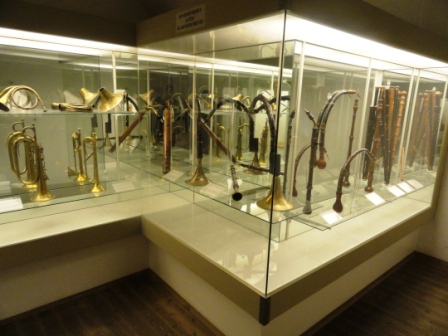
The historical instrumental museum has all manner of old keyboard, wind, and brass instruments.  Many were quite strange, like the combo violin-hunting horn (below); the bassoon with the sea dragon head (below); and the ocarinas that look like porcelain ray-guns (really--you'll have to take my word on this, as I don't seem to have a picture of them).  We eat lunch while listening to musical examples and descriptions (in English!) of many of the instruments.  Then it’s upstairs to the toy museum, with a train collection, play rooms for children, and a special exhibit about circus toys.  In the film room we watch (a dubbed) Danny Kaye escape from a circus lion cage, a fairly malevolent Mickey Mouse/Donald Duck short, and the Poochini cartoon I’m sure I saw on tv as a kid—the one about a dog magician who conducts a snobby tenor in Figaro’s famous aria while plaguing him with questionable ethnic and regional stereotypes, including a brief blackface episode.  Thoroughly out-museumed by now, we purchase an Advent calendar designed like the manuscript for “Stille Nacht” and head out into the rain, looking for a Konditerei.  Down one of the numerous alleys we find a quaint little place where we enjoy hot chocolate and a generous and truly delicious slice of plum tart.  (I have discovered that I love plum tart.)  Although it was good to sit in the warm and dry, we have to get back to the hotel, pick up our bags, and travel 5 hours up to Frankfurt, where we have a hotel room waiting for us a few minutes from the train station.


Saturday:
Him: See you on Skype!

DH gets up at the first alarm, grabs his bags, and walks to the Hauptbahnhof (main train station), where he catches the Strassenbahn to the Flughof (airport).  By the time I am finishing breakfast and similarly heading to the Hauptbahnhof, his flight to Heathrow is taking off.  I take the train to Fulda and change to Dresden.  By the time I am back in my apartment 6 hours later, he is somewhere over the Atlantic, on a 10-hour flight from Heathrow to DFW, where some of my relatives come to visit with him and see our pictures during his 4-hour layover there, before finally flying home again.

Although we walked a lot and had a fairly ambitious itinerary of sights, I think it was an enjoyable vacation.  DH would have preferred to “do Austria” without jet-lag, but he was happy to travel together.  It was certainly a mental break for me.  For just one week I stopped thinking about my dissertation all the time, and I will be sorry to get back to the grind.  Probably the catch-up reading I’ll do this weekend will light my fire again, and then there will be the sprint to Christmas/New Year’s.

The poster outside our Pension room is the closest we get to The Sound of Music.

Auf wiederschauen!


Tuesday, December 7, 2010

This isn't Mozart's Salzburg anymore, part 9 of 10

Thursday:
Mozart hated Salzburg; he found it provincial.  Although today it is a Mozart- and Sound-of-Music mecca, in his time this settlement nestled along the Salzach River was a salt-mining town and garrison.  The picture at left was taken from the fortress that overlooks the Altstadt.  I can’t get over the fact that the Festung Hohensalzburg was a fortress built by and for the various princely (arch)bishops who ruled here.  I am familiar with the Church’s secular and political Macht (power) up into the early-modern period, but the obvious militariness of it all is even more disturbing than the fact that they’ve set up a jail cell as a torture chamber, even though no prisoners were actually subjected to enhanced interrogation techniques here (the German audio guide makes this point twice).  Most of the rooms are pretty much empty, although there is a smallish museum of period material culture (furniture, tableware, jewelry, instruments).  In the gift shop I notice a sign the says the speedy Bergbahn up and down the plateau will be out of service beginning in January, in order to make improvements and decrease the ride time!  I guess it's a bottleneck during the tourist season.

There is also an unrelated Marionette Museum tucked in one corner.  Because the marionette theater is not playing anything the nights we’re in Salzburg, I make it point to stop in here.  I associate stringed puppets with Central Europe, not because of the Sound of Music, but because on my first trip there (to Prague in 1994), my brother and I were quite taken with the marionettes a street performer used.  In a box somewhere are the puppets on which we spent our precious souvenir money, a witch and a wizard.  And anyway, Richard Rogers got the idea for the "Lonely Goatherd" scene from the puppet theater that was founded here in 1913 already.  (The one at Schloβ Schönbrunn in Vienna may be older.)  Unsurprisingly, Mozart operas are a staple of marionette theater in Austria; you can see as at right as Papagano and Papagena from Die Zauberflöte.

We are traveling after the usual tourist season (which ends with October) and before the holiday season, so we thankfully miss most of the crowds.  Normally both DH and I bemoan the bleeding of Advent into the fall (the Christmas chocolates appeared in the grocery stores in Dresden two weeks before Halloween!).  However, we are grateful this one time that merchants are catering to tourists and have started the holidays early, because it means we get to “do” Christmas together this year after all.  And in fact, the Christkindlmarkt opens on the squares around St. Peter’s Cathedral and the Residenzschloss today.  We ogle the rows upon rows of straw, glass, and painted-wood decorations which would be adorable if it weren’t so obvious they were mass-produced.  We try a Schneeball (left) and a Winter Zauber (an alcoholic hot chocolate too strong for our tastes).


Then it’s back to the hotel to warm up and nap before going out for dinner.  We first try the traditional Austrian Stuberl next door, but it turns out that it is most authentic in its smokiness, something I have quickly come to associate with Salzburg, because it seems like someone near us is constantly smoking.  Austria is governed by the European Union’s smoking regulations, which require that restaurants have smoking and non-smoking sections (the “club” next door is apparently exempt).  However, of all the restaurants we visit with separate sections, not one ever actually closed the doors between the two sections, so it seems Europe is where much of the United States was ten years ago.  We are happy to live in a state that has gone smoke-free, because we are both fairly sensitive to smoke.  So we quit the Stuberl for the restaurant on the corner that is smoke-free, almost empty, and serves Austrian, Italian, and Indian cuisine.  We consume a yummy candle-lit meal of tortellini and schnitzel.


Monday, December 6, 2010

The treasures of Attnang-Puchheim, part 8 of 10

Wednesday:
On account of our over-stimulation on Monday, and also a pot of Goulasch made just for us, we decide to postpone our trip to Salzburg and spend another half-day here in Oberösterreich.  We enjoy a relaxed early morning and a traditional “sweet” Austrian breakfast of breads, meats, cheeses, and jams that suspiciously resembles the “savory” dinner we had last night of breads, meats, cheeses, and pickles.  Then the three of us (distant cousin, DH, and I) set off across some fields and woods to a nearby castle (Schloss Puchheim) and basilica (Wallfahrtsbasilika Maria Puchheim, below).


The "castle" is really just two long buildings around a central courtyard; one is an arts academy and the other was owned by some descendant of a noble family who recently passed away; it is in disrepair and the town is trying to acquire it for renovation.  The church is a certified pilgrimage site dedicated in 1891 to die Mutter von der immerwärenden Hilfe (“the mother of perpetual help”).  The central icon is a portrait of Mary and the Christ child, the Gnadesbild (mercy image), which is not only a replica of a painting in Rome but has also been touched to the original, which is credited with several healings.  The history of the icon is illustrated in paintings around the edges of the nave, and the basilica’s copy hangs in the chancel over the crucifix.  There is also a copy under a little pitched wooden roof on the path in the wood; such mini-shrines still dot the landscape in Catholic parts of Germany and Austria, although presumably they used to be more common.  What is more, thankful pilgrims will donate an image to the basilica in thanks for answered prayers.  There is an entire hallway of such pictures, going all the way back to the 1890s.  You can see the Gnadesbild in some of the frames on the wall.


The last, and really cool, detail about this church is the Krippe.  It dates from the 18th century and is what appears to us a “typical” Austrian nativity, in that it is stuffed with figures, most of whom are not mentioned in the Gospel accounts (townspeople, mountain men, musicians; heck, the stall can be debated, but we won’t go there right now).  The creche is protected from the light by a red velvet curtain, and here you can see some snapshots.  To read DH's blog post about nativity scenes, click here.


After a delicious lunch of Goulasch, Spätzle, and cucumber/vinegar salad, we hop on a train for the quick ride to nearby Salzburg.  Being none too ambitious, we wander through the Mirabelle gardens down to the old town, where we visit a woodworking shop, and end the day with Indian food.


Sunday, December 5, 2010

This one is for Grandma G.--part 7 of 10


Tuesday:

Today is the long-awaited day: DH’s return, and my first visit, to Zell am Pettenfirst, the tiny village in Oberösterreich (Upper Austria) where DH’s grandmother, great-grandmother, aunt, and father spent the 10 years after World War II.  His Oma just died in August, so it is a bittersweet pilgrimage.  From her eulogy I learned that they had been living in what was once Yugoslavia; she spoke German, Croatian, Hungarian, and—after immigrating in the 1950s—English.  When ethnic Germans were no longer welcome after the war, they traveled by foot north to this little farming community.  My father-in-law was only 2 years old.  There, Oma helped rebuilt the fire house, destroyed by Allied bombing intended for the nearby railroad station; and everyday she hiked over the Pettenfirst to work the fields.  We take pictures of the fire house (seen at left from the bus stop), church, the old school building, and the place where their house used to stand.  (By the time the family visited 17 years ago, it had already been torn down.)   And of course, we have to hike up the Pettenfirst.  At the beginning of this post you can see the town from the hill at the foot of the trail; it takes half an hour to reach the summit.  Someone has created a Wald der Kinder (Children’s Wood), with interactive stations all the way up to the top, so on our way down we indulge our inner kids and goof off a little.


We eat dinner that evening with some of DH’s remaining relatives in the Old Country: Oma’s cousin and her husband, and two of their daughters.  It is my job to tell them about Oma’s death, which puts a damper on what was otherwise a happy meeting sharing news and photographs of our families. We spend the night at the house of one of the daughters.