Friday, October 29, 2010

Riddle Me This

In an attempt to encourage audience participation on the blog, I have devised a visual game around some of the technologies I use here in Dresden.  Can you identify them from the photographs?  To allow everyone to participate without the early birds spoiling it, all comments will come to me for moderation until Monday, when I will publish them, along with the answers.


(When guessing, number the images 1-9 from upper left to lower right.)  Bon chance!


Tuesday, October 26, 2010

Adventures with my bicycle, Part 3 of 3

This is the last of my bicycle adventures, the detour I made on the long trek back up the hill above my house to visit Schloss Albrechtsberg, which dates to 1854 and a certain Prince Albrecht, kicked out of Prussia for his morganatic marriage to Rosalie von Rauch, the daughter of a former Prussian Minister of War and "merely" Countess of Hohenau. The afternoon was lovely, so I parked my bike and wandered around the grounds, which have been open to the public since 1930.  Like the other Elbschlösse (“Elbe castles”), this one has a magnificent view of the river and the city on the other side.  Because of the leaves on the ground and the vines over the baroque architecture, it felt a little like I was discovering a forgotten civilization.


Albrecht, in case you are wondering, was the fourth and youngest Hohenzollern son.  His older brothers included Prussian King Friedrich Wilhelm IV and also Prussian King/German Emperor Wilhelm I.  Poor Albrecht made it to the rank of Generaloberst (Colonel-General) in the Prussian cavalry before he kicked off in 1872 at the early age of 63, but he's probably best known for the Nazi SS using his Berlin palace as their headquarters, with the Gestapo just down the street, also named after him.

Monday, October 25, 2010

Adventures with my bicycle, Part 2 of 3

The Monday of my first full research week here in Dresden, I had an appointment with myself at the Main Saxon State Archive, which I had visited once before while doing pre-dissertation research several years ago.  After eating breakfast and packing a lunch, I checked Google Map one more time for directions to the archive, which I remembered as being in the Neustadt rather near the river.  It looked like I had a rather “straight” shot along the curve of the Elbe.  Just to be sure, I entered the address from the archive’s website into the directions form…and was surprised to discover that the archive had moved!  Sure enough, when I read the archive’s website closely, it gave its “interim address,” which was rather more north.  Fabulous.  I had almost ridden to the wrong part of town!  But the map suggested a 30-minute ride, so I wrote down the major streets, packed a city map just in case, and set out.

Right off the bat I ran into trouble: cobblestones.  Not the little ones either, but big bumpy ones. This was going to be an uncomfortable 2 miles.  Just after I noticed an older man going through a doorway in the wall holding up the hillside, I looked ahead and was disconcerted to discern what looked like continuous cobblestones and wall as far as I could see.  Which wasn’t far, considering the fog (right, a look back at the way I had come).  But what if there really wasn’t a path for me to turn north when I needed to?  So I back-tracked to the doorway.  Big mistake.  There followed the most ridiculous exercise of me pushing my bicycle up what I swear was a 45-degree angle for at least 10 minutes.  The path seemed never to end.  Below is a look back from the top of the path, which unfortunately was still not the top of the hill, so I had to continue up, up the street.

At the next intersection I checked my map, and I appears that I had taken 2 sides of the triangle that included a rather “straight” shot using another street that runs by my house.  Great.  Well, at least I was up now, and it should only be a matter of riding those two miles and then making a slight jog to the right.  Yeah, right.  This mostly down-hill stretch actually wasn’t too bad, if you excuse the calculations I tried to do in my head between whizzing cars on my left and when the signs allowed me to be on the sidewalk (i.e. not at tram stops).  My first attempt to turn right required another consultation of the map, because despite being a major intersection, there was no street sign.  Okay, I had to go another two blocks and then turn right.

And this is what I saw when I got there: Strassenumbau! (construction).  The picture doesn't really do it justice; to the left, where I wanted to go, the entire street is torn up several feet deep.  So I walked my bike through the gauntlet of pedestrian fences to the next street I was looking for, where there was more Strassenumbau!.  So I walked my bike along the street, until finally I came to the next turn.  Which I made.  Then things started getting a little strange: the road became a dirt footpath through some field with random trash piles.

And this is what greeted me at the end of the path:*
Just kidding, actually, it was a locked gate.  Thank you, GoogleMaps, for sending me the back way to the archive, which is currently housed at a low-key military base.  I didn’t stop to take a photo but turned around, retraced my route, and took the street like a normal (law-abiding) person.

An hour later, I had arrived…but I didn’t relish the trip home at the end of the day.  I ended up taking a different (cobble-stoned) street down to the main road, where I braved the traffic as I climbed the hill most of the way, before finally giving up and walking my bike to the top (no gears, remember!).  To break up the hike, I took a short detour, which is the adventure described in my next post.  To get home at the foot of the hill, I wasn't about to go back down the wooded path, so I decided to take the hypotenuse of the triangle from this morning (Schillerstrasse).  If I hadn’t been afraid of careening into the enormous intersection at the bottom, I might have actually enjoyed the slalom.  But—and this is the catch I mentioned in my last post—the brakes on my bicycle are rather "soft": you have to squeeze the handbrake all the way down, pedal backward to engage the pedal brake, and then will the bike to stop.  It was thrilling, to say the least.

I finally made it home, but I haven’t replicated the feat since, in large part because of the cold I had caught in Bonn developed into a full-blown sore throat/fever/cough, and also because the weather is getting colder, especially in the mornings.  It takes 30-40 minutes and a bus, a streetcar, and a bus to get from home to the archive, but as a compromise, I now walk one third of my commute each way: up the streets under construction in the morning, and down, down, down Schillerstrasse in the evenings.  So I get about 30-40 minutes of exercise each day that I go to the state archive.


*--This graphic courtesy of Electronic Captain.


Sunday, October 24, 2010

Adventures with my bicycle, Part 1 of 3

The first weekend I was in Dresden, I started looking for a bicycle as a cheap way to get around town and get some exercise too. (I can’t really make an environmental argument out of getting a bike, since my alternative mode of transportation is the city’s trams and buses.)  Plus, Dresdeners ride a lot, so that makes it a pretty safe town to bike in.  There’s a catch, though, and I’ll get to that in the second installation.

Anyway, I tried the local Craig’s List, but it was pretty sparsely populated, so I googled around for alternatives.  I ended up on an ebay site, where I found a nice enough looking bicycle, complete with basket, for 40 Euros.  I mustered up my best German and called the phone number listed.  Between the two of us we ascertained that the bike hadn’t been sold yet, and that I would come pick it up on Tuesday afternoon.  But she sent me an SMS with her address, to make sure I “got” it.

The bicycle is—how shall I put this?—a “classic.”  It’s reddish orange, and the front and back lights work, which is good, because the German police will pull you over if you are riding without them.  But the basket is smaller than I thought—my bookbag only fits if it is not full, which means I mostly have to carry it on my back = sweaty arrival.  And it has no gears…!  Sorry, that was a revelation for me, and it turns out that having gears or not matters, because I live on the right bank of the Elbe, which is elevated.  The reason my neighborhood used to be the most expensive in Europe is because of the stunning views and cool breezes way up above the stinking city = hills.

Nevertheless, one Sunday afternoon, when I should have been washing laundry or cleaning my room, I decided to take a bike ride instead.  The sun was shining on a beautiful autumn day, and it seemed like all of Dresden was out for a stroll, or a ride, or to fly a kite.  I had noticed a Schloss (castle or palace) a little ways up the river from me, so I checked the distance—something over 4 miles—and set off with some snacks, a book, and my camera.

Here’s where not having gears turned what might have been a joy ride into something of a workout as I pedaled through Loschwitz, Wachwitz, and Hosterwitz with their Biergartens and B&Bs.  (The place is probably a tourist trap during the summer.)  Thankfully the last bit was pretty flat as I rode past a pick-your-own farm and onto the grounds of Schloss Pillnitz.  I parked my bike and walked around for half an hour, enjoying the Elbe.  Then I sat and snacked and read a little.  Finally, I hopped on my bike for the half-hour ride home again.

Schloss Pillnitz is a popular site for walks and family outings; nearby is a steamboat stop; and it has a museum dedicated to Augustus the Strong (Protestant Elector of Saxony, and then Catholic King of Poland).  Augustus II got the estate after the death of his brother in 1694, and in 1706 he gifted it to his mistress, the famed beauty Anna Constantia von Brockdorff and Countess of Cosel.  The castle's official website doesn't give near as many juicy details as Wikipedia does: Anna Constantia had to wait a year for Augustus's previous mistress to be banished before she could take her place as the official royal concubine (hey, even kings must have standards: one wife tucked away in a castle somewhere* and one mistress at court at one time!).  They had two daughters and a son together.  But apparently Anna Constantia interfered too much in  Polish politics, and after Augustus took up with an appropriately Polish-Catholic mistress, she was confined to Schloss Pillnitz in 1713.  In 1715, she escaped to Berlin in an attempt to retrieve a secret document in which Augustus promised to marry her.  Unfortunately, she was captured and subsequently imprisoned at Burg Stolpen until her death in 1765.  
 
I suppose in part to erase the memories of his erstwhile favorite concubine, August had Schloss Pillnitz made into an Asian-themed getaway in the 1720s.  There is a Water Palace on the river, a Mountain Palace across the garden-courtyard, and a New Palace between them, reconstructed after the original burned in 1818.  I didn't go in any of the buildings, but the grounds were beautiful and at that time still quite green.


*--Christiane Eberdine von Brandenburg-Bayreuth lived in self-imposed exile from Augustus's court.  The marriage was for political reasons to begin with, and then she was really huffy over Augustus II's (husband) and III's (son) conversions to Catholicism for the sake of the Polish crown.  Remember that after the Thirty Years War, the residents of a state were to be the religion of their lord; so August the Strong did two things: he built a Catholic cathedral in Dresden, a stone's throw from the enormous and beautiful (and Protestant) Frauen Kirche; and he issued an edict that Saxons could remain Protestant.  Christiane was never crowned Queen of Poland and was respected for her faith as "Saxony's Pillar of Prayer".  She also fretted over her son's eternal soul after his conversion, as I learned at the exhibit on religion at the Hygiene-Museum (but that's a post for another day).

Saturday, October 23, 2010

Good News!

Everyone knows the earliest and one of the most wide-spread vernacular Bibles is Martin Luther's translation from 1534. It wasn't the first German translation, but it has been incredibly long lasting, and in Germany today, a 1984 version is the most common translation in use. (By comparison, the King James Version was completed in 1611 and has largely been superseded by the NKJV, ESV, RSV, NRSV, NIV, TNIV, NASB, NLT, GNT, and BLT. Actually just kidding about that last one.) Unfortunately, even the updated Martin Luther Bible isn't the easiest to understand, even for native German speakers, so on recommendation from a friend I opted for a Gute Nachricht Bibel, which is based on the Good News Bible (from 1976).

Tuesday I went to a Hauskreis (a "home circle"--a Bible study in someone's home) with a new friend from the DAAD. Maybe it's because I have to concentrate so hard on both the pronunciation and trying to get some meaning as the words go by. Also it probably helps that most praise songs are pretty simple. I'm looking forward to being completely over my cold so I can get my singing voice back.

Our text was 1 Samuel 2, and we discussed whether Hannah was channeling God's sovereignty and justice or her own very human jealously in her song of praise; Eli’s parenting skills or the lack thereof; and how Hannah’s song—with the rich being punished and the poor being rewarded—reminded us of certain Psalms, of Mary’s Magnificat, and the Beatitudes.

The group is nice, and I plan to attend every Tuesday night the 5 months I am here in Dresden. I was rather frustrated, though. Even though I can understand what I read in my Gute Nachricht Bibel and often know the words from my New Revised Standard Version in English, it is completely another matter to produce interesting commentary in the course of a discussion, because I don’t know the vocabulary in German well enough to insert it into my speech. And you can forget quoting verses. I’m not a big fan of memorizing Bible verses, but being able to insert snippets here and there can help you make a point. I mean, heck, I'm still just learning all of the names of the books of the Bible! (I really puzzled over Jesaja and Sacharja.) DH says there are a couple of Chinese students in Grad Study back home who are also having some difficulties, which I can easily believe, because we tend to be pretty Biblically literate, and sometimes drop names or theological theories like a tree sheds its leaves in autumn. I learned a lot of that stuff in that group, but for any newcomer trying to do it, and in a new language no less, it’s hard. But like I said, these Methodists(!) seem really friendly, and I think we'll get on just fine.

One final point: I have become one of those people...you know, the ones who read their Bibles in public. I take it on the bus or streetcar to have something to read while I commute. I don’t feel any social inhibitions about it, largely because reading my Bible in German is new and exciting--I mean, I can do it.* There’s so much to re-learn in this new language, and I want to know as much as possible. On top of that, I find myself approaching familiar passages with new eyes. (This probably isn’t what they mean when they suggest doing your reading in multiple translations, but there you go.) I am working my way through John (Johannes) right now, and then I think I will tackle Isaiah (Jesaja).


*--This feeling reminds me of the time I was cussed out by a German Zivi while staying at the Goethe Institut in Göttingen during college. A mutual friend of ours had taught him a bunch of English curse words, and when I joined them, he delighted in being able to use them "correctly", albeit it my expense! They thought it was a hoot. I have that kind of joy at the simple accomplishment of understanding my new Bible. :)

Wednesday, October 13, 2010

The Rhine River Valley

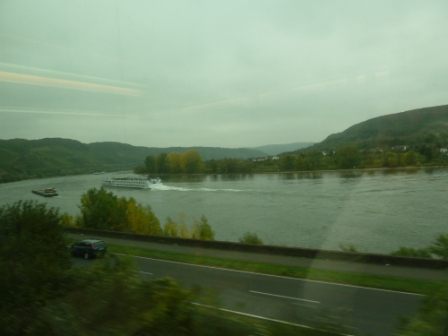
From last Friday: In a couple of months I will write a post about living on Dresden’s river, the Elbe. But today’s post is about Deutschland’s more famous waterway: the Rhine. I type this on the train heading north from Frankfurt am Main, German’s financial capital situated in the highlands of Hessen, up to Bonn, capital of the former West Germany on the plateau of Nordrhein/Westfalen. This stretch of the river's 820-mile course is known as the "heroic" Mittelrhein (Middle Rhine). As we travel in the same direction the Rhine flows, we pass countless picturesque scenes on my right-hand side. On the near bank Gartenstädte (Garden Cities) alternate with narrow strips of businesses and houses, sometimes only one house wide. On the other bank are the slopes of the Rhine Gorge. Plots of grapes tilt precariously among the forests--this is Riesling territory--and castle keeps and churches top the rocky cliffs with some regularity. Adorable small towns nestled at their feet on the water’s edge. I’ve made this trip once before, in the summer of 2006, when I participated in the German Historical Institute’s Summer Archive Trip. I was on my way to Koblenz, where the Mosel and the Rhine Rivers meet at what’s called the Dreutsches Eck (German Corner). I remember that I periodically looked up from reading Herculine Barbin: Being the Recently Discovered Memoirs of a Nineteenth Century French Hermaphrodite to admire the river valley. Nevertheless, familiarity in no way bred contempt today! The view was too beautiful not to do the touristy thing and snap a few pictures to share with you.  Unfortunately, my first foray into a video slide show didn't work, so here are a few snapshots.  The view was gorgeous, even though it was a rather gray day.


p.s.--I got some of my information from this genealogy website.

p.p.s.--My first train home from Bonn was late due to construction on the tracks, so I missed my connection at Frankfurt to Dresden. Thus, my inter-city Verkehrsmitteltabellierung* adds 2 buses, 1 S-Bahn, 1 taxi, and 5 trains (instead of 4).

*I just made that word up; it means "transportation tabulation."

Tuesday, October 12, 2010

Soup to Nuts

1) While researching at the Deutsches Kochbuch Museum in Dortmund, I couldn’t figure out why the cookbooks tended to start with a chapter on soup. I had supposed they would put the most important main dishes, specifically meat dishes, first. I later learned cookbooks were traditionally ordered by the courses of a formal meal, and soup comes first. Hence, soup to nuts!

Davidis-Holle, Praktisches Kochbuch (1901)

2) Living in hostels for the second two weeks of my travel, I tired of belegte Brötchen (sandwiches), so when I got to Dresden and could buy and make food for myself, I thought soup would be different (and cheap). I didn’t want to get canned soup or a soup mix, though—I was willing to compromise some of my food principles for economy, but not all of them!

Funny aside about soup mixes: the first time I was in Dresden (2006), I stayed in a youth hostel a ways out of town that had kitchens for the guests to use. On a very strict budget, I had purchased a split-pea mix that I cooked up for dinner one night. Having traveled in old Communist Europe before (Czech Republic, Berlin), I knew not to drink the tap water. But when making the soup, I didn’t think to cook it with the bottled water I had gotten from the store. It turned out—how shall I put this?—crunchy. The soup was actually gritty from the hard water from the tap. Thank goodness the water in our Dresden apartment is potable! Saves money instead of buying it bottled, and even though you get a Pfand (refund) for recycling the large bottles, it’s surely better for the environment that I’m just reusing an old bottle. Probably all the Bisphenol-A has leeched out by now, so why replace it, right?

3) So, the first dish I cooked for myself here in Germany was mixed vegetable and potato soup, using the soup vegetables I had bought bundled at the grocery store. While chopping them at home, I realized I didn’t recognize all the ingredients: the carrot was obvious, but what looked like it might be a celery stalk turned out to be onion; there was some green herb; and parts of two tubers, one of which I think was celery root and the other I guessed to be a turnip. So even soup I made myself turned out to be foreign.

4) This blog post was prepared in a facility that processes nuts and may contain traces of nuts or nut products.