Sunday, January 23, 2011

Lost in Translation

This was too good to pass up...

I recently returned to Germany from a 10-day trip to the United States.  When I got to the airport in Frankfurt for my flight across the Atlantic, I switched from German to speaking English, and I found this freeing.  My German is sufficient but not proficient; I especially understand more of what I read and hear than I can express fluently.  For the duration of my trip to the East Coast, I didn’t have to think about what I wanted say before I opened my mouth: whether I knew all the words I wanted to use, had them in the right order, or needed to beat around the bush to get my point across.  Sometimes I don’t say anything at all in German, if I don’t know the right phrase.  As a historian, I work with words, and I am used being able to say what I want to say, how I want to say it.  Living in a foreign country has been a linguistically humbling experience.  In recognition of this, I offer an entry about how sometimes meaning can be lost, even after translation.

My reading German is pretty good, but I still use a dictionary, usually LingoPad, which I downloaded onto my laptop before I came over.  Sometimes I recognize a word but can’t remember its definition.  Sometimes I come across completely new German words for me.  And sometimes I need help puzzling out something hand-written, so I start entering letters into the search box to see what the likely possibilites are for some chicken scratch of a word.  (This dictionary only searches vorwärts, or forward, which can make finding words tricky if I can read the prefix and suffix, but not what comes in between.)  It has other quirks, too.  For instance, there seems to be an entire bird watcher’s guide book of ornithological names.  And then sometimes even my English fails me, because this is a translation dictionary and not a definition dictionary.  So for instance, the entry for überschüttete is “to whelm.”  …?

When this happens I have to wait until I get home at the end of my day at the archive and use Miriam-Webster’s online dictionary to figure out what’s being talked about.  Here are some of the more interesting, amusing, or just plain confusing translations LingoPad has offered me.  

Pasch = doublets? snakes eyes? all fours?  boxcars?
Drachenschlucht = dragon ravine?
das Grummet = foggage, or after-grass (?)   
Schleie = tench (that's a kind of fish, if you're wondering)
Pfändungen = seizure distraints?
Teichmönch = pond monk??  actually, it's a convex tile
inkommodiere = incommode  well, yeas...
Schiebungen = wangles? wth? ...turns out it means "profiteering"
Rummel = shivaree (later I found out this is a hype or shindig, hype, shivaree)

Of course you have to watch out for cognates: Giebel = gable, Gabel = fork.  Zapfen are most commonly pine cones, but apparently the word also means gudgeon, spigot, trunnion, tenon, peg, and stud!

And then there are entries like the following.  I’m looking up the saying, “Lügen haben kurze Beine.” (Lies have short legs, or The truth will get out.)  I type “Beine” into the search box and scroll down.  Second to last is the sentence “Man kann sich die Beine abfrieren vor Kälte,” which translates more or less literally to „It’s cold enough to freeze one's legs off.“  Rather than offer something tame like that, however, LingoPad offers this gem: “It’s cold enough to freeze the balls off a brass monkey.”  I’m sure I’ve heard that before, but it was so unexpected that I nearly snorted out loud, there in the middle of the Main Saxon Archive.  Meanwhile, outside, it was cold enough to….well, you know.

Little Shop of Horrors

***Update below!***

"Our giant has haemorrhoids"
This past week while I was home on the East Coast, I delivered a public lecture on a topic related to my dissertation at Observatory, the lecture and exhibition space my friend Joanna Ebenstein runs in Brooklyn. She is an independent scholar and artist who also writes a blog called Morbid Anatomy. Joanna is interested in history of science and medicine, in museums and collecting, and most of all in death. In addition to books, she has an impressive collection of memento mori and specimens in her research library (right).  My talk was entitled "Body Voyaging or, A Short Excursion Through the History of Fantastic Anatomical and Physiological Journeys Through the Body" (sample image, left).

In this vein, during my travels here in Europe, I have occasionally come across some truly bizarre and/or disturbing things, some of which I will now share with you.


This was the first find, in the window of a bakery around the corner from the hotel in Copenhagen where Joanna and I shared a room while attending a conference on history of science and medicine museums. It’s a Barbie doll…baked into a cake. I hardly know where to go with that--a certain line from Alice in Wonderland comes to mind--but as this is a family publication, I’ll just leave it there.

Radio PSR. Always. There. Even when you’re
lying in bed drinking a cup of coffee.


If you can believe it, this billboard advertisement for a local radio station is the less creepy of the two iterations I’ve seen. The creepier version I saw from a streetcar involved this man poking his head from another dimension through the fabric of the universe into the front seat of a car being driven by a cheerful young woman in a yellow scarf.  I just *love* when my favorite disc jockey physically invades my personal space, don't you?


You know my roommate moved us across town between Christmas and New Year’s to an apartment so new it’s still under construction. It’s in an old factory warehouse that is being remodeled into apartments, an excellent project to re-purpose an existing structure. But the people who painted the stairways have a different aesthetic than I do, so I will include one of their pieces in my gallery of the disturbing.


My artist roommate needs a more avant-garde, in-your-face style to support her artwork. I rather preferred the slightly gentrified older neighborhood with the century-old buildings of our last place. Ah well. More on the aesthetics of Lebensraum in a future post.


You have hear how I found this one. I hadn’t come across it during our three months at the old apartment; then, when we moved, the utensil drawer (like everything else) was wrapped in industial-strength cling wrap for the Schlepp across town. While our kitchen was still under construction, if we needed something we just made a hole in the plastic and pulled out whatever we needed.


The week before I left for the US, I got tired of plastic-ware and went looking for a spoon. This…hoof was sitting right under a hole in the plastic, I guess because my roommate had wanted to open a beer. Now if I were the screaming type, I would have exercised my vocal cords. But as it is, I knew that whatever that foot was attached to, it wasn’t the rest of Bambi.


Chucky’s German cousin Hans
I haven’t shared much from my research yet, so I’ll close with this disturbing image.  It shows Baby Hygiene, decked out like Father Time on New Year’s Day, representing the Second International Hygiene Exhibition in Dresden, 1930-1931. It has the face of a Kewpie doll and not one but two Hygiene Eyes, the symbol of the German Hygiene Museum and the major sponsor of the health fair.

In case you’re wondering, the text reads:

Nun geh’ ich schon ins zweite Jahr,
Bin kerngesund und froh,
Das machs daβ ich hygienisch war.
Seid Ihr es ebenso!

Now I’m entering my second year,
Completely healthy and happy,
Which means I was hygienic [in my first year].
May it be the same for you!


original art deco hygiene eye, 1911
new objectivity logo, 1930


***Update!***
My MIL shared with me that the Barbie-doll-cake is an old cake-decorating trick:

"The Barbie doll in the cake is something we used to make in the late 70's.  Both Aunt M. and I made them at different cake decorating classes.  We had a good laugh one Easter at Grandma's because mine was too tall for the cake I had baked and I talked about cutting off the legs to make it work.  G. said why don't you just raise the cake?  Evidentally Uncle P. and Aunt M. had had the same conversation when her doll was too tall for the cake she baked.  You bake the cake in a bowl shaped cake pan and then cut a hole and insert the doll, then decorate it.  We have a picture of M. holding my decorated cake.  He was about 4 years old and so proud to have his picture taken holding the cake.  He probably won't want to see the picture now."     Thanks, MIL!

Saturday, January 1, 2011

Prosit Neujahr!

After my adventure in the Saxon Switzerland and the move across town to a new apartment right after Christmas, I was not feeling very ambitious about New Year's Eve.  So I almost didn't accept my roommate's invitation to a small party with some of her friends (whom I've met).  However, I'm glad I did: we had a stereotypical but very fun German "Silvester."

Some background: despite years of German language and culture education, I had no idea that New Year's Eve is known as "Silvester" here.  It was pretty easy to figure out from the posters advertising parties and concerts on 31 December; but it turns out my German hosts didn't even know how the day got its name.  When I asked about it, we learned from Google that the last day of the year is the feast day for Saint Sylvester, the fourth-century pope whose tenure saw the Council of Nicaea and Emperor Constantine's big building projects, notably the Basilica of St. Peter's in the Vatican.  As someone mentioned, there was very little to do with saints yesterday...


This snapshot doesn't do justice to the blue flames.
There were just five of us plus my roommate's six-year-old daughter at our party.  The evening started a little after 7pm in the kitchen.  I made guacamole from the avocados in the fruit basket DH got me for Christmas, and my roommate skewered some pan-fried ham and prunes (surprisingly delicious).  There was also cheese, olives, deviled eggs, flat bread, and Greek chicken.  But that was just ballast for the main attraction: a Feuerzangenbowle.  This party drink begins with a warm red-wine sangria.  Then you soak a sugar loaf with rum, light the rum on fire, and, let the sugar melt into the pot, sweetening it.  I knew what a Feuerzangebowle was because in a German humor class in college, we watched the 1944 comedy of the same name whose first scene involves a large one of these.  But I had never made one before.  Ours involved a little last-minute DIY excitement: my roomie had to construct a rest for the sugar loaf out of wire while the wine was heating on the stove. To the left you can see the final result.  I found the punch strong but tasty.

The next "Projekt" was Bleigiesserei, or lead pouring, in which a small amount of lead is melted in a spoon held over a candle (right) and then dumped into a bucket of cold water, where it hardens.  You are supposed to be able to tell your fortune for the coming year in the shape(s) that result.  This Sylvester tradition I had recently read about, because the one really helpful entry in the farmer's journal I transcribed from the 1920s and 1930s is about the family's celebration on New Year's Eve 1929.  Farming during Weimar was difficult because of weather misfortunes and the precarious financial situation, so this entry stands out for its warmth and obvious happiness.  After describing the dinner his daughter, fresh from Home-Ec School had cooked (a win for my dissertation!), Walter Lohs lists the results of their Bleigiesserei: his wife a zeppelin, his son something between a devil and a black cat, his daughter two frogs, him an owl and a flute with stag's antlers, one guest a bouquet of flowers and a swallow's nest, and the other something unintelligible.  We poured a tadpole (new beginnings, evolution); a witch flying on a broomstick and a child (travel); a swan carrying a ring (marriage?); either a dolphin leaping out of the water or a fairy flying above two layers of earth (achievement); and one moth wing, a leaf boat, and a small egg on fire.  Can you guess which was mine?  (Answer below!)

Then is was time to watch "Dinner for One," or "Der 90. Geburtstag," an 11-minute English-language comedy sketch that involves a delusional old lady, her comedic butler, and lots and lots of alcohol.  Never shown on either British or American tv, it has been a New Year's classic in many parts of Europe and also South Africa for about 40 years.  (The link above is a short history of this quirky tradition).  Critically speaking, I suppose it doesn't rank up there with Monty Python or "Are You Being Served?", but after a couple of rounds of Feuerzangenbowle...

At this point it was 11:30pm and time to light the fire on the balcony and watch the fireworks.  Fireworks are legal here, and Dresdners make the most of the chance to celebrate and destroy stuff.*  I saw home footage from last year: hundreds and hundreds of people crowd the plazas and the bridges and general mayhem ensues.  You could hear regular "bangs" from about 8pm, but with half an hour to go the noise became constant.  We huddled on our balcony and cheered our thanks to the group in the next courtyard for the bottle rockets and sparkler showers they set off.  Finally, at midnight we toasted each other with champagne and caught glimpses of the city's firework display over the Elbe.  The steady explosions began to drop off after about 12:30.  All the fireworks really made it feel like the celebration was an event.

What was the first thing you did in 2011?  Ours was the last "Projekt" of the night: fresh fruit and chocolate fondue.  Lecker!  It was a delicious and convivial way to begin the new year.  As we rutschen (slide) into 2011, may you find health, happiness, and adventures.

What do you think it is?


*--As I walked home this morning, I observed said destruction: a pane of glass from a telephone booth and most of the sheets of glass of a tram stop!


Sunday, December 26, 2010

Stille Nacht, Heiligabend

About a month ago, my roommate mentioned that she has had the tradition for the last 5 years of camping with a group in the Sächsischer Schweiz for Christmas Eve (Heiligabend). The impressive sandstone formations of the "Saxon Switzerland" lie about 60-70 km (c. 40 miles) southeast of Dresden, tucked right up along the Czech-German border, and I had heard the area was very beautiful. The dozen or so campers are not particularly religious and don't have family in town with whom to spend this most important night of German Christmas together. Some are friends back in Dresden, and others see each other only once a year at this gathering. They build a fire in a Boofe (rhymes with "sofa"), the Weihnachtsmann (Father Christmas) comes for the children, and the adults can generally escape from the hustle and bustle for a night. We would have to hike with all our food, drinks, gifts, sleeping bags, and sleeping pads. Did I want to go? Heck yes! Of Christmas Eve services there will be plenty in my life, but this was a once(?)-in-a-lifetime opportunity, so I told her I would love to come along.

View to Schmilka, Sachsen
Early in the afternoon on the 24th, a few of us met at the Neustadt-Bahnhof and took a regional train an hour to Schmilka, a small German village with a Czech name that is technically part of the famous spa Bad Schandau, 5 km away. A little creek (Bachlein) once powered a flour mill (est. 1665!), but since the 19th century Schmilka has been famous as a gateway along the Malerweg (painter's path) to picturesque views sketched and painted by the likes of Caspar David Friedrich and Carl Gustav Carus. We took the little ferry across the Elbe River and walked past the Pensions to the trail-head and into the woods. The misty-rain in Dresden had become snow by the time we got off the train, and large snowflakes were falling. The path climbs almost immediately, so with heavy packs and a six-year-old, the going was slow and sweaty. I think it must have been an hour later that we left the trail, rounded a precipitous crag, and finally came upon the cave hollowed from the sandstone where the group had agreed to meet.

The night turned out to be just what you would expect a quasi-legal* "alternative" Christmas Eve in a cave to be: we shared food and cooked over the fire that we all helped maintain, there was copious smoking and the drinking of large quantities of wine and Glühwein, we read aloud for each other, and when we woke up the next morning, the view was wonderful (see right). If you had to leave the Boofe to pee or get some wood, it was, in fact, a silent night. The star-scape probably would have been glorious if not for the snow clouds.

To get your gift(s) from the Weihnachtsmann, you either had to sing a song or read something. For my first present, what turned out to be a German-English Saxon cookbook from my roommate, I was having too much trouble sorting out English and German in my head to sing anything more complicated than "Jingle Bells". For my "Secret Santa" gift--a really sweet pocket knife and a chocolate Santa--I adapted a passage out of my German Bible (here from the NRSV):


Who has woe? Who has sorrow? Who has strife? Who has complaining? Who has wounds without cause? Who has redness of eyes? Those who linger late over Glühwein, those who keep trying new Glühwein mixtures. Do not look at Glühwein when it is red, when it sparkles in the cup and goes down smoothly. At the last it bites like a serpent, and stings like an adder. Your eyes will see strange things, and your mind utter perverse things. You will be like one who lies down in the midst of the sea, like one who lies on the top of a mast. ‘They struck me’, you will say, ‘but I was not hurt; they beat me, but I did not feel it. When shall I awake? I want another drink of Glühwein.’  ~Proverbs 23: 29-35

Later, at maybe 2:30 am, someone realized that the Christmas story hadn't been read yet and asked if I would do so. So I read the nativity out of Luke 2 for those who were still around the fire. At a quarter to 4 the fire was dying and I wanted to lie down, if not fall asleep quite yet, so I took off my boots and changed my inner pair of socks, then zipped myself up in my borrowed sleeping bag (coat, hat, scarf, gloves, and all), and did fall asleep. I woke up at 7:30 as if my second alarm had been set but was able to sleep for another hour, until the guy sleeping next to me needed some of the acetaminophen I had in my bag (hangover, maybe?). Awake but not wanting to venture into the cold, I lolled in the warmth of my Schlafsack like a hot tamale until my roommate had started the fire again. Then it was time for a leisurely breakfast.
 
Hiking had been planned but the rest of the group was much slower to start the day, so I finally packed my stuff up and set off myself.  I made my way back to the trail through a light snowfall and then climbed the rest of the Lehnsteig. It was rather dangerous going both up and down, as where the earlier snows hadn't been trampled by hikers on Christmas Eve, it came up to the top of my knee caps.  Thankfully there were often handrails to help with the very steep trail. It being Christmas Day, I was the first one to trample the freshly fallen snow. You can admire see some of my photos over at flickr.


On the way down it would have been nice to have someone else there for reassurance; although my roommate was just a cellphone call away, I prayed I wouldn't twist my ankle between the steps and break my leg. I tell you the truth: never in my life had I wished more for a cafeteria tray; then I could have slid part of the way down! As it was no bones were broken, and back on level ground I took more photos of the trees, and the snow, and the burbling brook. When I did slip, it was on the ice from the car tire tracks back in Schmilka. Camera rescued after falling out of my pocket, I finally made it down to the ferry dock, rather wet and cold, but close to catching the train back to Dresden and a warm bath a couple hours later. I still find the little river's-edge villages charming and snapped some photos through the snow-covered train windows (also on flickr).


After Skyping with the family, I took a tram across town to celebrate some more with one of the families in my Bible study. We had "sandwiches" (paninis) and fruit/chocolate fondue for dessert.  Then they put their 3 adorable daughters to bed and we drank tea and talked and played a game before I finally headed home.

Today was Second Christmas, and I used the occasion to relax at home and with an ex-pat family before writing this post, a love letter of sorts: to God for so ordering the laws of nature that such beauty results; to my friends here for the holiday cheer; and to my friends and family far, for reading this. Merry Christmas to all of you!

This photo hardly does justice to the way the snow coated every bough.

*--After we got there I learned that they had been warned on other trips that it is illegal to make an open fire in the national park; I couldn't figure out why, if this is so, there were large logs arranged in a square in the cave. At any rate, no ranger found us this night, and no one had to pay a 600(!) Euro fine.

Monday, December 20, 2010

Fourth Sunday in Advent

Can you see who's looking over the balcony?

To celebrate the fourth and last Sunday in Advent, I visited the Dresden Stadtmuseum (city museum), where they have an exhibition on the history of Advent calenders and other Christmas handcrafts.  The precursors to Advent calendars included paper "leaves" with Bible verses that could be added to a "tree" of needles stuck in a rod.  In 1902 in Munich was printed for the first time a calendar of numbered rectangles with one card to be torn out of a booklet and pasted on for each day.  A neat version of this was a nativity scene with figures to be cut out each day and pasted over their outlines, sort of like an Advent-calendar-creche two-in-one.

Unsurprisingly, these objects reflect their times.  The earliest ones were of course religious, and many began with December 6, Saint Nicholas Day.  By the 1920s, secular calendars with "windows" to open and pictures of toys had become quite popular.  Angels, der Weihnachtsmann (Father Christmas)*, elves, snowy winter landscapes, and homey family scenes were other common themes.  Sometimes the image behind the window was printed on translucent paper, and the calendar was meant to be hung in a window for the sunlight to shine through.

Probably the creepiest thing I've seen in a long time was the booklet produced during World War II by the National Socialists, who wanted to focus honor and attention only on themselves (a key tenet of fascism: not the Party above all else but the Party and nothing else).  It included a poem about German war dead visiting the Christmas celebrations of good German families just for one night--der Heiligen Abend (Christmas Eve)--and then going back to their solemn watch over das Volk.  It was accompanied by an illustration of a shadowy soldier figure and a Hakenkreuz made out of the flames of the candles of the Advent wreath.

During the DDR, religious themes were forbidden on most Advent calenders (no creche, no angels, etc.), so der Weihnachtsmann and fairy tales dominated.  Religious calendars were only available through churches or Christian book stores and not in the state-owned and -operated ones.  One of the oddest things to me has been the common use of 6-pointed (and sometimes 8-pointed) stars in German Christmas decorations, such as for the windows of Advent calendar.  I realize this may be a function of geometry (two triangles or two squares overlaid), but I somewhere internalized the idea that the Star-of-David is a "Jewish" shape and am more accustomed to using 5-pointed stars.  I didn't notice if 6-pointed stars showed up during the NS time period, but they were definitely used after the war, just a few years of their having been used to single out a people for destruction.

The museum also displayed more recent calendars, including a series drawn by a local artist about the Dresden Neustadt that has been going on for over a decade.  And of course there were fillable calendars, with chocolates, toys, and one that was essentially a 24-pack of beer!  As a kid I remember we had Advent calendars--sometimes they even had chocolates in them, and with three of us wanting to open the windows, that meant an unbearable wait of two whole days until the next piece!  I hadn't had an Advent calendar in many years, but this year I am using one that I purchased here.  It has a totally stereotypical nineteenth-century bourgeois family-in-the-parlor scene, and the windows open to reveal things like gingerbread and mistletoe, and a goose.  I have ambitious plans to try to make my own for next year.

In addition to 110 years' worth of Advent calendars, there are also wooden pyramids, antique toys, and a collection of Nussknacker, the oldest from 1850.  Slate recently published an illustrated history of nutcrackers.  Like many other Christmas handcrafts, they gained in popularity in Germany in the nineteenth century, probably on account of the development of a large middle class with the income to buy and the space at home to display such niceties.  These are also the people who developed the candle-covered Tannenbaum; poorer folk made do with a pyramid, whose candles' heat turned the blades and displayed the carved figures.  Finally, they also showed a collection of turned and painted wooden angels whose designs became instant classics in the 1920s and 1930s.  What is remarkable about them is that they were designed and made by a pair of women, when the woodworking tradition has otherwise largely been a male art and trade.


After the museum I headed down to the Christmas market at the foot of the Frauen Kirche, which happens  to be nineteenth-century themed.  The booths are simple wooden shacks with old-fashioned decorations, and the vendors often wear something approaching period clothing over/with their modern winter gear (hey, it's been really cold here).  In the picture above you can see the Frauen Kirche towering over the live-manger in the middle of the market; when I was there they had some very un-photogenic sheep amid the Holy Family and one really large Wise Man.

Meanwhile, I was hungry and on a mission: to find Glühwein and a waffle (or similar).  I bought my hot drink first and drank it while watching the Plinsen maker flip this crepe variety.  I wanted mine with Nutella and banana, but they were out of banana.  The crepe was delicious, but I'm still not a fan of Glühwein--it's tends to be too strong for my taste.  Ah well.  More for those of you who like it!


*--Here in Germany they still distinguish between Saint Nikolaus, who brings chocolate and fruit to children who clean their boots on the night of December 5, and the Weihnachtsmann (Father Christmas), who brings bigger presents on Christmas Eve.  Sometimes it's the Christ Child who brings the presents on the night of his birth.  And then there's the Russian Grandfather Frost, a similarly jolly fellow who brings gifts on New Year's Eve.  My roommate even constructed an Advent calendar of little numbered paper baskets that hang across her daughter's room (too high to reach by herself!), each with candy or small gifts in them.  Do these children get spoiled this time of year or what?

Monday, December 13, 2010

Third Sunday in Advent--Adventmarkt food & drink

A little music to accompany this post on some of the wonders of Christmas market food.

I like to eat.  I like Christmastime.  So I am devoting a whole post to eating at the Advent markets that are so popular here.  There is lots of food and drink to be had at the markets: Stollen, Glühwein, sugar-roasted almonds, hot chocolate, Bratäpfeln, waffles and crepes with whipped cream or applesauce or fruit compote or hazelnut chocolate, Kinderpunsch (fruit tea with juice),  echter Tharandter Würsten mit Senf* (and Ketchup?!?), fresh meats and sausages, and large frosted gingerbread cookies on ribbon to hang around a child’s neck.

We'll start with the Striezelmarkt, which I described in an earlier post.  On the Saturday of the second weekend in Advent every year, a big procession through the Altstadt delivers the eponymous Stollen.  And this isn't just any loaf of Christmas bread: it's enormous.  That link has pictures that show how 30 workers combined more than 300 sheets of Stollen to look like one huge, powdered sugar-covered loaf.  It weighed 4 metric tons (8818.4 lbs) and used 1540 pounds of flour, 1433 pounds of raisins, 772 pounds of butter, 265 pounds of sugar, 375 pounds of almonds, 330 pounds of candied lemon peel, and a jug of Jamaica rum.  This year's loaf was just over 10 feet long, almost 6 feet wide, and almost 3 feet high.  They used a five-foot knife to cut it into pieces to sell after the parade.

Aside:  I didn't get any of the official Stollen, but as it was my turn to bring the munchies for coffee time after the church service, yesterday I borrowed the kitchen  of some very generous friends here in town, to attempt to bake a loaf myself.  Due to the formidable list of ingredients and the touchy nature of yeast breads, it is something of a feat.  The last time I made a yeast bread, I think killed the little beasties with too-hot water.  This time, they bubbled happily in their warm sugar-water.  Unfortunately, I added too much milk, so the dough turned out VeRy sTIckY. I probably added another cup of flour while trying to attain the consistency I remembered from having baked Christmas bread with my mother.  However, there was little risk of the dough becoming too tough, as I hadn't measured the filling, either (what's the use in saving partial packages of candied cherries and lemon peel?) and so had plenty of raisin-almond-candied-fruit-mix to go with the extra flour.  To my great delight, the bread rose beautifully on the radiator.  Then I had a fight with the oven, which I had been warned was cantankerous.  To make a very long story short, I had to take the bread out early because it was starting to burn.  After trimming the loaf, dusting it with powdered sugar, and letting it cool, I had to cut it to make it fit the the Tupperware, whereupon I discovered that the bottom and insides were still doughy!  So I reheated the oven, cut the loaf in half and brushed off the extra sugar for a second stint in the oven.  After cutting off the melted/burning sugar and dusting again, at last I had two edible loaves (powdered sugar improves  pretty much everything it touches).  The first loaf at least got good reviews, and next time I will have gotten the hang of it.


All that bother is why you can buy some tricky-to-make treats at the markets, like Bratäpfeln.  There are lots of ways to enjoy a baked apple, as the video above attests, but the one I had at the Striezelmarkt had been cored and baked with sugar and cinnamon in the middle and was served with a vanilla sauce.  Amazingly it wasn't too sweet.  My roommate has some loose Bratapfel tea mix, which is fantastic.  I think it's the cinnamon that does the trick.


I also bought a Pflaumentoffel, a figure made out of prunes that represents a chimney sweep and is supposed to bring good luck.  The people from whom I bought my figure were wearing puffy black winter coats and had large metallic collars on, like the Pflaumentoffel do.  I surely hope those were the proprietors, because it is cruel and unusual to subject one’s employees to such treatment!  I like dried plums, so I will actually eat it (not all at once, of course!).

Each Christmas market I have visited has its own character.  I have already mentioned the touristy nature of the Christkindlmarkt in Salzburg and the Erzgebirgische winter wonderland of decorated stalls at Dresden's Striezelmarkt.  I attended the Loschwitz-Elbhang Weihnachtsmarkt on the Saturday afternoon of its opening.  It was packed!  This market consists of stalls in a narrow courtyard in front of some shops, and then another ring of stalls across the street.  It is obvious that most of the vendors are local and produce what they are selling: wooden toys and figures, ceramic bowls, knitted finger puppets, felt hair accessories, stained glass decorations, and of course the requisite stall of socks.  The food offerings include roasted sugared almonds, Quarkbällchen, Bratwürst, and Pfefferkuchen (gingerbread).


At this market, I tried a Hefeklöße with sugar-butter and Heidelbeeren sauce.  I didn't really like it, although when the proprietor stopped by my table as I was finishing to ask, Hat es geschmeckt? ("Did it taste good?"), I told him it had.  A Klöße is a dumpling, and the one I ate tasted underdone.  I hear that may be on account of the way dumplings are cooked (dumped in a pot of boiling water), especially since this was a sizable dumpling.  The next week I went back for Quarkbällchen, which are powdered-sugar-covered deep-fried nuggets of deliciousness, also known as home-made donuts.


A few days later, a friend and I had a little time before Bible Study started, so we wandered through the Mittelalterlicher Markt am Stallhof.  It wasn’t as big as I had expected, but they go all-out with the theme: there are crest-flags hanging from the arches, the signs on the stalls use old-fashioned words, and the vendors are wearing variations on brown and green sacks.  There are a few gift stalls, and at one you can even purchase reproduction armor!  But the main purpose of this market (like the the one on Postplatz with the wattle-and-daub restrooms in the construction trailer, below) could be summed up as Ye Olde Outdore Meade Taverne.

Hopefully I'm not done with my tasting adventures.  I would still like to try a waffle and maybe the requisite Glühwein.  Also another bag of Quarkbällchen.  You know, for quality control.


*--"original sausage from the Tharandter Forest (southwest of Dresden) with mustard"—a long sausage served on a short crusty roll; ketchup is an American "improvement" on something that doesn't need improving!

[Ed. note--I have been assured that all the food and drink mentioned here was consumed purely in the interest of furthering the author's research aims.]

Wednesday, December 8, 2010

Auf wiederschauen Österreich!, part 10 of 10

An entire shop dedicated to Mozartkügeln (Mozart balls).
Friday:
Me: Es regnet.  (It’s raining.)

Today we have two goals: to visit Mozart’s birthplace, and to see the historical musical instrument museum, both near each other in the old part of Salzburg.  Although the one is fairly expensive, the other is cheap and comes with entrance to the historical toy museum, too.  The Geburtshaus Mozart museum is actually located in the very rooms Mozart’s parents occupied for 26 years, in a building on the Getreidegasse, now famous as a shopping district.  DH is disappointed that the apartment was filled with display cases; not even the bedroom is furnished as it might have looked then.  (In fact, the bedroom/birthroom was staged as an odd sort of shrine, with some of Mozart’s personal effects in black column cases in the darkened chamber.)  We compare the various portraits of the composer, read excerpts from his letters, and ooh at the collection of set and costume designs for his operas.  Okay, I am the one doing the ooh-ing, as I’m particularly taken with Karl Friedrich Schinkel’s designs for Die Zauberflöte.  If you’ve seen Amadeus, you may  remember the star-strewn sky in front of which the Queen of the Night sings her famous aria.  That detail in the movie is historical but a-chronological, as Schinkel’s production was staged in 1815, but the movie obviously takes place before Mozart’s death in 1791.  (Rather a lot of that movie is true-but-not-true; DH is planning to write a blog post about it.)


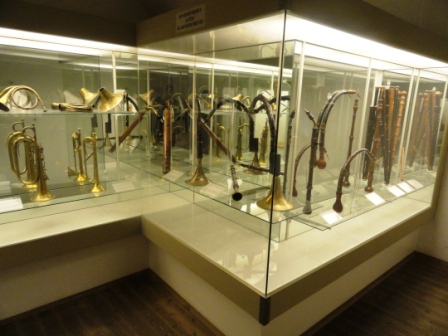
The historical instrumental museum has all manner of old keyboard, wind, and brass instruments.  Many were quite strange, like the combo violin-hunting horn (below); the bassoon with the sea dragon head (below); and the ocarinas that look like porcelain ray-guns (really--you'll have to take my word on this, as I don't seem to have a picture of them).  We eat lunch while listening to musical examples and descriptions (in English!) of many of the instruments.  Then it’s upstairs to the toy museum, with a train collection, play rooms for children, and a special exhibit about circus toys.  In the film room we watch (a dubbed) Danny Kaye escape from a circus lion cage, a fairly malevolent Mickey Mouse/Donald Duck short, and the Poochini cartoon I’m sure I saw on tv as a kid—the one about a dog magician who conducts a snobby tenor in Figaro’s famous aria while plaguing him with questionable ethnic and regional stereotypes, including a brief blackface episode.  Thoroughly out-museumed by now, we purchase an Advent calendar designed like the manuscript for “Stille Nacht” and head out into the rain, looking for a Konditerei.  Down one of the numerous alleys we find a quaint little place where we enjoy hot chocolate and a generous and truly delicious slice of plum tart.  (I have discovered that I love plum tart.)  Although it was good to sit in the warm and dry, we have to get back to the hotel, pick up our bags, and travel 5 hours up to Frankfurt, where we have a hotel room waiting for us a few minutes from the train station.


Saturday:
Him: See you on Skype!

DH gets up at the first alarm, grabs his bags, and walks to the Hauptbahnhof (main train station), where he catches the Strassenbahn to the Flughof (airport).  By the time I am finishing breakfast and similarly heading to the Hauptbahnhof, his flight to Heathrow is taking off.  I take the train to Fulda and change to Dresden.  By the time I am back in my apartment 6 hours later, he is somewhere over the Atlantic, on a 10-hour flight from Heathrow to DFW, where some of my relatives come to visit with him and see our pictures during his 4-hour layover there, before finally flying home again.

Although we walked a lot and had a fairly ambitious itinerary of sights, I think it was an enjoyable vacation.  DH would have preferred to “do Austria” without jet-lag, but he was happy to travel together.  It was certainly a mental break for me.  For just one week I stopped thinking about my dissertation all the time, and I will be sorry to get back to the grind.  Probably the catch-up reading I’ll do this weekend will light my fire again, and then there will be the sprint to Christmas/New Year’s.

The poster outside our Pension room is the closest we get to The Sound of Music.

Auf wiederschauen!