Sunday, January 30, 2022

Blown Away!

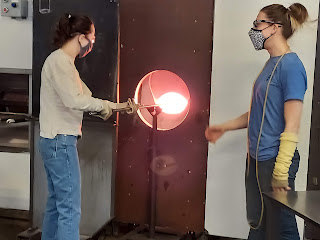
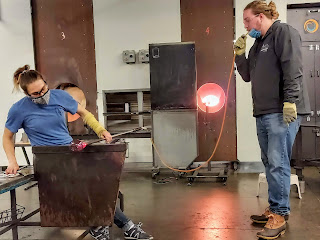
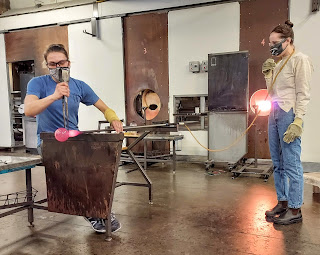
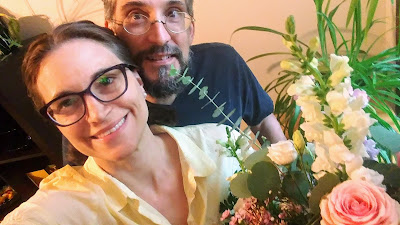
If you've been reading this blog since before the pandemic, you probably know that Dear Husband and I have a fondness for art glass. Pittsburgh has been home to the Pittsburgh Glass Center since 2001, but it got famous thanks to the Netflix competition called Blown Away. They hold classes and (free!) exhibitions as well as train professional artists. DH and I had stopped by the gallery just down the street from the children's hospital a few times, but I very much wanted to take a class to make my own, squat, blown glass pumpkin with a curly-que stem. I was able to schedule a group session in between stints on service in the hospital in the fall, but forgetting our vaccination cards and a flat tire put the kibosh on that. So I rescheduled for a private lesson with another couple in January, when work got a little quieter. We pretty much had the shop to ourselves, our teacher was amazing, and we had FUN making two pumpkins each. One pumpkin she blew and we shaped, and the other we blew and she shaped. I like this photo because it makes it look like I have pink hair.


One of our favorite parts was definitely picking colors to mix and match. After Christa picked up a blob of molten glass from the central repository and cooled down the pole, we dabbed it in the crushed fret to add color.


You have to heat the glass in a glory hole in between steps so it doesn't cool off too much, then it gets blown into a mold to create ridges. There was a larger mold for the pumpkins and a smaller mold for the stems.


Then the glass is blown into--if you push too much or too fast, it makes a weak bleb off the bottom that, however, can be fixed.


Meanwhile, the neck of the pumpkin is narrowed with an enormous pair of tweezers.


After that, you knock the pumpkin off the stick with a bat (it was literally one of those mini Louisville Sluggers). Our other favorite part of the process was watching the instructor put on the twisty stems: so satisfying!


 Tada!


Colors: orange with lime green stem; supposed to be teal but came out green, with green stem; purple with black stem; medium blue with light yellow stem (could have been darker)


These ones are golden with a black stem;  white and tan;  blue and white with a red stem; and mottled black with a golden stem. 

Sunday, January 23, 2022

"Sew" excited!

In the first year of the pandemic, I played a lot of Settlers of Catan online. (A LOT.) Since there was a lot of swearing at the other players, or the computer, or our internet connection, in the second year I dropped that and picked up DuoLingo, in order to improve my German. I kept that up for 366 days in a row (give or take a few freebies). That eventually began to feel like a chore, so I'm taking a break. Also last year I decided to return to a childhood hobby of cross stitch, which I recently realized is so satisfying because it's a lot like coloring, but slower. There's also a geometrical angle that satisfies the Tetris-lover in me.

Anyway, one reason I decided to cross stitch was because I could do it quietly during Zoom meetings, and the other is that I found a cause to which I could donate the final products, the annual student auction to benefit the Birmingham Free Clinic. This way I get all of the fun of making them without having to figure out how to display or store them!


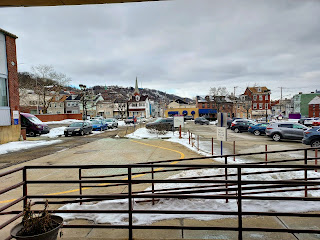
Here's the entrance to the clinic and the view of the South Side from the porch. The administrator who accepted the pieces was very excited and thinks the students will bid against each other for them.


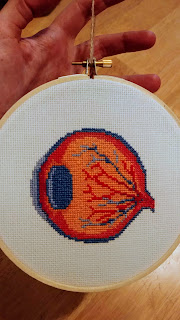
The canvas for the "wash your hands" signs held up pretty well, so I just set them in hoops hung with some red ribbon. The anatomical body parts I have stuffed with cotton batting with brown velvet behind. I'm working on the lungs right now, which are even trickier than the eye ball.


I've also finished a golden honey bee, which I framed and gifted to a local friend who keeps bees, and I sent syphilis (aka Treponema pallidum) through the U.S. postal mail to a senior historian of medicine in Massachusetts who spent her career researching the Tuskegee Syphilis Study.


What have you made during the pandemic?

Winter Wonderland


It's been a snowy January here in Pittsburgh. I took these photographs on Martin Luther King Jr. Day, while tramping through Frick Park with Dear Husband. It was a marvelous way to spend an hour on a Monday, avoiding the work we had to do. It wasn't as deserted as you might think, however, thanks to the number of dog walkers (and one cross-country skier). I had originally drafted this post with the photos in case I wanted to flesh out the tragedy I began composing in my head while sitting on the bench overlooking the ravine: two young lovers, just married on New Year's Eve, take a walk in the park to enjoy the beauty of the surroundings but, each not wanting to spoil the moment for the other, continues to sit in silence through a snowstorm until they freeze to death, and the sun comes up on New Year's Day over their still and lifeless bodies. DH told me I was no O'Henry, so maybe I'll leave it at that.

I hadn't realized this post was still in my drafts folder, so it's nice to come back to now that those paths are blocked off on account of the bridge collapsing just to the left/west of what you see here. Better to have nice memories until the mess is cleaned up, the weather warms, and we take our long walks through and over Fern Hollow again.

Saturday, January 15, 2022

2021 Rememberlutions

Birthday flowers for both of us from a dear friend

The rememberlutions jar isn't as full as it has been previous years. Part of that is me forgetting to write things down; part is having a list on my old phone that didn't make the transition with other files to the new phone; and part is the on-going pandemic providing far fewer ticketed opportunities, although goodness knows there are enough free Zooms to fill in the void!

Here was what I pulled out of the jar:

Every time someone told me they wanted to take my nutrition course. I've described it in more detail here. We're halfway through the month, and I'm hoping a) to get a poster and eventually a medical education publication out of it, b) that the course will be offered regularly at least once a year, and c) that it might give me enough teaching credits to drop a half day of clinic. TBD!

"The best teaching we've ever had." Both interns on one of my inpatient teams told me this during feedback, and it was very gratifying. I am not an expert in clinical reasoning, and I can't cite the latest drug studies, but I can teach other people about the language we use speaking and writing notes, break down concepts into simple terms, and of course broaden someone's horizons through medical history and humanities.

This was the same team of residents that was excited to play hooky from a lunchtime lecture in order to attend my Grand Rounds lecture on the history of polio vaccination. Hey, I gave Grand Rounds as a second-year faculty! You can watch it on YouTube here.

I finally got my own desk and renovated my office space.

Rafting on the Lehigh River with my parents in June, even though I got a wicked sunburn on the front of legs (blog post). Drizzly hiking pic above.

I want to remember every pretty sunrise (or rainbow!) if I happened to be commuting that early, and several lovely sunsets. 

Christmas brunch with Dear Husband was a truly special occasion, a rate date in this time of pandemic that we were able to squeeze in amidst the holiday bustle, work, and COVID (blog post).

The time when a colleague liked my answer to a medical student question about standards of knowledge so much that he said aloud, "Wow, I wish that had been recorded."

A cold if beautiful autumn daytrip to Ohiopyle Falls and Frank Lloyd Wright's Kentuck Knob.

Every time a patient told me how happy they were that I am their doctor. One of the office staff even said that she would come to me if she didn't already have a PCP. 

I've also had a couple coworkers comment on my "style"; I don't think of myself as a naturally fashionable person, but over the years I have accumulated a few signature pieces, and it's nice to be noticed if I put in a little more effort than usual.

Carrot cake for Easter

Watching Rosamunde chase a string around in the evenings. She truly is a fierce huntress!

My ticket to Die Zauberfloete at the Pittsburgh Opera. When it looked like the pandemic was lifting last year, I purchased us season tickets to the PO. The other four shows are in 2022, and I've just invested in some KN95 masks for the both of us. ::sigh::

A really nice walk on the Frick Mansion grounds one fine evening (blog post here).

Hosting Easter dinner for a father and his daughter, complete with plastic egg hunt and ukulele concert.


Everything about our family vacation to Lake Anna: from the location to the company to our 16th anniversary celebration to the model rocket launch to the fishing!


I did a lot of cross-stitch. I even gave another historian of medicine syphilis (below)!


Our weekend stay at the Gaylord Opryland Resort for Thanksgiving/Christmas was the first time I got on an airplane since March 2020.


There were also a couple of older things: the slip that said, "my very last graduation ever--by Zoom/Teams (thanks, COVID)!" was from 2020. (Here's the blog post.) The ticket for our Frank Lloyd Wright tour of the Florida Southern College grounds from 2019, a blog post I neglected to write because we traveled home the next day. I also found a sweet handwritten note from two medical students, also from spring 2020, thanking me for being a good senior resident.


Sunday, January 9, 2022

Light During Dark Days: Phipps Holiday Show 2021-22

The Phipps Conservatory and Botanical Gardens puts on a holiday display every winter that combines themed gardens and a model train set indoors, and lights in the outside courtyards. I am sure it is a money-maker and probably enables the Phipps to stay open the rest of the year. Dear Husband and I skipped the show last year due to the pandemic, but this year a colleague organized a group trip on the last night. It COLD but delightful and not too crowded.


The space-age glowing orbs outside are one of our favorite features.
We think they multiply while in storage between holiday shows.


The greenhouses seemed extra colorful this year.
Can you spot the Chihuly glass sculpture hanging over the foyer?

The Sunken Garden was bright in blue, red, and green.


The centerpiece of the Victoria Room this year was a traditional fir tree decorated in white lights and red ribbons in white gazebo at the center of the pond.


This wreath impressed me with its simplicity: a "pearl" in an oyster shell surrounded by dried branches.


Above, the Rachel Carson and ?Hot Metal Bridge. Below, the Pittsburgh Bus Sinkhole, the infamous incident that spawned many Halloween costumes in 2019.


Their summer show had been "troll" themed. Here, they've been re-dressed for Christmas.


In the Children's Discovery Garden, DH and I slow danced in this gazebo to the music that was playing.
Once we were outside and I felt comfortable momentarily taking down my double mask, I did try the "hot" mulled wine, but for the 3/4-full cup they gave me, the $8 was more like a donation. We are considering purchasing another annual membership, maybe in the summer when things calm down again. Until then, we hope your holidays were bright and spent in good company.

Saturday, January 8, 2022

Dollar General: It's what's for dinner

One of the hands-on lessons I asked the medical students in my nutrition elective to do was to engage with the geography of food accessibility and with the well-meaning advice that it is possible to eat healthfully on a shoestring budget from convenience stores. 

You've probably heard the term "food desert," a term coined in the the 1990s to describe a neighborhood in which any kind of food, but especially fresh foods, are scarce. This is sometimes measured by at least 1/3 of the population living >1 mile from a store. "Food deserts" can be urban, as when a neighborhood is considered too dangerous for a company to want to put a standard grocery store. But they can also be rural, as when a family might have to drive 30-45 minutes to get to the closest big-box store. Some people have talked about "food swamps," where products are available but not of good quality (e.g. convenience stores with mostly processed items), but other food justice advocates argue that they don't want where they live to be described as "a swamp," and besides both of those terms suggest natural phenomena, whereas lack of accessibility to healthy food is a human-made problem. So the latest concept is "food apartheid" to recognize that human policies set some communities apart. (I asked students to listen Food Apartheid: (And Why We Don’t Call it a Food Desert),” a Point of Origin podcast from November 2020 with Karen Washington, Bryant Terry, and Hanna Garth.)

The assignment was for students to shop for and prepare a recipe from a convenience-store food guide published by the local children's hospital, or from Dollar General's own website of "easy meals." Because I didn't want to make anyone have to spend money on this class or necessarily change their eating habits, the other option was to compare one of these recipes to a standard recipe (e.g. mac and cheese from two different sources) to see what similarities and differences would emerge. I am usually wary of experiential learning like poverty or disability simulations, because I think it fosters the idea that the best way to understand another point of view is to try to replicate it, when that lived experience is just an identity put on for a few minutes or hours and then taken off again, like a costume. As someone who studies historical ideas and practices, I will never KNOW what it was like to live 100 years ago, but I have to believe that it is possible to gather a good enough impression from texts and objects. How much easier to ask someone who lives with food scarcity what that's like, rather than trying to recreate it?

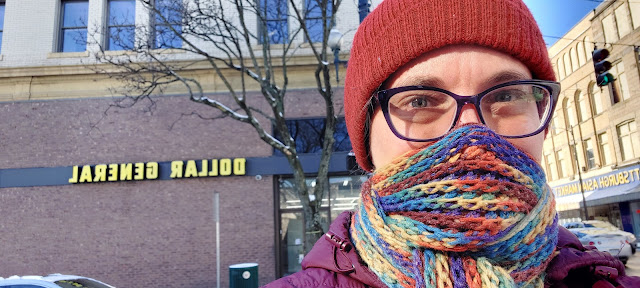
However, I also believe that healthcare workers should be part of their communities, and that includes knowing where people shop, or send their kids to school, or place their elderly relatives in nursing homes. It would be pretty condescending of me to advise a single mother to "just use these recipe suggestions" to feed herself and her kids without ever having tried it myself, as if I were too good to eat food from a convenience store. So I designed this meal challenge with limited expectations. A purist, I decided to stick with the Dollar General a 15-minute walk from our house, although there is an organic grocery store 2 blocks from us, and I passed 3 pharmacies with "food marts" (Walgreens, Rite Aid, CVS) on the way. I can't say that the shopping experience was enjoyable, given the pallets of items blocking the aisles due to insufficient employees to stock them, and the fact that I was the only person properly wearing the mask that I had retraced my steps to grab. A sign on the door says this location is closing due to lack of staff, so I almost didn't go in, thinking it might already be closed.
It was lucky timing that Nicole Spector's article asking "Should You Buy Groceries at the Dollar Store?" came across my news feed the week before. Writing for a personal finance website, Spector notes, "It really depends on what you’re buying and how well you’ve done the math. Perhaps surprisingly, there are instances in which you’ll pay more for essentials at the dollar store than you would at a grocery mart." This is because the convenience store doesn't buy in bulk or move items at the same rate as a grocery store, which is why she also recommended checking both the expiration dates and the unit prices. Non-perishable goods and spices may be sweet deals, while baking supplies and perishable items may cost more. My experience was varied, with off-brand powdered ginger costing $0.50 and McCormick's red pepper flakes $2.95.

For our salmon patty dinner, I nabbed the remaining 4 packets of salmon packed in vegetable broth ($5.40) and easily found the quick oats ($1.65). The recipe has no serving suggestions--it doesn't even opine on whether to serve the salmon burgers on buns--so I freelanced the rest of the meal. I contemplated making cornbread with canned corn in it, but there wasn't a ready mix, so I would have had to buy the corn meal, flour, sugar, oil, and baking powder, in addition to the corn and other things I already needed. The packages of fancy pasta had too much sodium, so I opted for a packet of sour cream and chive instant mashed potatoes (4 servings for $1.00). I later found that an 8-pack of white hamburger buns go 2 for $1.00, and the extras could have been used for other meals. 

For vegetables, I spied a can of asparagus spears ($2.70) on the top shelf, and even though it claimed to be a single serving, I picked up a can of carrots ($0.75) because I didn't think DH would like the asparagus. The need to provide multiple options for sometimes picky household members is one reason that has been cited for why low-resource families do not offer their children more fruits and vegetables, because they can less easily absorb the cost of wasted purchases. I had salt, pepper, dill, and cooking spray at home, so I did not purchase these staples separately, but I did notice that sodium-free "Mrs. Dash" flavoring costs $3.20 compared to $1.00 for a canister of Morton's salt and only $0.55 for the off-brand. Meanwhile, you can get a 6-pack of Ramen noodles for $1 and lot less fuss for dinner.

I did decide to get the milk and eggs from the Dollar General. The cooking booklet recommends skim or 1% milk, but skim was not available, and 1% only in a gallon. I therefore chose a 1/2 gallon of 2% (even though I only needed 2 tablespoons of it and contemplated just using water for moisture, $3.20). The eggs were easy, although they came in an environmentally unfriendly Styrofoam container ($2.15). I didn't notice any fruits or veggies for sale, although there were a variety of dairy products such as yogurt, cheese, and sour cream.

It is too bad there are no serving suggestions beyond drinking water or milk, as these could have carried over the MyPlate.gov ideals of portion sizes and "a balanced diet" that includes fruits, veggies, and a reasonable number of carbs or starches in addition to the protein entrée. Nevertheless, because the booklet suggests these salmon burgers are suitable for a "fancy" meal, I decided to upgrade our usual beverage of choice (filtered tap water) by splurging on a zero-calorie lemon-lime flavored water ($0.80) and dessert. We rarely have "dessert" in our household but almost always snack in the evenings, typically on pretzels, popcorn, hot chocolate or cider, grapes, cherries, clementines, or occasionally ice cream. The freezer cabinet was surprisingly well stocked; because chocolate gives DH migraines, I chose a box of 6 strawberry popsicles $3.75, for a total of $21.40 for 4-5 servings, plus milk, oats, and eggs that would be left over.

Salmon Burgers Estimated Preparation Time: 10 minutes Serving: 1 [meal? makes 5 patties]

Ingredients 14 oz Canned salmon (bones removed, if needed) 1 cup Quick oats 1 tsp Dried dill 1 Egg, lightly beaten 2 tbsp Low-fat milk ¼ tsp Salt 2-4 tbsp Canola oil Black pepper to taste

Instructions 1. Drain salmon. Remove bones, if required. 2. Combine salmon, oats, dill, egg, milk, salt, and pepper in a medium bowl. Mix thoroughly. 3. Shape into 5 patties. 4. Cook in a small amount of oil in a hot pan. 5. Flip when the first side has cooked to golden brown. Serve immediately when second side is done cooking (approximately 7 minutes per side). 

Helpful Hints Allow your kids to make a “fancy” dinner tonight. ~ Have them take your order, set the table and pour the water or milk you ordered. ~ Set out all of the ingredients for the burgers in bowls on the counter and allow them to pour them all into one big bowl. Let them use their hands to mix up and form the patties (after washing their hands, of course). ~ Assist them in cooking the salmon burgers while encouraging them to arrange the plate and serve it to you.

Dinner took a little longer than 10 minutes to prepare, of course, but less than half an hour. Although I only had 10oz of salmon instead of 14, I still ended up with 5 patties. Unfortunately, these didn't hold together well during cooking, and I found them under-seasoned (may be due to operator error). The mashed potatoes were fast and delicious, and the flavored water tasted sweet thanks to the sucralose (aka Splenda). The asparagus were the big disappointment of the night, coming out of the can a dingy gray-green color and only made more damp by my trying to steam them. I suppose some hot sauce could have livened up the taste, but there was nothing to do for the texture. The can advertised itself as a single serving, but we got three out of it, and I threw the rest away in favor of the canned carrots with the leftover patties.

Nutritionally, I estimated 340 kcal per serving, including a tablespoon of ketchup for the patties, but >50% recommended daily value of sodium. For $5 per serving, that's not bad, although I can understand why this was pitched as a "fancy" meal, given the trouble it takes to make the salmon burgers. While I do not think I have much of a sense of what it would be like to rely on a convenience store for the majority of my diet--when a fast-food burger with lettuce and tomato might provide a rare opportunity for fresh produce--I do feel that I could better navigate a conversation with a patient about what is and isn't possible given the constraints of food apartheid.

Read more about this medical school elective here.

Thursday, January 6, 2022

Butter versus Margarine

This month I am piloting a new elective in nutrition for senior medical students. Every day they read a combination of historical and contemporary literature on food and diet, and we meet for 2 hours for a lecture and/or discussion. Each week has a different theme: "adult" nutrition, including the food groups and common "dietary diseases" such as diabetes and hypertension; pediatric nutrition, including infant feeding and eating disorders; obesity, including both medical/surgical solutions for weight loss as well as the anti-diet movement; and surgical nutrition, including perioperative management of fluids and "artificial" nourishment via TPN or tube feeds. I started with a brief history of some themes in the science of nutrition; here is the YouTube recording of my lecture.


For the day on fats and cardiovascular disease, I assigned Todd Olszewski's article "The Causal Conundrum: The Diet-Heart Debates and the Management of Uncertainty in American Medicine" (JHMAS, 2014); Edgar R. Miller III, Thomas P. Erlinger, and Lawrence J. Appel's summation, "The Effects of Macronutrients on Blood Pressure and Lipids: An Overview of the DASH and OmniHeart Trials" (Current Atherosclerosis Reports, 2006); and the latest version(s) of the American Heart Association and American College of Cardiology nutritional recommendations, Lichtenstein, et alia (Circulation, 2021) and/or Van Horn, et alia (Circulation, 2016).

Olszewski writes about the sometimes furious professional debates in the mid-twentieth century over "the diet-heart hypothesis," or the idea that increased dietary fat correlates with increased serum lipid levels, which are associated with higher rates of heart attacks and strokes. Some experts were persuaded by the circumstantial evidence, while others pointed out these are correlations of risk factors based mostly on epidemiological studies, not causations proven through strict feeding studies with histological proof of clinical disease. Meanwhile, the American public largely accepted the argument and changed their dietary practices (consider the substitution of cereal or a bagel for a breakfast of eggs and bacon), despite the lack of scientific agreement, probably due to fear of suffering ill health.

Images from Jeff Nobs

I broke the students into four groups in Zoom breakout rooms and asked them to research and defend a position for or against butter or margarine. 20-30 minutes later, they were ready to present. I asked the first group why I should put butter on my toast. Their spokesman acknowledged that there was an association between saturated fats and cardiovascular disease BUT, based on the label from the butter in someone's fridge, 1 serving was only 1 tablespoon with 11 total grams of fat and 63 kcal, with 7 grams of that being saturated. However, they argued that the most common butter fats are palmitic acid (29%), maristic acid, stearic acid, and laric acid. They had found two epidemiological studies that proposed those last two reduce the HDL/TGL ratio decreased CVD risk. Furthermore, the national Dietary Guidelines allow up to 5% of calories to come from saturated fat for the production of hormones, cell membranes, etc., and that amounts to 100kcal in a 2000kcal/day diet.

The pro-margarine group pointed out that their product had been designed to reduce the amount of saturated fat in the diet, with only 0.67 grams per serving of tub margarine versus 7 grams from stick butter. They acknowledged that the original margarine had contained more trans fats (as well as a color packet to make it yellow instead of white), whereas newer margarines are healthier because they contain more unsaturated, non-trans fats. I pointed out that it is important to remember food history when weighing evidence of nutritional claims, because food products have changed over time. They even found a study from the Journal of Epidemiology (2018) that showed lower rates of myocardial infarction (but not other outcomes) among individuals who consumed margarine rather than butter. This is an impressive example of a nutritional study with a clinical outcome rather than one based on risk factors like measuring serum lipids or blood pressure. They concluded with the statistic that margarine production releases 3.5x less carbon dioxide than butter, making it the better choice for the environment.

Images from Jeff Nobs

When I asked the third group why I shouldn't put butter on my toast, their spokespeople warned us about high saturated fat content (especially any product with >60% fat), salted butters as a double health-whammy, too many calories, and not enough micronutrients. Plus, many people are lactose intolerant [however, the lactose content is very low, so this actually isn't a problem]. The anti-butter students urged us to "free the dairy cows!" and choose one of the many, many non-butter options for our toast...like avocados. They used the webpages from HealthLine, Harvard Health, and Mayo Clinic.

Finally, the anti-margarine group argued hyperbolically yet persuasively against the butter substitute. Their very entertaining spokesman railed against polyunsaturated fats being associated with obesity and heart disease, and that margarine couldn't be classified as a "health product" given its association with asthma, eczema, and other inflammatory disease processes. He then graphically described the "disgusting process" of manufacturing margarine with chemicals and metals as compared to "just churning butter" [as if that were not also a highly industrialized process these days]. It was a command performance that left us in stitches, and I was sorry we weren't in a room together to share the laughter. The students joked in the chat that the anti-margarine spokesman had roasted margarine so well its fats had turned rancid. Interestingly this "anti" group had also used patient-facing sources such as from the Cleveland Clinic.

When I asked what evidence they had found most persuasive, the students discussed individual health concerns, butter as part of a balanced diet ("a little dab'll do 'ya"), and environmental worries such as how much water has to be diverted into California for agricultural production of non-butter options. It was an engaging lesson that let the students think about the nature of evidence, how a message can be shaped by its presentation, and the applicability of general nutritional advice for individual patients. Me? I reverted from the margarine of my childhood--when it was a health product--to butter in college, based on the strength of my roommate's argument, "If it was good enough for my grandmother, it's good enough for me!" How's that for an emotional argument? But then, we don't just eat for nutrition, so it makes a certain kind of sense.