Sunday, March 25, 2012

It's good to be green, 2

The last post with this title was about holiday-themed fun with food coloring; this one concerns another kind of green: environmentalism. When we bought our house a couple of years ago, Dear Husband and I decided to try to reduce our carbon footprint. I built a compost heap behind the shed in the back yard for food scraps (egg shells, carrot peelings, apple cores...). We turn off our Christmas lights when we go to bed. I wash our laundry on "tap cold" and hang almost everything to dry on lines in the back yard in the summer and on drying racks in my study during the winter. We even hand wash dishes instead using the dishwasher (mostly!).

In warm weather we try to leave our car in the garage and use other means of transportation. We live just half a mile from the grocery store and so try to walk when we can. However, buying food for two people once a week, plus the occasional bag of cat food or kitty litter, is really too much to carry, even with each of us lugging a large LL Bean tote bag. So DH finally bought me a "bag lady cart." To the left you can see me adding a name tag to the cart after returning from my first trip with it. All of our groceries juuust fit. This will make going to the store so must easier. It's good to be green!

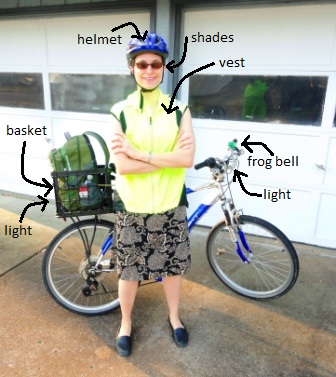
We are both functional bicycle riders (as opposed to biking for fun or exercise). When the weather is warm we bike the 2 miles to church, which is also work for him, and I try to bike the 3.5 miles to campus as often as possible. Here you can see my get-up:

Biker Graduate Student
Biker Graduate Student comes complete with a $50 refurbished, second-hand mountain bike from the local cycling co-op. Affixed over the rear wheel is a plastic crate large enough for a backpack stuffed with laptop, library books, and graded student papers. The bag has pockets for an umbrella and a reusable water bottle (not included). Comes with a bike lock. For an extra $10 you can get the square, hooked, bungee-cord net--perfect for containing her jacket or lunch bag over the bumpy streets!

The action figure's helmet and sunglasses tell motorists to take her seriously. Remove the reflective vest to reveal a snazzy sun dress and sensible black flats. She is ready to zip across town to teach all morning and research all afternoon! Even if she stays late on campus for meetings, the bicycle's safety features include detachable front and back lights, a chain guard, and a cheery bell in the shape of a frog for warning pedestrians to get off the *$&#% bike path!

Click here to view her companion, card-carrying union-member student action figure.

What do you do to be "green"?

Saturday, March 17, 2012

It's good to be green


The color isn't quite right, but here you can see the green cream of wheat I ate for breakfast Saturday morning--actually the only green-themed part of my St. Patrick's Day this year. I didn't even wear any green, but it's too late now, so you can't pinch me, even remotely. I enjoyed my farina with cut-up banana (it's under there) and a swirl of local honey.

A few years ago I sent one of my younger brothers a care package in honor of the holiday. I included some shamrock beads and homemade chocolate-chip cookies I attempted to die green. The color was a little odd (hard to do when the base is brown rather than white, like milk)--but the tragicomic thing about this attempt at sisterly love was that the cookies had come out rather flat and ugly. You see, DH and I were going through a rough patch. Yes, that's right: one of us had been buying el-cheapo flour at the grocery store, and our chocolate cookies were no longer rising. The first time this happened, I thought it was because I was talking on the phone while mixing the dough and had forgotten to add baking powder. MIL suggested I add more to the next batch, which I did, to no avail. Eventually, after much googling around and reading of random cooking threads, I discovered that other people had also had flat cookies and that the culprit was the unbleached flour. So we switched our flour and returned to chocolate-chip bliss.

What memorable green comestibles or potables have you ever consumed? What else have you ever food colored in honor of a holiday?

Saturday, March 10, 2012

It's a book!

Apologies for cross-posting! This is the official blog announcement.

I am pleased to announce that the book I co-authored with a neuroscience professor, neuroscience graduate student, and anthropology graduate student here on campus has just been released by MIT Press. Individual and Collective Memory Consolidation: Analogous Processes on Different Levels is an interdisciplinary monograph that offers a unified theory of memory formation.

Here is the blurb from Amazon: We form individual memories by a process known as consolidation: the conversion of immediate and fleeting bits of information into a stable and accessible representation of facts and events. These memories provide a version of the past that helps us navigate the present and is critical to individual identity. In this book, Thomas Anastasio, Kristen Ann Ehrenberger, Patrick Watson, and Wenyi Zhang propose that social groups form collective memories by analogous processes. Using facts and insights from neuroscience, psychology, anthropology, and history, they describe a single process of consolidation with analogous--not merely comparable--manifestations on any level, whether brain, family, or society. They propose a three-in-one model of memory consolidation, composed of a buffer, a relator, and a generalizer, all within the consolidating entity, that can explain memory consolidation phenomena on individual and collective levels. When consolidation is disrupted by traumatic injury to a brain structure known as the hippocampus, memories in the process of being consolidated are lost. In individuals, this is known as retrograde amnesia. The authors hypothesize a "social hippocampus" and argue that disruption at the collective level can result in collective retrograde amnesia. They offer the Chinese Cultural Revolution (1966--1976) as an example of trauma to the social hippocampus and present evidence for the loss of recent collective memory in mainland Chinese populations that experienced the Cultural Revolution. It is available in hardback and Kindle formats.

The book is the product of a research assistantship I got my third year of graduate school. We figured we would work for a year or two and write a couple of articles for a neuroscience journal. As the project ballooned over the first year, we thought bigger. Pat Watson and I researched and wrote the first two thirds of the book, under the direction of Tom Anastasio (and Lillian Hoddeson). When we discovered that GoogleDocs wouldn't let us simultaneously edit separate documents, we started to sit down together at a single computer to write. Pat is a great interdisciplinary collaborator, because he knows what he knows really well, and he respects what I know. He was able to synthesize our findings, and I found the words to say it. Working with him was the best part of the whole experience. The second year, Wenyi Zhang researched and wrote about religion and literature among Chinese on the mainland and refugees to northern Thailand and Taiwan, and I helped smooth the writing of the last third to match the rest of the book. The research is mostly based on published secondary literature, plus some computer modeling from Tom and Pat. And Tom did a bang-up job getting us contract offers from both MIT Press and Oxford University Press.

The book is really handsome, with white pages and wide margins. I love the verve of the black-red-white color scheme. And the cover really draws you in. Who is the man in the white tank top? What is his relationship as an individual to the crowd (the collective) around him? Plus, all the shades of gray suggests that memory is not something that can be restricted to black-and-white terms.

This project doesn't really have anything to do with my dissertation research, but it has shown me (again) that I can write on a large scale. (My undergraduate history honors thesis was 5 chapters and 125 pages long, and I researched and wrote it in one year!) In fact, that first dissertation chapter I am writing has now been split and one case study spun off into a whole new chapter. If that continues to happen, I will probably stop at five or six chapters and let the others become articles. Because, as they say, the best dissertation is a done dissertation. It need not include alllll the research and writing I have ever done or have yet to do on the subject. And I'm okay with that. I do hope that Individual and Collective Memory Consolidation is just my first book of at least two, as I would love to present to you my dissertation, the published book edition.

Friday, March 2, 2012

Soup for the servants' table, photo journal edition

It turns out I love the way cooked barley feels when I eat it. I can't post that sensation on my blog, so here's the visual version of a recent culinary adventure. This is a companion to my earlier post on trying out an old German recipe.

white turnip

greenish kohlrabi

garnet-red beet
brownish celery root
a little bit of onion
bright green leek--yummy!
young potatoes
cooking--with extra water for thinning

anachronistic serving suggestion


the last bowl. notice the color!

Wednesday, February 22, 2012

Pancake Tuesday

What do you call it: Carnival? Shrove Tuesday? Mardi Gras? Fat Tuesday? How about...Pancake Tuesday?

Last night, Dear Husband and I gathered with our Bible study to celebrate the beginning of the season of Lent while wearing purple, green, and gold beads. No king cake for us, we all contributed ingredients to several patches of really yummy pancakes. Originally, the point of eating pancakes on the day before Ash Wednesday was to use up the remaining fat in the larder before six weeks of fasting and Fish Fridays. These days few Christians give up truly bad habits for the period before Easter, much less meat. I, for one, will continue to enjoy pancakes with creamy peanut butter and syrup every Sunday morning. But this time we went all out: regular pancakes with blueberries, with pecans, with chocolate and peanut butter chips, and with blueberries AND mango. Also pumpkin pancakes plain, with pecans, with chocolate and peanut butter chips, and with pecans AND chocolate AND peanut butter chips (upper left). The pumpkin pancake recipe is long if you are used to combining a mix out of a box with some water like I am, but the finished result cooks up wonderfully thick and tasty. Here is the pumpkin pancake recipe I used. There was yummy maple syrup with which to top them all off.


Then it was time for dessert: Bananas Foster, a quintessential New Orleans treat on a day that is nearly synonymous in this country with "The Big Easy."

Afterwards we played a game--Banagrams, of course!

The multi-colored sprinkles are a festive touch, don't you think?

Sunday, February 19, 2012

Soup for the servants' table

About a month ago I decided that I needed to learn how to make more kinds of soup. Frequent recipes in my old German sources for groat or barley soups piqued my curiosity, so I looked up one from Henriette Davidis and Louise Holle's 1901 cookbook for "Soup from oat groats with potatoes." "Very nutritious," groats are the inner kernels of wheat or buckwheat (actually not related to wheat) with the hull removed; they may also be broken into pieces larger than for grits. Unfortunately, Dear Husband could find no groats at the grocery store, but fortunately the recipe authorized a swap for barley, and "dishes with barley" is also on my list of "things to learn how to cook." More difficult was trying to identify the kohlrabi, celery root, parsley root, fennel root and/or leeks over the phone to each other (they were poorly labeled at the store), so DH came home with one of each of the following mystery vegetables and some onion. Whereas today, Americans eat a lot of "common vegetables" like carrots, broccoli, and tomatoes, these mostly root vegetables were all usual in traditional German kitchens. Can you identify them? (Answers below.)  
Per the instructions, I soaked the pearled barley in some water while chopping the veggies. It didn't say how much, so I started with 2 cups and added more while it was cooking. There were also no suggested amounts for the vegetables, so I just cut up everything I had--even the beets, which weren't in the original recipe and made the broth pinkish orange. DH said he thought it made the soup look "interesting." (!) Because I wanted to make meat-less version soup, I skipped the "good fat" from smoked beef, ham broth, or bacon and just put the soaked grain on to boil for two hours with a large pat of butter and some chicken bouillon. Around 1900, most Germans still valued beef broth or bouillon, sold as "meat extract" (Fleischextrakt), for its supposed nutritional value. It was often recommended to sick people as easy to digest and a food to build up their strength. Unfortunately, that was a misconception developed by Justus von Liebig, a famous German scientist in the mid-1800s, and propagated by Davidis, the most famous German cookbook author from the mid-nineteenth into the twentieth century. As nutritional scientists were discovering around the time this cookbook was published, Fleischextrakt really only tasted good--there was nothing nutritionally redeeming about it.
The last sentence of the recipe I followed is particularly interesting: "If the soup is meant to be filling for the servants' table, then one can measure out 50g [~ 1/2 cup] of oat groats." This is almost twice the amount of groats/barley per person as the original recipe calls for (30g = 1/3 cup), probably because in bourgeois families, this soup was merely the first course of a midday meal that also included one or two meat courses. (Soup was meant to stimulate the appetite.) The servants, however, would have been eating this as their main dish, most likely with bread and beer. We ate ours with a very anachronistic salad of baby spinach, carrots, and celery. It's anachronistic because at the time, raw vegetables were still a curiosity in Germany and widely considered indigestible! Even uncooked fruit was regarded with suspicion, something to warn children away from eating. My how things have changed since then! Part of the fun of my dissertation project is watching the discoveries of vitamins and minerals creep onto the pages of medical textbooks and home health manuals. Authors start in the 1910s by referring to the "so-called vital-amines" and their supposed benefits, and by the 1930s they open such discussions with the confident assertion that, "Because vitamins are so important to a healthy diet, ...." 


I'm still really focused on the early part of my period (1890 or 1900 to 1930 or 1935), but maybe later I will try to recreate some of the dishes I found in ladies' magazines at the end of the period, when these came with black-and-white or false-color photographs of vegetable or meat dishes arranged "just-so." It's hard to get inspired to decorate serving platters when it's just the two of us eating, but perhaps for Easter or another get-together I will use the opportunity of feeding many people to try my hand at this once-important cooking and hostessing skill.


Answers: DH came home with kohlrabi, a beet, a celery root, a leek, an onion, and a turnip. I knew I liked kohlrabi, but the turnip and celery root are also good. The leek in particular I find tasty. It's a pity neither of us has really taken to beets, which seem to take forever to cook and soften, because they have such a gorgeous garnet color to them. I also like the purple on the turnip skin, although it's plain white on the inside.

Saturday, February 18, 2012

It feels GOOD!


THIS is the first chapter of my dissertation, as outlined on little pieces of scrap paper taped to our dining room wall. I finally assembled it Thursday night, and Friday I typed everything up and inserted all the bits of text I have been working on since early January. The good news is that I have almost 40 pages! The bad news is that 40 pages is the upper limit for the length of a chapter, and the analysis is only half written. I have a LOT of editing and cutting to do, but it feels really good to have gotten this far after only officially writing for six weeks. I have at least another six weeks to whip this chapter draft into shape, in time to workshop it in mid-April. I am quite pleased, because after all of the reading in primary sources I have done since last semester, it turns out I actually have many interesting things to say. I am a little daunted by the handful of important books (auf Deutsch!) still left to read, but the professors have advised me that my analysis is most important and can be supported or tweaked by what others have written, later. I am taking a break this weekend to work on grading and other academic projects, like syllabi and a conference poster, so that I can approach the chapter with fresh eyes on Monday. I am also whipping up another traditional German dish tomorrow, so come back to see photos and read my entry about that!