Showing posts with label teaching. Show all posts

Saturday, January 8, 2022

Dollar General: It's what's for dinner

One of the hands-on lessons I asked the medical students in my nutrition elective to do was to engage with the geography of food accessibility and with the well-meaning advice that it is possible to eat healthfully on a shoestring budget from convenience stores. 

You've probably heard the term "food desert," a term coined in the the 1990s to describe a neighborhood in which any kind of food, but especially fresh foods, are scarce. This is sometimes measured by at least 1/3 of the population living >1 mile from a store. "Food deserts" can be urban, as when a neighborhood is considered too dangerous for a company to want to put a standard grocery store. But they can also be rural, as when a family might have to drive 30-45 minutes to get to the closest big-box store. Some people have talked about "food swamps," where products are available but not of good quality (e.g. convenience stores with mostly processed items), but other food justice advocates argue that they don't want where they live to be described as "a swamp," and besides both of those terms suggest natural phenomena, whereas lack of accessibility to healthy food is a human-made problem. So the latest concept is "food apartheid" to recognize that human policies set some communities apart. (I asked students to listen Food Apartheid: (And Why We Don’t Call it a Food Desert),” a Point of Origin podcast from November 2020 with Karen Washington, Bryant Terry, and Hanna Garth.)

The assignment was for students to shop for and prepare a recipe from a convenience-store food guide published by the local children's hospital, or from Dollar General's own website of "easy meals." Because I didn't want to make anyone have to spend money on this class or necessarily change their eating habits, the other option was to compare one of these recipes to a standard recipe (e.g. mac and cheese from two different sources) to see what similarities and differences would emerge. I am usually wary of experiential learning like poverty or disability simulations, because I think it fosters the idea that the best way to understand another point of view is to try to replicate it, when that lived experience is just an identity put on for a few minutes or hours and then taken off again, like a costume. As someone who studies historical ideas and practices, I will never KNOW what it was like to live 100 years ago, but I have to believe that it is possible to gather a good enough impression from texts and objects. How much easier to ask someone who lives with food scarcity what that's like, rather than trying to recreate it?

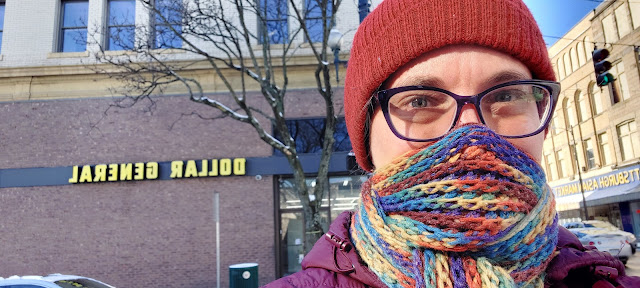
However, I also believe that healthcare workers should be part of their communities, and that includes knowing where people shop, or send their kids to school, or place their elderly relatives in nursing homes. It would be pretty condescending of me to advise a single mother to "just use these recipe suggestions" to feed herself and her kids without ever having tried it myself, as if I were too good to eat food from a convenience store. So I designed this meal challenge with limited expectations. A purist, I decided to stick with the Dollar General a 15-minute walk from our house, although there is an organic grocery store 2 blocks from us, and I passed 3 pharmacies with "food marts" (Walgreens, Rite Aid, CVS) on the way. I can't say that the shopping experience was enjoyable, given the pallets of items blocking the aisles due to insufficient employees to stock them, and the fact that I was the only person properly wearing the mask that I had retraced my steps to grab. A sign on the door says this location is closing due to lack of staff, so I almost didn't go in, thinking it might already be closed.
It was lucky timing that Nicole Spector's article asking "Should You Buy Groceries at the Dollar Store?" came across my news feed the week before. Writing for a personal finance website, Spector notes, "It really depends on what you’re buying and how well you’ve done the math. Perhaps surprisingly, there are instances in which you’ll pay more for essentials at the dollar store than you would at a grocery mart." This is because the convenience store doesn't buy in bulk or move items at the same rate as a grocery store, which is why she also recommended checking both the expiration dates and the unit prices. Non-perishable goods and spices may be sweet deals, while baking supplies and perishable items may cost more. My experience was varied, with off-brand powdered ginger costing $0.50 and McCormick's red pepper flakes $2.95.

For our salmon patty dinner, I nabbed the remaining 4 packets of salmon packed in vegetable broth ($5.40) and easily found the quick oats ($1.65). The recipe has no serving suggestions--it doesn't even opine on whether to serve the salmon burgers on buns--so I freelanced the rest of the meal. I contemplated making cornbread with canned corn in it, but there wasn't a ready mix, so I would have had to buy the corn meal, flour, sugar, oil, and baking powder, in addition to the corn and other things I already needed. The packages of fancy pasta had too much sodium, so I opted for a packet of sour cream and chive instant mashed potatoes (4 servings for $1.00). I later found that an 8-pack of white hamburger buns go 2 for $1.00, and the extras could have been used for other meals. 

For vegetables, I spied a can of asparagus spears ($2.70) on the top shelf, and even though it claimed to be a single serving, I picked up a can of carrots ($0.75) because I didn't think DH would like the asparagus. The need to provide multiple options for sometimes picky household members is one reason that has been cited for why low-resource families do not offer their children more fruits and vegetables, because they can less easily absorb the cost of wasted purchases. I had salt, pepper, dill, and cooking spray at home, so I did not purchase these staples separately, but I did notice that sodium-free "Mrs. Dash" flavoring costs $3.20 compared to $1.00 for a canister of Morton's salt and only $0.55 for the off-brand. Meanwhile, you can get a 6-pack of Ramen noodles for $1 and lot less fuss for dinner.

I did decide to get the milk and eggs from the Dollar General. The cooking booklet recommends skim or 1% milk, but skim was not available, and 1% only in a gallon. I therefore chose a 1/2 gallon of 2% (even though I only needed 2 tablespoons of it and contemplated just using water for moisture, $3.20). The eggs were easy, although they came in an environmentally unfriendly Styrofoam container ($2.15). I didn't notice any fruits or veggies for sale, although there were a variety of dairy products such as yogurt, cheese, and sour cream.

It is too bad there are no serving suggestions beyond drinking water or milk, as these could have carried over the MyPlate.gov ideals of portion sizes and "a balanced diet" that includes fruits, veggies, and a reasonable number of carbs or starches in addition to the protein entrée. Nevertheless, because the booklet suggests these salmon burgers are suitable for a "fancy" meal, I decided to upgrade our usual beverage of choice (filtered tap water) by splurging on a zero-calorie lemon-lime flavored water ($0.80) and dessert. We rarely have "dessert" in our household but almost always snack in the evenings, typically on pretzels, popcorn, hot chocolate or cider, grapes, cherries, clementines, or occasionally ice cream. The freezer cabinet was surprisingly well stocked; because chocolate gives DH migraines, I chose a box of 6 strawberry popsicles $3.75, for a total of $21.40 for 4-5 servings, plus milk, oats, and eggs that would be left over.

Salmon Burgers Estimated Preparation Time: 10 minutes Serving: 1 [meal? makes 5 patties]

Ingredients 14 oz Canned salmon (bones removed, if needed) 1 cup Quick oats 1 tsp Dried dill 1 Egg, lightly beaten 2 tbsp Low-fat milk ¼ tsp Salt 2-4 tbsp Canola oil Black pepper to taste

Instructions 1. Drain salmon. Remove bones, if required. 2. Combine salmon, oats, dill, egg, milk, salt, and pepper in a medium bowl. Mix thoroughly. 3. Shape into 5 patties. 4. Cook in a small amount of oil in a hot pan. 5. Flip when the first side has cooked to golden brown. Serve immediately when second side is done cooking (approximately 7 minutes per side). 

Helpful Hints Allow your kids to make a “fancy” dinner tonight. ~ Have them take your order, set the table and pour the water or milk you ordered. ~ Set out all of the ingredients for the burgers in bowls on the counter and allow them to pour them all into one big bowl. Let them use their hands to mix up and form the patties (after washing their hands, of course). ~ Assist them in cooking the salmon burgers while encouraging them to arrange the plate and serve it to you.

Dinner took a little longer than 10 minutes to prepare, of course, but less than half an hour. Although I only had 10oz of salmon instead of 14, I still ended up with 5 patties. Unfortunately, these didn't hold together well during cooking, and I found them under-seasoned (may be due to operator error). The mashed potatoes were fast and delicious, and the flavored water tasted sweet thanks to the sucralose (aka Splenda). The asparagus were the big disappointment of the night, coming out of the can a dingy gray-green color and only made more damp by my trying to steam them. I suppose some hot sauce could have livened up the taste, but there was nothing to do for the texture. The can advertised itself as a single serving, but we got three out of it, and I threw the rest away in favor of the canned carrots with the leftover patties.

Nutritionally, I estimated 340 kcal per serving, including a tablespoon of ketchup for the patties, but >50% recommended daily value of sodium. For $5 per serving, that's not bad, although I can understand why this was pitched as a "fancy" meal, given the trouble it takes to make the salmon burgers. While I do not think I have much of a sense of what it would be like to rely on a convenience store for the majority of my diet--when a fast-food burger with lettuce and tomato might provide a rare opportunity for fresh produce--I do feel that I could better navigate a conversation with a patient about what is and isn't possible given the constraints of food apartheid.

Read more about this medical school elective here.

Thursday, January 6, 2022

Butter versus Margarine

This month I am piloting a new elective in nutrition for senior medical students. Every day they read a combination of historical and contemporary literature on food and diet, and we meet for 2 hours for a lecture and/or discussion. Each week has a different theme: "adult" nutrition, including the food groups and common "dietary diseases" such as diabetes and hypertension; pediatric nutrition, including infant feeding and eating disorders; obesity, including both medical/surgical solutions for weight loss as well as the anti-diet movement; and surgical nutrition, including perioperative management of fluids and "artificial" nourishment via TPN or tube feeds. I started with a brief history of some themes in the science of nutrition; here is the YouTube recording of my lecture.


For the day on fats and cardiovascular disease, I assigned Todd Olszewski's article "The Causal Conundrum: The Diet-Heart Debates and the Management of Uncertainty in American Medicine" (JHMAS, 2014); Edgar R. Miller III, Thomas P. Erlinger, and Lawrence J. Appel's summation, "The Effects of Macronutrients on Blood Pressure and Lipids: An Overview of the DASH and OmniHeart Trials" (Current Atherosclerosis Reports, 2006); and the latest version(s) of the American Heart Association and American College of Cardiology nutritional recommendations, Lichtenstein, et alia (Circulation, 2021) and/or Van Horn, et alia (Circulation, 2016).

Olszewski writes about the sometimes furious professional debates in the mid-twentieth century over "the diet-heart hypothesis," or the idea that increased dietary fat correlates with increased serum lipid levels, which are associated with higher rates of heart attacks and strokes. Some experts were persuaded by the circumstantial evidence, while others pointed out these are correlations of risk factors based mostly on epidemiological studies, not causations proven through strict feeding studies with histological proof of clinical disease. Meanwhile, the American public largely accepted the argument and changed their dietary practices (consider the substitution of cereal or a bagel for a breakfast of eggs and bacon), despite the lack of scientific agreement, probably due to fear of suffering ill health.

Images from Jeff Nobs

I broke the students into four groups in Zoom breakout rooms and asked them to research and defend a position for or against butter or margarine. 20-30 minutes later, they were ready to present. I asked the first group why I should put butter on my toast. Their spokesman acknowledged that there was an association between saturated fats and cardiovascular disease BUT, based on the label from the butter in someone's fridge, 1 serving was only 1 tablespoon with 11 total grams of fat and 63 kcal, with 7 grams of that being saturated. However, they argued that the most common butter fats are palmitic acid (29%), maristic acid, stearic acid, and laric acid. They had found two epidemiological studies that proposed those last two reduce the HDL/TGL ratio decreased CVD risk. Furthermore, the national Dietary Guidelines allow up to 5% of calories to come from saturated fat for the production of hormones, cell membranes, etc., and that amounts to 100kcal in a 2000kcal/day diet.

The pro-margarine group pointed out that their product had been designed to reduce the amount of saturated fat in the diet, with only 0.67 grams per serving of tub margarine versus 7 grams from stick butter. They acknowledged that the original margarine had contained more trans fats (as well as a color packet to make it yellow instead of white), whereas newer margarines are healthier because they contain more unsaturated, non-trans fats. I pointed out that it is important to remember food history when weighing evidence of nutritional claims, because food products have changed over time. They even found a study from the Journal of Epidemiology (2018) that showed lower rates of myocardial infarction (but not other outcomes) among individuals who consumed margarine rather than butter. This is an impressive example of a nutritional study with a clinical outcome rather than one based on risk factors like measuring serum lipids or blood pressure. They concluded with the statistic that margarine production releases 3.5x less carbon dioxide than butter, making it the better choice for the environment.

Images from Jeff Nobs

When I asked the third group why I shouldn't put butter on my toast, their spokespeople warned us about high saturated fat content (especially any product with >60% fat), salted butters as a double health-whammy, too many calories, and not enough micronutrients. Plus, many people are lactose intolerant [however, the lactose content is very low, so this actually isn't a problem]. The anti-butter students urged us to "free the dairy cows!" and choose one of the many, many non-butter options for our toast...like avocados. They used the webpages from HealthLine, Harvard Health, and Mayo Clinic.

Finally, the anti-margarine group argued hyperbolically yet persuasively against the butter substitute. Their very entertaining spokesman railed against polyunsaturated fats being associated with obesity and heart disease, and that margarine couldn't be classified as a "health product" given its association with asthma, eczema, and other inflammatory disease processes. He then graphically described the "disgusting process" of manufacturing margarine with chemicals and metals as compared to "just churning butter" [as if that were not also a highly industrialized process these days]. It was a command performance that left us in stitches, and I was sorry we weren't in a room together to share the laughter. The students joked in the chat that the anti-margarine spokesman had roasted margarine so well its fats had turned rancid. Interestingly this "anti" group had also used patient-facing sources such as from the Cleveland Clinic.

When I asked what evidence they had found most persuasive, the students discussed individual health concerns, butter as part of a balanced diet ("a little dab'll do 'ya"), and environmental worries such as how much water has to be diverted into California for agricultural production of non-butter options. It was an engaging lesson that let the students think about the nature of evidence, how a message can be shaped by its presentation, and the applicability of general nutritional advice for individual patients. Me? I reverted from the margarine of my childhood--when it was a health product--to butter in college, based on the strength of my roommate's argument, "If it was good enough for my grandmother, it's good enough for me!" How's that for an emotional argument? But then, we don't just eat for nutrition, so it makes a certain kind of sense.

Monday, February 10, 2020

What Residency Looks Like LXXXVII: Doppelgaengerin


Sometimes residency looks like your facecard hanging on the wall when you are the "Clinic Supe" (supervisor) for the month. It's a relatively new position whose duties we're still figuring out, but so far it involves leading the pre-clinic conference lesson, managing the flow of patients, teaching the medical students, handling paperwork for absent residents, answering all manner questions, and blogging about it. I am also doing a small quality improvement project about making referrals for nutrition counseling.


Older

Monday, November 11, 2019

What Residency Looks Like LXXX: Smile!


Sometimes residency looks like teaching first-year medical students how to perform a physical exam, including mnemonics to help remember where to listen for murmurs on the chest, and the order in which the heart valves close.


These are the heart valves (an oldie but a goodie):
All = Aortic valve
Physicians = Pulmonic valve
Take = Tricuspid valve
Money = Mitral valve

This is the order in which they close (I wrote this one!):
My = Mitral valve
Teeth = Tricuspid valve
Are = Atrial valve
Pretty = Pulmonic valve

And then you smile, because you got it right!

Older

Tuesday, January 1, 2019

Rememberlutions 2018: Here's to the Year that Was


I have a tradition of collecting good memories throughout the year to look back on at the end. 2018's jar was full of ticket stubs and little scraps of paper. Here they are, in no particular order, with some as-yet unpublished photos.

In January, Dear Husband and I thumbed our noses at the frigid temps of the "bomb cyclone" with tropical drinks and friends S.B. and R.B. I also visited my paternal relatives in Charlotte, NC, for MLK Weekend.

In March, we visited family (and alligators!) in Florida for Spring Break. Then M.A.P. (My Awesome Parents) visited, and we ate our way through Allentown.

In April I treated myself to "Potted Potter," a comedic abridged version of the books/movies. We also watched a local production of Jane Eyre at WQED's Fred Rogers Studio. Unfortunately, their Jane was much too feisty for me. In my head, she was quieter and mousier.

In May I traveled back to Champaign for two retirement parties and to see old friends. I want to remember the smell of lilacs there in May.

In June we laughed our @$$es off at The Reduced Shakespeare performance.

In August, DH and I celebrated 13 years of marriage, and in October, 20 years of being a couple. (Flowers above.)

Over Labor Day weekend, DH, friend A.S., and I visited the Art of the Brick exhibit at the Carnegie Science Center, where we geeked out at the amazing things Nathan Sawaya can do with Legos.

In October we memorialized my grandfather with military and Sokol honors (right). Also, being an Elite Yelper for the second year in a row entitled us to attend the best Halloween party in the city.

In December, DH and I joined friends J.H.R. and K.R. at Peter Jackson's British Great War documentary, They Shall Not Grow Old.

I want to remember...
- The intern who thought I was so good I must be a third-year resident (I was a second-year at the time).
- That time I predicted a patient had "sick sinus syndrome" and the electrophysiology fellow disagreed--at first!
- Every time another resident sought my opinion as a colleague.
- Being mistaken for a new attending because of my Palliative Care phone skills.
- How it felt to be challenged to speak to medical students the way I talk to patients.
- Every attending, fellow, intern, and medical student who told me how pleased they were that I was their senior resident.
- Seeing my first Acute Tubular Necrosis (ATN) muddy brown cast under a microscope.
- The second time I took the microphone for Chairman's Report, I did better than the first.
- Playing "Marco Polo" with my attending in his office building.
- When the care manager told me, "You are the best resident at running rounds."
- How much personal growth I underwent while rotating as the Neonatal ICU triage on the way to pediatric Emergency Department sedation resident.
- The repercussions after improperly supervising a medical student doing a HEADS exam.
- The sound of Haendel's Messiah with the Pittsburgh Symphony Orchestra and Mendelssohn Choir.
- Every nurse and every patient who thanked me for my enthusiasm and good doctoring.
- The patient's wife who kissed me on the cheek after  I comforted her.
- That one attending complimented me for writing "fellow-level notes."
- The 90-year-old patient who called me "Dr. Magic" and teased that I had a healing handshake.
- When a colleague stopped me in the hallway to say he doesn't study very much but always enjoys my Teaching Rounds posts.
- That I knocked my research presentation to the Internal Medicine Department out of the park.

Once, three different people in three weeks described me as "a calm team leader." Other compliments included "lifesaver" and "consummate team player." Then there was the time a genetics fellow complimented me months later on doing a really good neurology exam on a patient.

Yes, I really posted a picture of a battery with the caption,
"On RED team, we're positive" in the team room.
I finally lost my Rocky Horror Picture Show virginity.

I also went to trivia sometimes on Wednesday evening. Once I won both a free drink and third place in the competition with a team called "TiKel Me Kristen."

The friend who sent me this note: "Lady, You are valued. You are a force to be reckoned with. You are amazing. Thinking of you."

Baseball games:
Pittsburgh Pirates vs Philadelphia Phillies at Spectrum Field (Largo/Clearwater blog post)
We also watched the Baltimore Orioles lose to the Toronto Blue Jays at Ed Smith Stadium (Sarasota blog post)
Milwaukee Brewers vs Pittsburgh Pirates on Johns Hopkins Alumni Day
Pittsburgh Pirates vs New York Mets on a HOT day at the end of July
Butler Bluesox vs Kokomo Jackrabbits with new friends in the Home of the Jeep

Also, we attended Pitt Gymnastics vs North Carolina State, Temple, and Towson University. This was a neat date, since our third date ever was to a Towson gymnastics meet. We also had a hot date at the hospital cafeteria together.

DH and I shared the experience of a lifetime with some artistic friends at a concert called "Into the Earth" that literally took place IN A CAVE. These are some of the same people with whom we went on retreat, retreat! to Raccoon Creek State Park.

Presenting in Los Angeles with the American Association for the History of Medicine and in Pittsburgh with the German Studies Association. I'll be at both conferences in 2019, in Columbus, OH, and in Portland, OR.

Enjoying the floral displays at the Phipps Botanical Garden for Valentine's Day, in the spring, and the holiday decorations with friend J.B. [post and pics coming!].

Finally, DH and I adopted Rosamunde "Rosie" from the local humane society. She has fattened up nicely, has a beautiful coat and glorious purr, and there will surely be many more photos of her on this blog.

I had HOPED to share I had finally gotten my first solo academic history piece published, but it still hasn't happened yet. I am looking forward to being recruited to join the Pitt faculty without the need for further training (i.e. a fellowship, a medical education degree).


Editor's Note: You can find previous years' blog posts here: 2017, 2016, 2015 Parts 1 and 2.

Friday, April 20, 2018

What Residency Looks Like XXIII: Clinical Pearls


I recently had the honor of presenting the pre-intervention survey results of my research group's project on medical education on social media. This was our title slide. You can find us on Facebook and Tumblr at Teaching Rounds, and on Instagram and Twitter at Med Ed Pittsburgh. More pics on Twitter @MedEdPGH.

Older
Newer

Wednesday, June 21, 2017

What Internship Looks Like XL: Historical Dietetics Noon Conference

Me at the podium; photo credit M.V.
Sometimes internship looks like giving the very first noon conference to the new Pediatric interns. In the first part I made an argument for the usefulness of medical humanities to clinical medicine (aka "why I did not waste 8 years of my life earning a PhD"); in the second part I presented a case study of two little boys who took sick in Dresden during World War I; and in the last part I explained the current clinical guidelines for the treatment of acute gastroenteritis (the BRAT diet is no longer "state of the art" when treating vomiting and diarrhea).

At Housestaff Lunch later in the week, a very kind senior resident submitted a kudos that was shared with the whole program:

Kudos to Kristen Ehrenberger for her awesome noon conference this week - your fun and enthusiastic ability to blend historical context with practical recommendations made for an awesome hour. What a great way to kick off the year for the new ‘terns!  P.S. I would fund a kickstarter for a weekly “Medical Story Time with Dr. E”


Older
Newer 

Sunday, March 13, 2016

Children's Sermon: the Jesus Fish

This morning's children's sermon was an illustration of the importance of being flexible while trying to stay on message. The following is a transcript of what (should have) happened.


~ * ~ * ~ * ~

Good morning! How are you today? I'm so glad to see you. Today, I have a riddle for you. Are you ready? What...is the sound of one hand clapping? [I get some garbled answers, finally someone says, "silence!"] Listen! [I flap the hand that isn't holding the microphone.] One hand can't clap by itself! But two hands can clap together, because "Two are better than one." (Ecclesiastes 4:9a) [I get two of the girls to hive-five/clap my hand.]

Okay, I have another riddle. I'm going to draw you a picture. [I draw one, long, curved line on a piece of paper.] What is it? ["A hill!" "A smile/frown!"] Hmmm, maybe it's not done. Pastor Sheryl, could you complete the picture for me, please? [This is where the train derails, as she has a brain freeze and can't remember that I had asked her at the start of the service to help me draw a "Jesus fish." So she draws two eyes and a nose. "A face!" says one child. "Teamwork!" declares another. Teamwork it will be, as half a dozen children take turns adding teeth, a tongue, and a head to the face. I compliment them on their cooperation but attempt to steer the conversation back on track.]

Well, that's one way of completing the picture, but this is what I had in mind. [I scrawl two intersecting curved lines on the other side of the paper.] What does it look like? ["A fish!"] Yes, a fish, the "Jesus fish."


Have you ever seen a fish like this before? Maybe on the back of someone's car? Why do you suppose the fish is a symbol for Christians? ["Fishers of people," the feeding of the 5000/fishes and loaves, big catch of fish on the other side of the boat.]

A long time ago, when Christians were trying to find each other but couldn't say it out loud because they were being persecuted, one of them might draw a line like this--maybe in the dirt--and if the other one finished the drawing of the fish, then they knew they had found another Christian.

In one of my favorite verses in the Bible, Jesus says, "For where two or three gather in my name, there am I with them." (Matthew 18:20) Let me say that again, "For where two or three gather in my name, there am I with them." That means that whenever we get together for Christian fellowship, Jesus is with us, through the power of the Holy Spirit.

How can you be in Christian fellowship this week? [Say grace before dinner, pray together, donate to the poor, go to Wednesday Night Live, attend Sunday School and church.] Those are all great ways to be together in Christian fellowship with the Holy Spirit.

Will you pray with me? Awesome God, / Help us / to love each other, / in Jesus' name. / Amen!

~ * ~ * ~ * ~

Sheryl and I laughed about it later. No harm done, and I'm hardly going to complain about a "mistake" that gets the children more involved in the lesson. In case you were wondering, the "Jesus fish" is a play on a Greek acrostic: Iesous Christos Theou Yios Soter (Jesus Christ, God's Son, Savior) = ichthys = fish.


N.B. ~ Other children's messages have been about mountaintop experiences and United Methodists around the world.

Sunday, February 7, 2016

Children's Sermon: Mountaintop Experiences

I traveled so much last semester that I couldn't join the children's sermon roster, so I was pleased to get back in the swing of things on Transfiguration Sunday. I knew the pastor wanted to talk about how mountaintop experiences prepare us for the valleys of life, so I wrote this little message about a one such moment in my life.

Dear Husband was recording the hymns during the service, and he captured the children's sermon too, so you can hear it live by clicking here.

Editor's Note: Other children's sermons have considered the Pentecost/the Tower of Babel and Holy Week.


~ * ~ * ~ * ~ * ~


All right young mountaineers, are you ready for a challenge? I know this mountain looks tall and dangerous, but if we stick together and try our hardest, we can make it to the top. Are you ready to climb this mountain with me? Let’s go! [Have each child hold onto a length of rope, then throw the other end to a helper at the top of the mountain. Huff and puff and struggle to the top.] Phew, that was hard! But we made it! [DH played a triumphant fanfare on the organ here.] The view from the top of this mountain is so beautiful! And look--if you squint, you can see all the way to Indiana from here! [DH told me after the service that we had actually been facing the wrong direction to see Indiana. Oops! Guess the clouds got in my eyes.] Let’s sit down and rest.

There’s a story in the Bible about the time that Jesus took three of his disciples (Peter, James, and John) up to the top of a mountain, where he was “transfigured.” Can you say that? [“Transfigured.”] It’s a fancy word that means changed from within. The Bible says that Jesus’ face “shone like the sun” and that his clothes became pure white. Then Moses and Elijah appeared and talked with Jesus. God’s voice said, “This is my Son the Beloved, with whom I am well pleased. Listen to him!”*

Isn’t that amazing? There was Jesus with two of the Prophets, and God was speaking directly to the disciples! It was such a perfect moment that Peter wanted to just stay there forever. But they couldn’t stay there forever.  If the disciples just sat on the mountaintop and listened to Jesus, then they would never get around to actually doing what Jesus told them to do. What kinds of things do you think Jesus was telling them to do? [Love your neighbor, be kind, help the poor.]

Sometimes we have mountaintop moments, too. Maybe it’s going on retreat to the lakeside, or a time when God’s voice was particularly clear during prayer. Have you ever had a mountaintop experience? [Answers.] Here is a photograph from one of my mountaintop experiences. It was taken at the beginning of my second year of medical school, when I received my white coat. It was a very proud moment and symbolized the responsibility I had to my future patients. Just like the disciples, we can’t stop time and stay on the mountaintop forever. If I had tried to relive this moment over and over again, I never would have gotten around to seeing any patients! We have to get on with our lives. But mountaintop moments refresh our spirits so that we can continue our faith journeys. Photographs like this one remind us of how wonderful the mountaintop experience was and give us renewed energy toward the goal, whether that is creating God’s Kingdom on earth or graduating from medical school.

Sound like a plan? Let’s pray about it: Loving God, thank you for mountaintop moments. Refresh our spirits, so we can serve you. Amen!

Be careful going back down the mountain!


*I used Matthew 17:1-9; the voice says something slightly different in Mark 9:2-8 and Luke 9:28-36, but all agree the disciples were told, "Listen to him!"

Monday, September 30, 2013

Little Ms. Brain Learns a Thing or Two

Little Miss Brainy
This is Little Miss Brainy,
credit Roger Hargreaves.
When I was about 12 years old, my uncle came out to me as gay. We were out rollerblading, and I nodded, knowingly. He asked me if I knew what that meant. Being a Little Ms. Brain, I said yes. I'm sure he smiled, skeptically. Nevertheless, growing up "my gay uncle" wasn't a hypothetical. It was my--quiet, otherwise undiscussed--normal.

Once, early in grad school, I had a heated conversation with a student from another university. It was lunchtime during a conference, and somehow we found ourselves talking about queer issues and teaching. I think we were discussing Jack Halberstam's In A Queer Time and Place: Transgender Bodies, Subcultural Lives, in which she argues that the primacy of lived, embodied experience is why we need more diversity in academia. I was insisting that despite being a heterosexual, married woman, I was open and welcoming of any of my future students who might identify as gay, lesbian, bisexual, etc. The other grad student--who outed herself in the course of the conversation (Me: "Okay.")--strongly denied that there was any way I could ever make my classroom "safe." Why not, I asked? I believed in the possibilities of a liberal arts education, meaning personal experience is not necessary to know something; rather, it is possible to learn things from books--even or especially if the author had a different embodied experience. We didn't resolve the issue of the classroom, but I tucked it away in the back of my brain.

I came out as a GLBT* ally sometime later in graduate school. I can't remember if it was because my immediate circumstances changed (I learned about queer theory, among other things) or if it was because national conversations about sexuality in politics and religion became that much more prominent. Most of my "activism" consisted of facebook posts and signing online petitions, but I also mentored a high schooler with an uncertain home situation and went to the local Pride Fest. As a medical student I attended a seminar on campus about queer issues in medicine and started wearing a rainbow flag button on my white jacket. (I wear a cross label pin, too, and figure patients will notice one or the other if they're looking for them.)

This past week I decided to "level up" by getting some formal training from the GLBT Resource Center on campus. Actually, this was the second time I had signed up for the ally training; the first time it had filled up super fast. The newly revamped training consisted of 3 hours jam-packed with definitions, testimonials, scenarios, and questions. One part of the training involved a panel of students who identify as gay. They told us their coming-out stories (two happy, one not) and shared some of their experiences on campus. When it was time for Q&A, my hand shot up: "As a classroom instructor, I already lay down ground rules at the beginning of the semester about appropriate language and things discussed in class not leaving the room. In your opinion, could I do anything else to make my classroom a safe space, or was that even a possibility?"

The general consensus was yes, this is possible. Instructors can design activities that are gender- and sexuality-neutral. To practice the future-probable tense in a foreign language class, for instance, students don't need to be broken up into boys and girls to discuss their ideal girl/boyfriend; let them talk about their ideal partner, job, house, or vacation instead. In addition, we should assign readings that include a variety of characters and family situations (i.e. two lesbian moms with kids).

And then there was what the one graduate-student panel member had described: in his first semester on campus, he felt uncomfortable submitting a paper to peer review that would likely out him to his classmates. The TA was very understanding, excused the student from class on those days, and did the review himself. Being open to my students' varying comfort levels--including the need to skip class sometimes--was held up as an example of how to make my classroom a safe space.

I didn't press the issue at the time, since there was so much more material to cover in the training, but upon later reflection, I realized that my original question had in fact been answered in the negative. The TA had removed the student from the situation precisely because he could not ensure that a room filled with other persons who think, talk, and act independently would be a safe space. While I should declare and police such boundaries, I have to realize that I lead the class, but I am not in control of the class.

This was a minor epiphany that my friends and family whose embodied "normals" include such uncertainties will probably laugh and roll their eyes at. Little Ms. Brain often thinks she knows what you mean, but she doesn't always, so she's trying to be a good ally by listening, reading, and watching all the time. After all, I still believe in the possibility of a classical liberal arts education, beginning with myself.


* GLBT = Gay Lesbian Bisexual Transgender. In college I remember a banner that was a veritable alphabet soup of an acronym: GLBTQQIA: Gay Lesbian Bisexual Transgender Queer Questioning Intersex Ally. There may also have been another A for Asexual. You can see why GLBT or "queer" is simpler to use; but please do not forget the diversity that hides behind those 4-5 letters.